The Virtue Scholar Program residents are selected through the National Residency Match Process (NRMP) in March each year. Applications for the Virtue Scholar Program are accepted only through the NRMP system. Residents are required to apply to the core residency program using the Electronic Resident Application Service (ERAS). Applicants are encouraged to talk about their research interests and career goals in their residency application.
All interviews will be held virtually (on Zoom) for the 2025-26 match cycle.
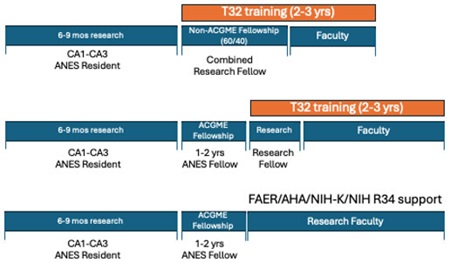
Overview of research/clinical time: A total of 6-9 months of research time is allowed throughout the residency.
Although tailored depending on the research interests and residency training interests, research time may be split as follows:
• CA1: 1 month research
• CA2: 2 months research
• CA3: 6 months research
• Fellowship: Variable depending on specialty training and research interests
Scholars may decide to do 2-3 years as a T32 trainee with 75% protected research time.
Example tracks:
A research allowance of $10,000 for each Virtue Scholar will be available for the duration of the Virtue Research Scholars Program to be used for supplies, expenses related to presentations, publications, or other essential research expenses.
Virtue Scholar candidates will be selected for interview based on their accomplishments including performance in medical school and undergraduate studies, USMLE (or equivalent) scores, prior research experience and success, leadership, volunteer and professional activities.
Virtue Research Scholar applicants will have two interviews. The first interview day will be with other categorical residency applicants and with clinical faculty interviewers. The second interview day will be with research faculty. On this interview day, Virtue Scholar applicants will have the chance to meet potential research mentors, discuss their research interests with the program leadership, and participate in a Q&A reception with research faculty and trainees.
A rank order of candidates will be submitted to the NRMP. Candidate assessments will be based on academic merit, previous experience, program fit, and interview. Candidates for the Virtue Research Scholar Program are not excluded from applying for the general 4-year residency program or 5-year combined ICU program. Successful candidates will join the anesthesiology CBY in June after the match or may join the Virtue Program as CA1s after completion of the CBY elsewhere.
Virtue Scholars will be expected to participate as much as possible in the workshops and seminars available to T32 postdoctoral trainees in the department.
To remain in good standing in the residency program, ALL residents (including the Virtue Scholar residents) must satisfy the essential requirements mandated by the ACGME, the ABA and the CU Anesthesiology residency program, described in the CU Anesthesiology Resident Manual.
A resident must also have a satisfactory CU Anesthesiology Clinical Competence Committee report for 6 months of Clinical Anesthesia training immediately preceding any research period unless prospectively approved by the ABA Credentials Committee. An overview of the domains of competency and expectations are below.
1. Clinical competency
Residents who enter the Virtue Research Scholar Program are required to maintain a high standard of clinical, professional, and academic achievement. Specifically, Virtue Scholars residents must be at or above the ACGME and ABA milestone levels for their training year in order to receive approval for research rotations and must pass the ABA part 1 (Basic) examination.
2. Research competency
In addition to clinical excellence, scholars are expected to achieve research-based competencies in research methods, implementation, and dissemination during their residency training. Scholars will demonstrate competency in designing sound research studies and display an understanding of study design, experimental methodology, and appropriate statistics. They should be capable of organizing and implementing data collection as appropriate to their field of investigation. Scholars should demonstrate a level of research productivity commensurate with their level of professional development, which may include preparing grant proposals and manuscripts, publishing, and presenting research findings.
3. Communication expectations
The Residency Research Track Program Director, in cooperation with the Anesthesiology Residency Program Director, will have overall responsibility for scheduling the Virtue Scholar’s research time in a way that both meets the Virtue Scholars resident’s needs and needs of the training program (for example during July when only 2/3 of the resident body are available to take call it is very difficult to schedule research residents time off).
To facilitate meeting scheduling needs for academic meetings and conferences, Virtue Scholars and/or their mentors are expected to reach out to the residency program director and Chief Residents (who are responsible for monthly OR schedules) at least 4 months in advance for the program director to review requests for residents to attend any academic meetings that would require time away from regularly-scheduled clinical duties.
4. Research Portfolio
Each Virtue Scholar in conjunction with the Virtue Scholar-Specific Mentor Committee will be required to develop a research portfolio. The portfolio should include the updated Learning Contract with the Virtue Scholar’s research goals, details of projects, conferences attended; abstracts and papers submitted and published, etc. The research mentor will be asked to complete a yearly evaluation to rate research competencies and progress of the Scholar.
5. Evaluation of Progress
In May each year, the Virtue Scholar Oversight Committee will evaluate the progress of each Virtue Scholar. The Oversight Committee will review the Virtue Scholar’s academic and clinical performance (with input from the Clinical Competence Committee and Residency Program Director) and the Virtue Scholar’s research portfolio.
The Virtue Research Scholar resident will be notified in writing of their successful continuance in the program by the end of June each year. Virtue Research Scholar residents who do not meet the requirements for continuation in the Virtue Research Scholar Program will be offered the opportunity to continue the regular 4-year clinical residency program but will no longer be eligible for the Virtue Research Scholar Program benefits and awards.
The committee is available to help facilitate trainee/mentor matching and is the group that provides leadership for the resident in terms of supporting their presentations at national meetings, introducing them to academic leaders in the field, and joining them in social outings with visiting professors.


.png?sfvrsn=abbf3bbb_0 "Research Header 1500 x 500 (2)")