

If you are an enrolled therapist in the TOUCAN Study, please select which intervention you are learning to be directed to more information, steps, and resources.
Welcome to the TOUCAN Study – Unstuck and On Target (Unstuck) training group! We’re excited to have you participate. This page will guide you through each step of the study and provide quick access to important links and resources. If you
have not been communicated with about enrollment, or you are interested in enrolling, please visit this page to find out how to get started.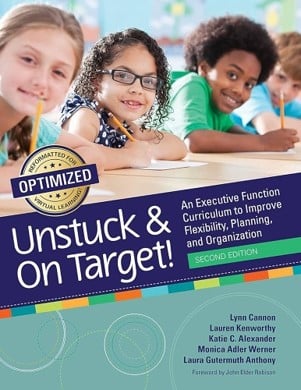
What is Unstuck and On Target?
Unstuck is an intervention to teach kids how to be more flexible, planful, and goal directed to function better day to day. In other words, it aims to improve executive functioning
skills.
Unstuck was originally designed for delivery in school settings but has been adapted for delivery in mental health programs in partnership with providers with clients with executive functioning difficulties.
This intervention includes five modules with 1-5 sessions per module. These sessions aim to increase cognitive flexibility, organization, planning, and emotion regulation abilities so that kids can more easily shift from topic to topic,
task to task, consider new ideas or another person’s point of view, and function or behave independently at home, school and beyond!
How was Unstuck Developed and Adapted?
Unstuckis a cognitive-behavioral
intervention collaboratively developed by executive functioning experts in collaboration and refined with community providers, autistic individuals, and their families. The version adapted for mental health settings was similarly developed in partnership
with autism experts, community mental health providers, and caregivers of autistic youth.
What is the Evidence for Unstuck?
Unstuck is classified as an intervention with good quality evidence
by the US Department of Health and Human Services Agency for Healthcare Research and Quality. Results from recent studies support its effectiveness for autism and ADHD when delivered by school staff in school settings. Preliminary data also support
the feasibility and effectiveness of the adapted version of Unstuck for outpatient mental health settings.
Who should use Unstuck?
Unstuck is a good fit for anyone providing outpatient
psychotherapy to youth.
Your Steps to Participate
Below are the general steps for participation. For a detailed description of these steps, please refer to the informational packet linked here
Timeline & Expectations
Need Help?
If you have questions or need support at any point, please contact the TOUCAN Study team at:
[Email] | [Phone]
Welcome to the TOUCAN Study – Unified Protocol for Children (UP-C) training group! We’re excited to have you participate. This page will guide you through each step of the study and provide quick access to important links and resources. If you have not been communicated with about enrollment, or you are interested in enrolling, please visit this page to find out how to get started.
What is UP-C?UP-C is a program designed to help kids better understand and manage their emotions, like anxiety, sadness, or frustration. It teaches practical skills for recognizing and being mindfully aware of emotions, thinking in more helpful and realistic ways, solving problems, and approaching situations they may have previously avoided. The UP-C also includes skills to support caregivers.
UP-C can be used with children from diverse backgrounds and is often implemented by therapists in mental health settings, schools, or community programs. It’s a transdiagnostic approach, meaning this treatment is effective for a range of emotional and behavioral concerns rather than focusing on just one specific diagnosis.