A Seat at the Table: Masters Licensed Therapists Expand Their Role in Academic Medicine
Oct 19, 2026
Written by Angel Tran with Support from Emily Hemendinger, Mandy Doria and Laura Anthony
For many years, academic medicine has been a space traditionally associated with physicians, psychologists, and other doctoral-level professionals. However, within the University of Colorado Department of Psychiatry, Masters Licensed Therapists (MLTs) are demonstrating that meaningful contributions to clinical care, research, education, and leadership are not defined solely by academic degrees. These include people who have LCSW (licensed clinical social worker), LPC (licensed professional counselor), LMFT (licensed marriage and family therapist), and LAC (licensed addictions counselor) licenses.
As the Department continues to grow, so does the presence and influence of MLTs. The recent adoption of the Masters Licensed Therapist designation brings greater clarity to their professional roles while recognizing the expertise they contribute to the Department's missions. What started as a handful of therapists has grown into a workforce of nearly 100 providers (and keeps growing!). The Department of Psychiatry is proud to have amazing therapists who can work with our psychiatry, psychology, and nurse practitioner providers.
Historically, questions surrounding degree requirements and eligibility for promotion also contributed to uncertainty about opportunities for MLTs. Some faculty recall that the interpretation of a "terminal degree" was not always straightforward, making it difficult for some clinicians to envision a path toward higher academic ranks. The reality though is that even though they may not have been hired into a role that is on the promotion track, they may qualify for the promotion track by the demonstration of amazing work they are doing. Over time, MLT faculty began challenging those assumptions by pursuing opportunities to teach, publish, conduct research, develop programs, and take on leadership responsibilities.
An important point to emphasize is that MLTs can be on the promotions track and all faculty follow the same criteria regardless of degree. Faculty promotion is a collaborative process involving ongoing communication among faculty, mentors, and department leadership. Discussions should focus on professional goals, alignment with departmental and School of Medicine (SOM) priorities, career growth, mentorship, and opportunities to contribute to teaching, clinical practice, scholarship, and service.
The department follows the School of Medicine’s guidelines for promotion. An Advancement Workgroup recently created clearer guidelines on terminal degrees and advancing to Sr. Instructor or Assistant Professor: https://medschool.cuanschutz.edu/docs/librariesprovider173/default-document-library/faculty-promotion-document---final.pdf?sfvrsn=c02d6cb5_1
Being on the promotions track isn’t just about research. There’s so much more that people can offer, including teaching, presenting at conferences, writing articles, publishing or creating patient materials, program planning and implementation, policy improvement, and so much more.
The School of Medicine Faculty Affairs now has a document that outlines scholarship outside of research: https://medschool.cuanschutz.edu/docs/librariesprovider173/current-docs-3-25/defining-scholarship---2025-04.pdf?sfvrsn=c06831b4_1
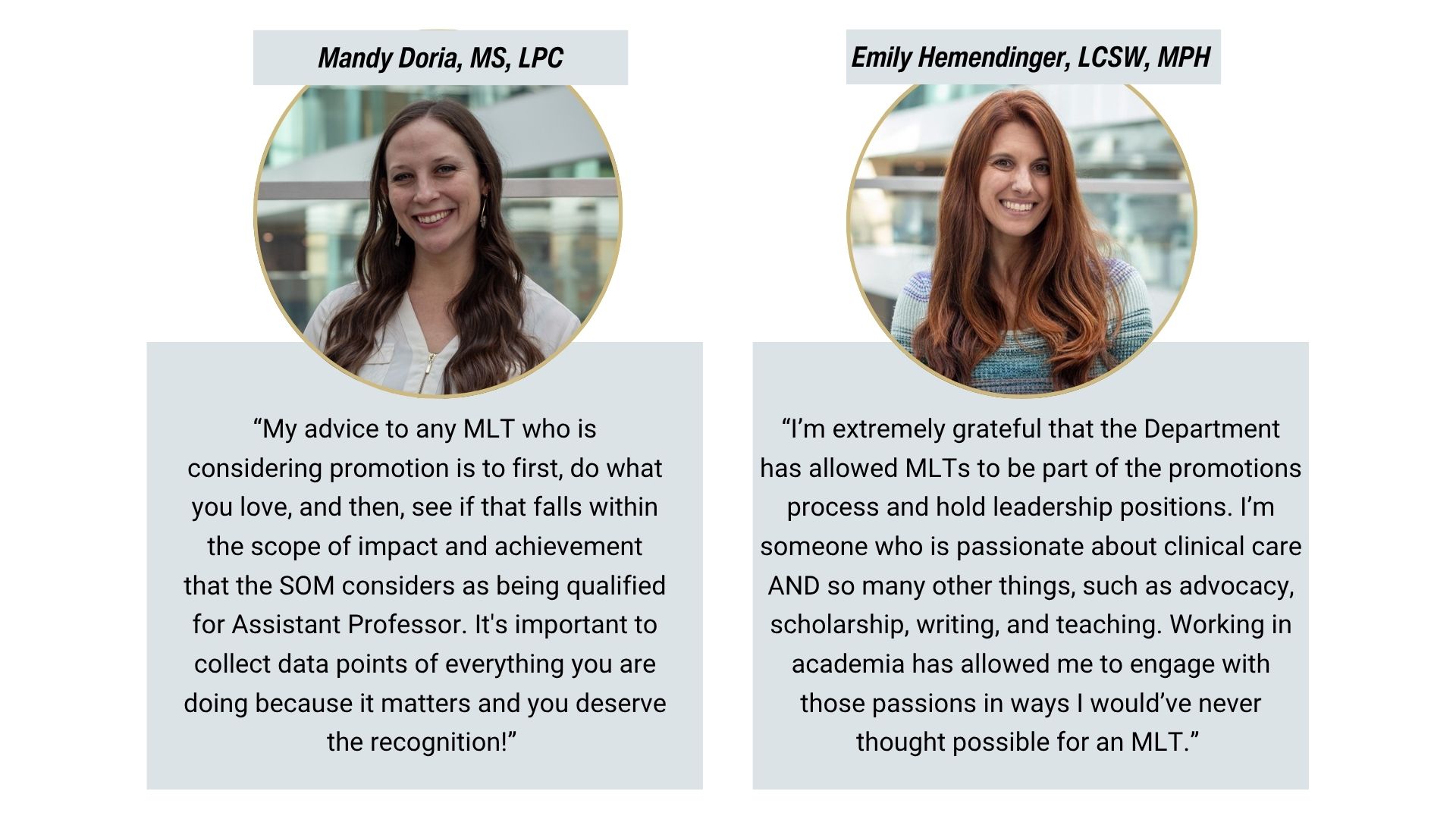
The growing presence of MLTs in academic and leadership roles represents more than individual career advancement. It reflects a shift in how expertise is valued, whose voices are heard, and what is possible for master's-level clinicians. “Our academic MLTs are multidimensional in skill sets, incredible problem solvers, and overall well-rounded humans that care about other humans. They have a history of having one of the most undervalued, difficult jobs in mental health, while also having a huge impact on a wide range of outcomes for patients and trainees,” says Mandy Doria, Associate Professor in the Department of Psychiatry.
For MLTs, having a seat at the table is no longer just about being included in the conversation. It's about helping lead it, shaping the future of academic medicine, and paving the way for the next generation of MLTs.