

World-Class Skull Base Course Puts CU Anschutz on the Global Stage
The annual skull base surgery course draws surgeons from around the globe, exposing residents to comprehensive surgical approaches in one of the most challenging surgical specialties.
Makenzie Hardy Nov 23, 2026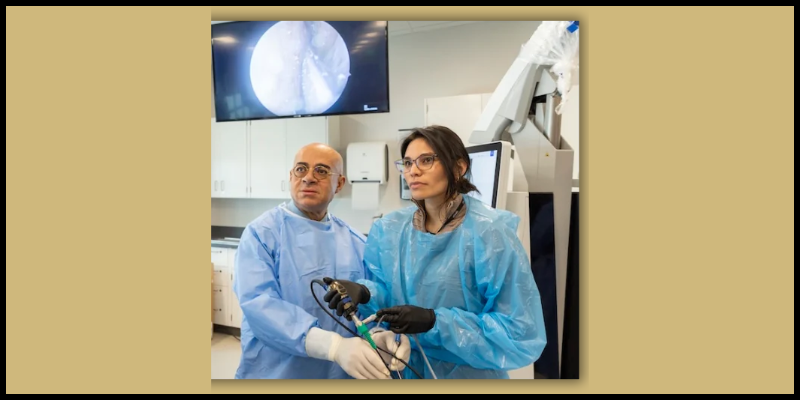
Benign pathologies but malignant location. This is the unofficial slogan for skull base surgery according to Samy Youssef, MD, PhD, professor of neurosurgery at the University of Colorado Anschutz School of Medicine, who leads an annual skull base surgery course that trains residents on the newest technology in their field.
Skull base surgery is widely considered one of the most challenging surgical specialties because the anatomical location is difficult to access and filled with vital structures. Lesions in the skull base form in between 12 cranial nerves that control the most basic human functions and major blood vessels pass directly through or nearby. Successful surgical procedures in this area require a multidisciplinary approach with the expertise of both a neurosurgeon and an ear, nose, and throat (ENT) surgeon.
“We want to teach young neurosurgeons how to do comprehensive approaches to skull base,” Youssef says. “The majority of residents that attend the course are from the U.S. I want to enhance exposure for our American trainees.”
His desire to educate the rising generation of surgeons led Youssef to organize a comprehensive skull base training course led by surgical leaders from around the world.
Charting a new course
The idea to host an international skull base course on an academic campus came to Youssef more than 25 years ago during his fellowship.
“At the time, the idea of inviting senior residents and fellows and international faculty was only done on the medical
industry side,” Youssef says. “The idea to do it at a university was novel.”
In the early 2000s, safety enhancements to surgical labs created new opportunities for academic institutions to host educational courses. In Tampa, Youssef hosted his first skull base course at the University of South Florida. The course was held annually at the cadaver dissection lab on campus.
In 2014, Youssef was recruited to join CU Anschutz. During his first visit to the campus, he recalls asking about lab space and the potential to host the course.
“I came and visited the campus and looked at the mountains and thought, ‘I can throw an international course here.’ Less than a year later, I did my first course,” Youssef says.
When Youssef arrived that June, construction on a new lab space, the CU Anschutz Center for Surgical Innovation (CSI), was underway. He took a hard hat tour of the lab space and held his first course at the CSI in March 2015.
Since joining the department, Youssef has hosted the course 11 times, missing only one year due to the COVID-19 pandemic.
Balance in surgical decision-making
What makes this course unique? There are only a handful of courses worldwide offering a comparable level of expertise in open and endoscopic approaches, cutting-edge technology, and hands-on time with a cadaver. The course is highly equipped with an intense agenda including scheduled lectures preceding demonstrations in the lab.
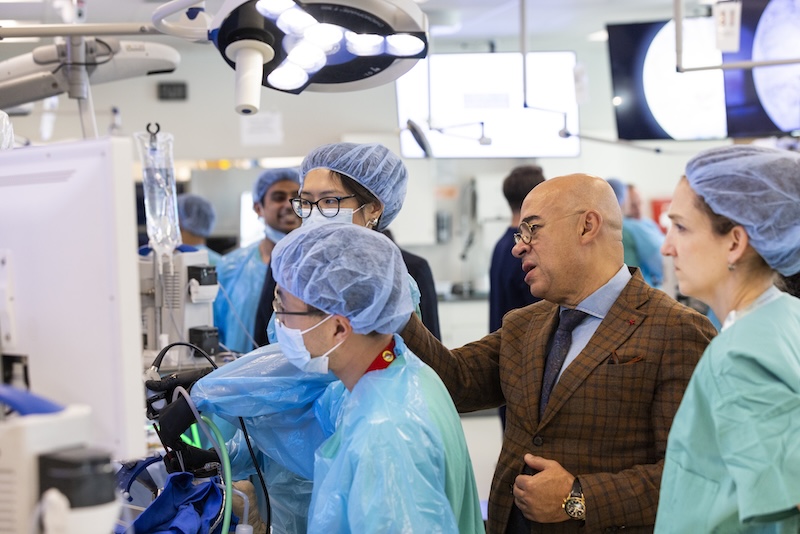
Each of the 14 stations at the CSI is set up as miniature operating rooms, using the latest microscopes, endoscopes, and neuro navigation software provided by the course’s industry sponsors. Some of the technology is so new that many course participants use this technology for the first time at the course.
“Seventeen different companies provide technology and education funding for the course,” Youssef says. “They fly their equipment to the lab here for the event. Because the course is very high level and attracts elite skull base surgeons and experts from all over the world, medical industries want to be part of it.”
Stations are also equipped with video monitors, allowing course participants to watch surgical demonstrations at the master station, then replicate it at their own station.
Another unique aspect of the course is a neurosurgeon and an ENT surgeon are paired at each station to provide exposure to the multidisciplinary approach. Youssef explains that this dual surgeon approach is much more common in the U.S. For minimally invasive procedures, an ENT surgeon provides crucial insight into accessing lesions through the ear, head and neck, the eye, or the nose.
“We start the multidisciplinary concept in the lab, initiating this collaboration at the training level,” Youssef says. “The international faculty love the concept, especially for the long, complex cases. This team approach keeps both surgeons sharp for every part of the case.”
The best of the best
Youssef travels around the world for teaching and speaking engagements. His frequent travels combined with his reputation as a skull base surgeon allows him to recruit international faculty for his course. He says he extends conference invitations up to a year in advance.
“Every faculty member is a world leader in minimally invasive skull base and endoscopic approaches, which is the
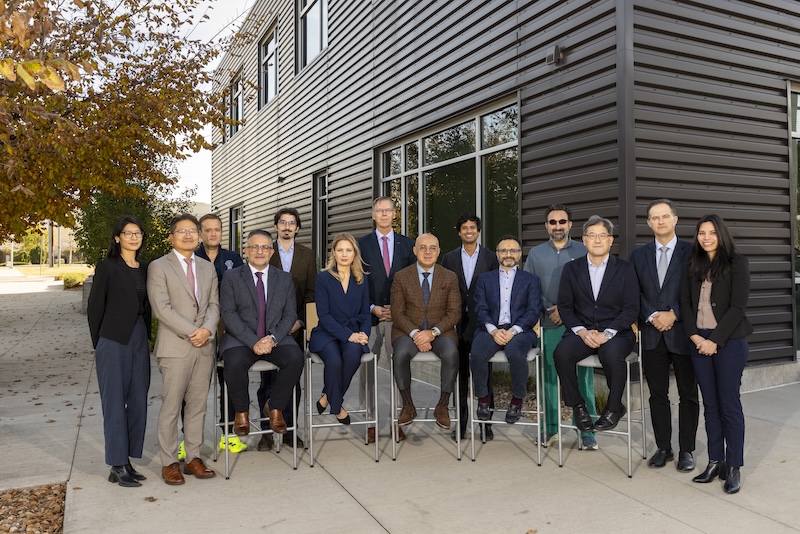
contemporary skull base practice of lesser invasive approaches,” Youssef says.
While faculty members are selected from a curated list, invitations are sent out to all neurosurgery and ENT resident programs in the U.S. Youssef also invites international trainees that he meets while traveling or those recommended by colleagues. This year, residents training in skull base came from Chile, Japan, Argentina, and from the Middle East.
“We like to share our knowledge and expertise with all the young surgeons,” Youssef says. “Whatever we learned the hard way, we want to share with them.”
In addition to the education and networking experience, the course also provides great recognition for the skull base program at CU Anschutz, creating a competitive skull base fellowship program.
Youssef creates a program that gives each faculty member equal time to lecture and present at the master station to expose residents to different surgical perspectives. Garni Barkhoudarian, MD, chief medical officer and director of the neuroanatomy laboratory at the Pacific Neuroscience Institute (PNI) contributes to the course each year. Youssef serves as co-director of the PNI skull base courses.
Among the faculty members is Maria Peris-Celda, MD, PhD, a skull base neurosurgeon and director of anatomy at the Mayo Clinic, who travels to the course with her 3D projecting technology. Before each session, she leads a 3D anatomy session focused on the area they will be working on in the lab. In addition to her expertise in anatomy, she also leads sessions at the master station.
South Korean skull base surgeon, Doo-Sik Kong, MD, from the Samsung Medical Center in Seoul, is a close friend of Youssef and a world leader in trans orbital approaches.
Residents and fellows also received instruction from Japanese skull base surgeon and neurosurgery chair at the Osaka Metropolitan University Graduate School of Medicine, Takeo Goto, MD, who is well known for his innovation in lesser invasive and endoscopic approaches to the skull base. Daniel Prevedello, MD, chair of neurosurgery at the University of North Carolina Health is also considered a world leader in skull base endoscopy and offers his unique surgical perspective along with Samer Al-Baba, MD, pediatric skull base surgeon and president elect of the International Federation of Neuroendoscopy.
Looking to the future
Next year, Youssef plans to extend the length of the course to three and a half days. While the agenda is full, Youssef makes time for faculty and residents to network and decompress with a hard stop at 6:30 p.m. for dinner. He hopes this will show the residents the importance of balance and life outside of work.
Youssef plans to continue to refine the course and invite more faculty to the CU Anschutz campus. This course is part of his legacy as a skull base neurosurgeon, he says, and his way of refining surgical approaches in the rising generation of surgeons worldwide.
“We are the most comprehensive course in the world. We provide a 360-degree approach around the skull base,” Youssef says.