

Essential Tremor — A Patient’s Lifelong Journey to Finding Relief
Texas resident travels to the CU Anschutz campus for the highly reputable high-intensity focused ultrasound program.
Makenzie Hardy Aug 7, 2026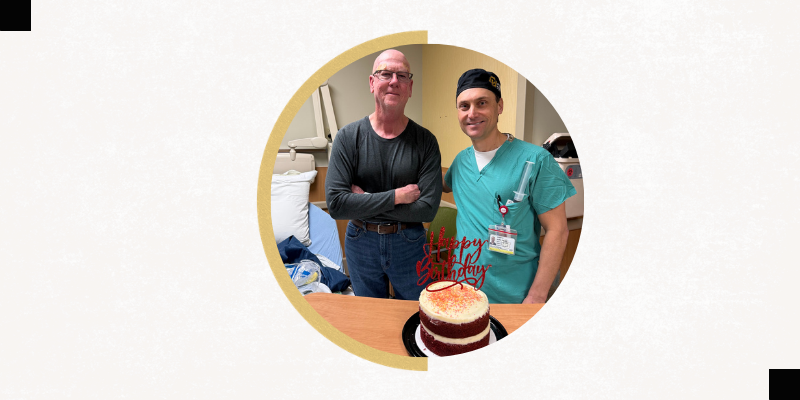
Stephen “Steve” Dillon first noticed his shaky hands during little league games as a child. He chalked it up to nerves, never suspecting that his inability to hold still at the plate was due to an undiagnosed disease that would progress as he aged.
The nervous shakes from little league followed him into social situations in high school, then college, where dorm mates noted he was clumsy and placed friendly bets on how long it would take for Dillon to drop his food tray. He entered law school and spent long hours in a courtroom, managing his tremor on his own until a Texas judge embarrassed Dillon by calling him out in a full courtroom to ask if he was nervous since his hands were shaking.
Dillon was eventually diagnosed with essential tremor, a neurological disorder that causes involuntary shaking in the hands, arms, head, or voice. His tremor increased over the years, and after a series of neurologists and medications, Dillon explored surgical treatment options.
Medically refractory essential tremor
Dillon worked with a neurologist in Houston to find an effective medication and was fortunate to find one that managed
his symptoms for many years. Later in his career, he relocated to Austin, Texas, and stopped seeing a neurologist. But by the end of his career, his tremor made day-to-day activities increasingly difficult.
“In my final years before retiring, my handwriting was so bad when I signed enforcement orders as lead deputy that I needed to take medicine to get through it,” Dillon recalls. “It kept getting worse and everyday things became more difficult.”
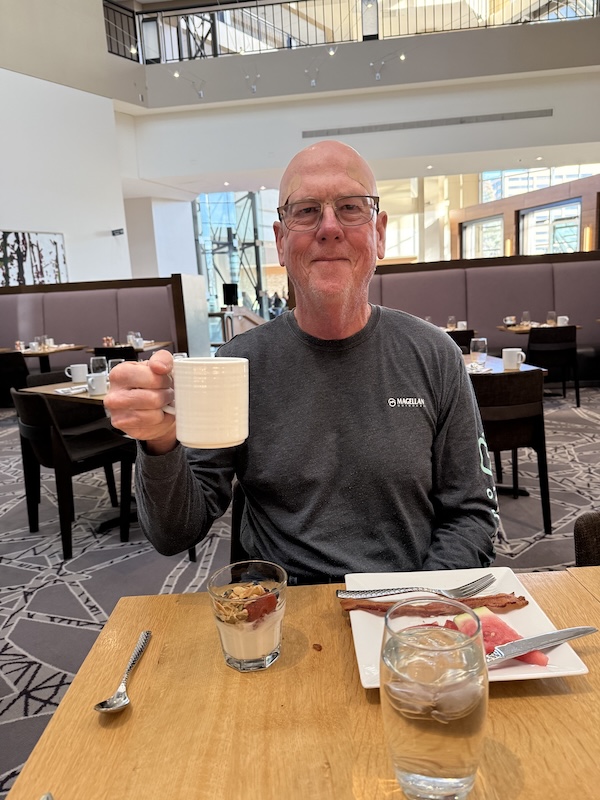
During the Covid-19 pandemic, Dillon retired and moved to Woodland Park, Colorado. By this time, his tremor had become debilitating and interfered with his quality of life.
“I cut myself shaving quite a bit and I had difficulty holding glasses and drinking from them,” Dillon says. “I did a lot of yard work at our home in Colorado and the tremor was impacting my ability to do that.”
Dillon was referred to a neurologist in Boulder. He tried various medications and a wearable device that worked temporarily, but nothing provided long-term tremor relief.
As the youngest of four children, all diagnosed with essential tremor, Dillon was familiar with the surgical treatment option deep brain stimulation (DBS). Both of his sisters had varying degrees of success with their DBS procedures in their home states, and he was hesitant to try it.
During his many neurology appointments, he learned of the successful high-intensity focused ultrasound program at the University of Colorado Anschutz led by neurologist Drew Kern, MD, associate professor of neurology, Steven Ojemann, MD, professor of neurosurgery, and Daniel Kramer, MD, associate professor of neurosurgery.
Focused ultrasound for essential tremor
Essential tremor is the most common movement disorder affecting an estimated 3% of the population. The cause of essential tremor is unclear, but, as demonstrated in Dillon’s family, it has a strong genetic component. High-intensity focused ultrasound (HIFU) is a noninvasive therapeutic technology used to identify, target, and treat the precise area in
the brain responsible for the tremor.
A neurosurgeon and a neurologist work closely to identify the area of the brain causing the tremor. Once they establish a precise target, the focused ultrasound beams converge to produce precise ablation, or thermal destruction of the tissue, without damaging the surrounding healthy tissue. Most patients experience instant tremor relief.
Kern, Ojemann, and Kramer determine the optimal site for ablation, targeting the hemisphere of the brain on the patient’s dominate side. Based on the results of the first side, a patient can then decide to return in nine months to treat the second side.
“At CU Anschutz, our primary clinical goal is to provide the very best care for our patients, the same level of care that we expect for our loved ones and ourselves,” Kern says. “This comes from working together as a team with each member having unique skills that overlap amongst all team members to yield superior outcomes.”
Focused ultrasound for essential tremor is an outpatient procedure, and patients typically go home the same day.
Treating the right side
Dillon relocated back to Texas but was still determined to have his HIFU procedure performed by what he calls “the dynamic duo” — the departments of neurology and neurosurgery — at CU Anschutz. He traveled to Denver for his pre-op appointments at the end of 2025.
In early February, Dillon returned to Colorado for his right-side HIFU procedure. He was hopeful and extremely nervous, exacerbating his tremor, he says. Before the procedure began, Dillon passed out in the MRI suite.
“After that, I was feeling uncertain about the process,” Dillon says. “But Dr. Kern gave me a pep talk and told me that he still thought I was good for the procedure and that I was ready.”
Dillon decided to give the procedure another try. “I wanted to get it done, so I rescheduled it in February, the day after my birthday.”
Back in an MRI suite on the CU Anschutz campus, Dillon recalls feeling cold and nervous waiting to start. This time, he made it through the entire procedure.
“My tremor was so bad during the procedure,” says Dillon, who recalls the two final sonifications being uncomfortable. “Dr. Kern did a great job preparing me for it. This is not a procedure for the faint of heart, but in recovery, I immediately noticed the difference.”
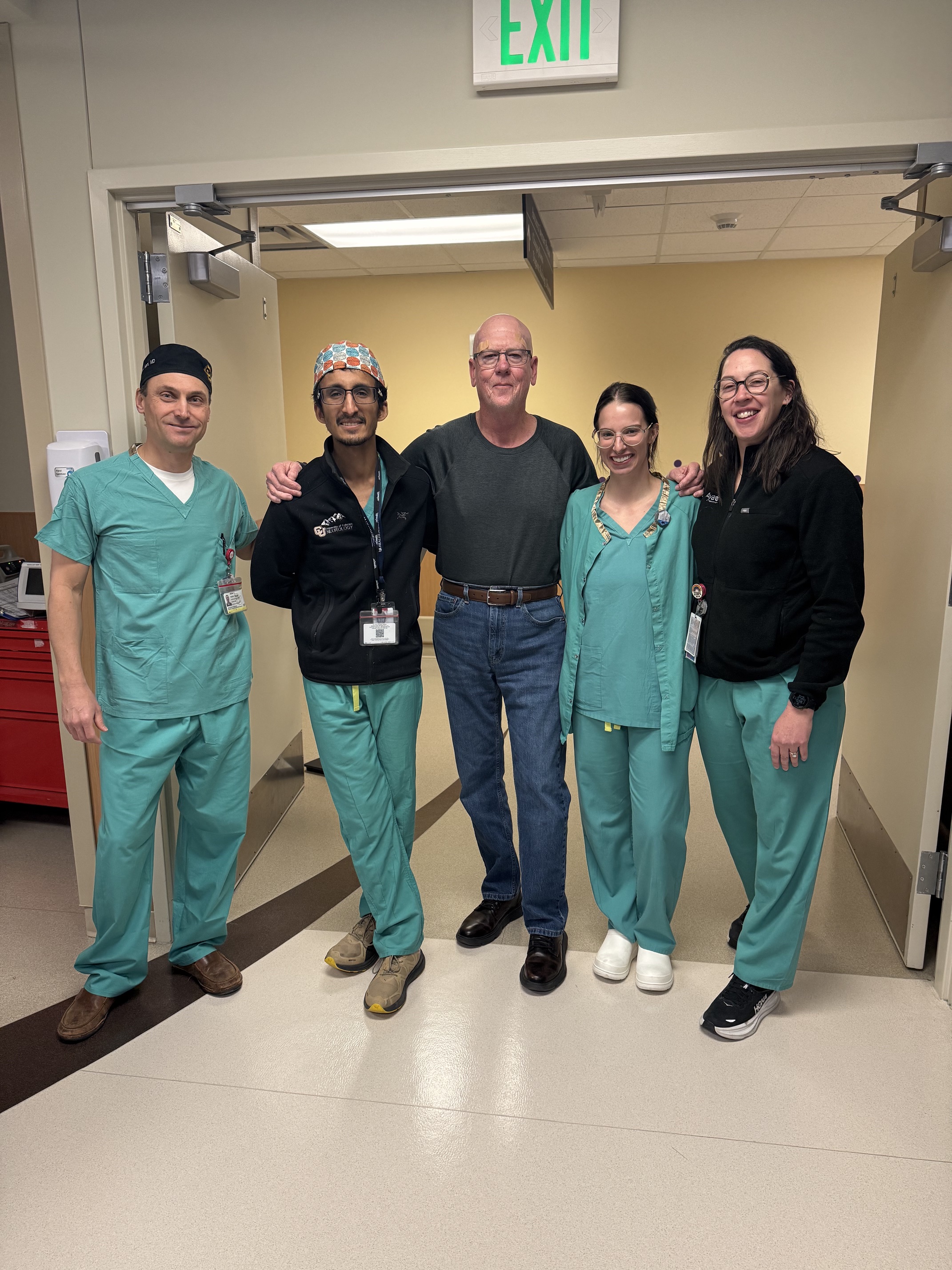
After Dillon was moved to recovery, his care team surprised him with a birthday cake. The moment was an emotional one for him since it was the first time in years that his hand was steady enough to cut a cake. After pictures with his care team and a slice of birthday cake, he was discharged.
Dillon saw his care team the following day for a post-op visit. Two days after the procedure, he flew back home to Texas.
“The results of the treatment are amazing,” Dillon says. “The tremor in my dominant right hand has been greatly reduced, and I’ve also noticed improvement in my voice and in my head and neck tremors.”
‘I would do it again’
Dillon noticed that his depth perception was a little off for a couple of weeks after the surgery, something his care team prepared him for. His neurology team gave him balance exercises to do at home to help his balance during recovery, and he quickly returned to his active lifestyle and spending time out with friends. Dillon loves to hike and looks forward to his next visit to the mountains in Colorado.
“I like eggs over easy, I could not cook those before, and now I can,” he says. “I can hold a glass and drink without spilling. I can write in cursive. It’s made a remarkable difference socially and I am participating in more social activities.”
The patient outcomes and the reputation of the HIFU program at CU Anschutz brought Dillon to the campus, but the kindness and expertise of every member of the care team gave Dillon confidence in his care, he says.
“I would do it again without hesitation,” he says. “It was totally worth it.”
Interested in learning more? Visit the CU Anschutz Movement Disorders Center webpage for next steps and additional information on focused ultrasound treatment.