

From Chaos to Clarity
Navigating Higher Education from the Eye of the Storm
Michael Harris-Love Nov 17, 2025
In recent years, one could lob a variety of critiques at the firmament of higher education with little fear of being wrong. Targets of criticism have included the escalating costs of higher education, campuses roiled by corrosive political strife, swelling endowment coffers that seem to rarely benefit students, and outsized investments in corporate architecture manifested as Colosseum-like football stadiums and training facilities. Despite both real and perceived shortcomings in higher education, our nation’s universities have been instrumental in establishing and maintaining our country's global leadership in medical research and scientific development. Through the largess of federal grant funding coupled with the ingenuity of academic researchers, universities have produced world-changing discoveries, trained generations of scientists, and created a research network that has served as a benchmark for others. But alliances that require the university to be joined at the hip with government or industry always carry risks. Publications may constitute academic currency, but the one who holds the gold still makes the rules outside of the ivory tower. And how the gold is spent may be subject to ill-conceived policy changes or capricious decisions by those in power. Universities are now discovering that the erosion of their independence is the steep cost to be paid for the reliance of funding sources that buckle under the weight of political change.
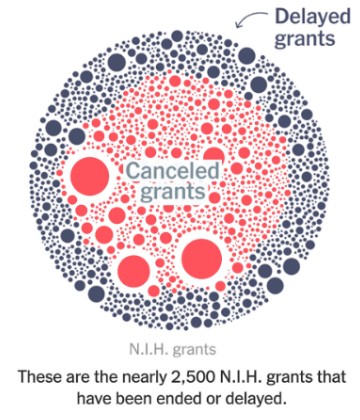
Figure 1. A visualization of cancelled and delayed NIH grants. (Kolata, G. The disappearing funds for chronic diseases. The New York Times, June 4, 2025)
The frontal assault on federal funding for scientific grants has been striking. The National Institutes of Health (NIH) has terminated or delayed thousands of research grants (Figures 1 and 2), representing more than $2.4 billion in lost funding. What began as an effort by the current administration to scrutinize funding support for the mere 6.6% of NIH grant recipients who are underrepresented racial and ethnic minorities (FY 2020; Nguyen et al. 2023) has now expanded to affect research funding for cancer and other chronic diseases. Moreover, the impact of the proposed National Science Foundation (NSF) budget cuts may reduce the number of funded investigators from 330,000 to 90,000. Since World War II, U.S. investments in basic research have contributed an estimated 75% of global economic growth, with the majority of technical advances since 1990 driven by fundamental science. To be sure, every research project isn’t a world-changing idea or a key step in the next big technological breakthrough. After all, that’s not how science works. Nevertheless, universities have become major regional employers and economic anchors in Colorado and throughout the country. In recent years, the university-industry nexus has resulted in annual invention disclosures and issued patents exceeding 24,000 and 7,000, respectively (World Economic Forum 2018). U.S. institutions have consistently filled the top ranks of global universities involved in biomedical research, and over 250 Nobel laureates have received NSF support during the course of their careers. This shift in our national priorities, if one can truly call it that, will take generations to fully unwind in its implications on our research infrastructure and scientific leadership.
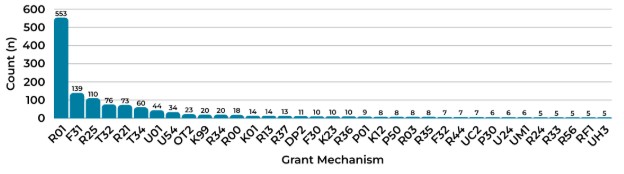
Figure 2. NIH grant mechanisms with five or more terminated grants. (National Institutes of Health. NIH grant terminations and funding impact report. U.S. Department of Health & Human Services, 2025)
Deepening this cascade of events, the U.S. Department of Education delivered an unfortunate announcement last week: lower federal loan caps scheduled to take effect in July 2026 for various degree programs including the health sciences. Graduate borrowers face an annual limit of $20,500 (with a $100,000 aggregate cap), while physician programs are restricted to $50,000 per year. Aimed at cutting "wasteful" borrowing, policymakers have categorized physical therapy programs as “graduate programs, not professional programs” despite the required clinical training hours, specialized accreditation requirements, national examination process, and state licensure required for U.S. practitioners. The failure to categorize physical therapy as a professional program seems to run counter to this federal agency’s own criteria for such programs (34 CFR § 668.2, 2025). Workforce planning and regional economic analysis efforts from the Colorado Department of Higher Education categorize specific rehabilitation careers, such as physical therapy, as Tier 1 jobs. Tier 1 Jobs are high-demand, high-wage occupations that typically require advanced education, earn workers income above the median threshold, and are considered critical for Colorado’s economic competitiveness. The current approach of the U.S. Department of Education represents a self-inflicted economic setback. Healthcare employs one in eight Americans and accounts for an estimated 18% of the U.S. gross domestic product (CMS 2025; KFF 2025). The proposed discipline-specific limits on federal financial aid create steep challenges even for physical therapy students attending lower-cost options, such as in-state learners at public universities like the University of Colorado. Out-of-state students without the benefit of a consortium agreement (e.g., the Western Interstate Commission for Higher Education Professional Student Exchange Program), and those relying on supplemental private loans, will find the pursuit of the Doctor of Physical Therapy degree even further out of reach.
At this moment, it is important to remember that the physical therapy profession emerged from our response to military conflict during times of great uncertainty. Our profession traces its origins to the Reconstruction Aides of World War I, a group of groundbreaking women who provided rehabilitative care to injured soldiers and laid the foundation for modern physical therapy practice. The profession of physical therapy has been under-appreciated and under-valued at various points in our history. Sadly, this has occurred even within the medical community that we proudly serve. There are echoes of this regrettable stance in the U.S. Department of Education’s sin of omission regarding professional education and the apparent fate of physical therapy programs. But from the chaos of these serial policy missteps lies our clarity of vision and purpose. We have always been resourceful, committed, and resilient, and that legacy will guide us now. These virtues will be essential as we confront the dual challenges of working with our universities to manage ongoing funding pressures while also unifying our professional societies to build a cohesive advocacy effort in response to the U.S. Department of Education and other looming challenges. If you thought that we were done after attaining greater direct access or growing our body of scientific literature, then you were wrong. A long battle lies ahead and the opposition is formidable, but make no mistake… we are ready.
References
American Physiological Society. (2025). Letter to Congress on FY 2026 NSF funding. https://www.physiology.org/career/policy-advocacy/federal-research-funding/letter-to-congress-on-fy-2026-nsf-funding?SSO=Y
Association of American Medical Colleges. (2024). Summary report: The complexities of physician supply and demand: Projections from 2021 to 2036. Washington, DC: AAMC. Retrieved from https://www.aamc.org/media/83686/download
Colorado Workforce Development Council. (2022). Colorado Talent Pipeline Report. Colorado Department of Higher Education. Retrieved from https://spl.cde.state.co.us/artemis/lbeserials/lbe520011internet/2022/2022%20Talent%20Pipeline%20Report.pdf
Centers for Medicare & Medicaid Services. (2025). National health expenditure data: Historical. https://www.cms.gov/data-research/statistics-trends-and-reports/national-health-expenditure-data/historical
Crow, M. M., & McNutt, M. (2025, August 22). ‘Universities are the invisible hand’. ASU News. https://news.asu.edu/20250822-science-and-technology-universities-are-invisible-hand-michael-crow-marcia-mcnutt
Hanson, M. (2024, September 9). College tuition inflation rate. EducationData.org. https://educationdata.org/college-tuition-inflation-rate
Holmes, R. (2025, November 12). The decline of the great American research university. The Chronicle of Higher Education. https://www.chronicle.com/article/the-decline-of-the-great-american-research-university
Kaiser Family Foundation (KFF). (2025, October 8). Health care costs and affordability. https://www.kff.org/health-costs/health-policy-101-health-care-costs-and-affordability/
Kolata, G. (2025, June 4). The disappearing funds for chronic diseases. The New York Times. Retrieved from https://www.nytimes.com/2025/06/04
Lane, N., & Riordan, M. (2025, June 18). Trump is undermining U.S. science. Here’s why that’s dangerous. The Washington Post. https://www.washingtonpost.com/opinions/2025/06/18/trump-science-attacks-internet/
National Institutes of Health. (2025). NIH grant terminations and funding impact report. U.S. Department of Health & Human Services. Retrieved from https://www.nih.gov
Nguyen, M., Chaudhry, S. I., Desai, M. M., Dzirasa, K., Cavazos, J. E., & Boatright, D. (2023). Gender, racial, and ethnic inequities in receipt of multiple National Institutes of Health research project grants. JAMA Network Open, 6(2), e230855.
Partridge, B. (2025, July 6). These scientific advances were ‘Made in the U.S.A.’ Will they continue? The Washington Post. https://www.washingtonpost.com/opinions/interactive/2025/federal-science-funding-cuts-united-states/
The Washington Post. (2025, April 16). Women, minorities fired in purge of NIH science review boards. https://www.washingtonpost.com/science/2025/04/16/women-and-minorities-fired-nih-board-science/
The Washington Post. (2025, August 21). Supreme Court allows nearly $800 million in cuts to NIH grants. https://www.washingtonpost.com/politics/2025/08/21/supreme-court-nih-grants-diversity-equity-inclusion-trump
U.S. Department of Education. (2025). 34 CFR § 668.2 — General definitions. Code of Federal Regulations. https://www.ecfr.gov/current/title-34/subtitle-B/chapter-VI/part-668/subpart-A/section-668.2
Waldman, A. (2025, June 17). Federal judge deems Trump administration's termination of NIH grants illegal. Government Executive. https://www.govexec.com/management/2025/06/federal-judge-deems-trump-administrations-termination-nih-grants-illegal/406148/
World Economic Forum. (2018, January 18). 4 ways universities are driving innovation. https://www.weforum.org/agenda/2018/01/4-ways-universities-are-driving-innovation