

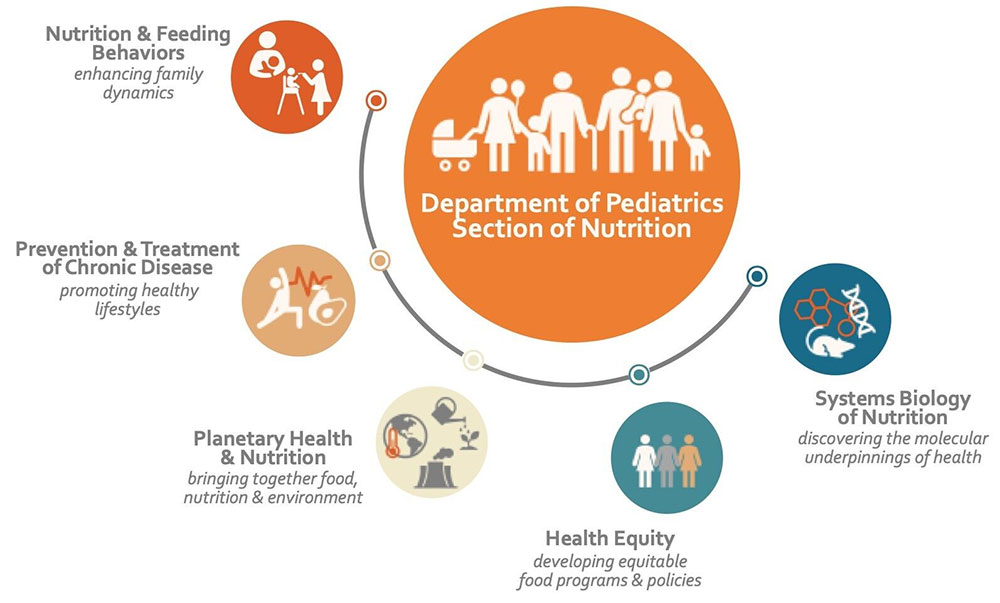
Our work in this area aims to expand the understanding of the biological, social, cultural, societal and personal factors related to feeding and nutrition. Our work also focuses on creation of health food environments.
Our work in this area focuses on the weight management and medical monitoring of weight related comorbidities. Our multidisciplinary research and clinical counseling approaches focus on nutrition, physical activity and sleep habits.
Our work in this area promotes optimizing the two-way relationship between nutrition and planetary health. Climate change and pollution impact the nutritional value of our food, and therefore, human health. At the same time, how the food we consume is grown, processed, packaged, transported and stored are major contributors to planetary health.
Our work in this area examines the multilevel factors contributing to nutrition-related health inequities, including the social determinants of nutrition. We seek to provide the data needed to develop programs and policies that meet the need of everyone, decrease health disparities, and do not cause harm.
Our work in this area aims to uncover the genetic, epigenetic, cellular and physiologic mechanisms underlying response to nutrition and weight status during pregnancy, infancy, childhood and into adulthood. We use a variety of cell and animal models, as well as more focused studies in humans.

Total active awards:
Total active award amount:

January 23, 2026, by Kristen Boyle, PhD
Dr. Boyle: Today we're interviewing Noel Meuller, a researcher and Associate Professor in the Section of Nutrition and The Lifecourse Epidemiology of Adiposity and Diabetes (LEAD) center at the University of Colorado Anschutz. This is the first in our series of ‘Five Questions’. Where we ask Section of Nutrition researchers about their new grants, publications, and ideas. Today we’re interviewing Noel about his newly funded research grant from the NIH National Heart, Lung & Blood Institute.
Dr. Boyle: What key question does your project address, and how might the findings impact clinical care or public health?
Dr. Mueller: The key question our new project addresses is: how do the different microbiomes in pregnancy – namely the oral, gut, and vaginal microbiomes – relate to hypertensive disorders of pregnancy and future CVD risk for mothers and their offspring. Findings from our new project have great potential to: (a) identify early predictors of hypertensive disorders in pregnancy that can be targeted for prevention, (b) reveal novel mechanisms of these hypertensive disorders, (c) offer new disease prevention strategies and therapeutic possibilities, and (d) inform use of the microbiome-metabolome nexus for precision nutrition/medicine.
Dr. Boyle: What novel aspect of the study design or methods are you most excited about?
Dr. Mueller: I am excited about being the first prospective study to concomitantly assess how the oral, gut, and vaginal microbiomes, along with the molecules that these microbiomes produce, are related to hypertensive disorders in pregnancy. Furthermore, our study will be conducted in a historically understudied, racially- and ethnically-diverse population at high risk for cardiovascular disease. We will have the opportunity to use multi-omic integration, and state of the art methodology in microbiome and metabolome science, to identify novel targets for prevention.
Dr. Boyle: How will this project help you build your broader research program?
Dr. Mueller: This project represents an exciting extension of my lab’s prior work 1) demonstrating that microbial metabolites in pregnancy, including short chain fatty acids and trimethylamine N-oxide, are associated with risk of pre-eclampsia, and 2) demonstrating that mothers share microbes with their offspring, and this mother-to-newborn sharing of microbes may influence the future health of the offspring. Knowledge to be gained from this project will help to inform future microbiome-focused interventions, including dietary interventions, in mothers and children.
Dr. Boyle: What has been the most surprising challenge or insight from your research career?
Dr. Mueller: The project is still in the early stages, but I would say the biggest surprise is the enthusiasm from mothers in the Denver area to participate in our study. We have had a very positive response to the study, with participants very excited about the idea of harnessing the microbiome to improve health.
Dr. Boyle: Are there resources or expertise within the section or across campus that would help you succeed?
Dr. Mueller: I see multiple potential opportunities for collaboration within the Section and across campus. We are collecting multiple different samples from the mothers with the hope that we will be able to learn even more about the etiology of hypertensive disorders of pregnancy, like preeclampsia, which has been on the rise and has limited preventive therapeutics. I think our project could benefit from additional collaboration on how specific foods, and dietary patterns, and other lifestyle factors might impact the different microbiomes of pregnancy, and the infant microbiome. I also think there is a tremendous opportunity to examine how other environmental factors, such as microplastics, are associated with the different microbiomes and health outcomes. Furthermore, we are collecting data on many other health outcomes in pregnancy and after pregnancy that could be examined in collaboration with other investigators on campus. These include gestational diabetes, excess weight gain in pregnancy, pre-term birth, and immune-mediated outcomes, just to name a few. If anyone is interested in collaboration, please do not hesitate to reach out to us!
Located on the University of Colorado’s Anschutz Medical Campus, the Pediatric Nutrition Laboratory specializes in precise and accurate measurement of zinc and other trace minerals and their stable isotopes. Our analytical capacity by ICP MS includes measurement of isotope ratios (enrichment) in blood, urine, and other tissues; multi element analysis of essential minerals (zinc, iron, calcium, copper, selenium, sodium, potassium, magnesium, iodine) and of heavy metal contaminants (arsenic, cadmium, lead) in food and biospecimens. We support micronutrient biomarker analyses for clinical trials, epidemiologic studies, basic nutrition research, and large scale nutrition surveillance programs across biomedical, obesity, weight management, and public health fields.
Need more information? Please reach out to [email protected].
CU Anschutz
Administrative Pavilion
13123 E. 16th Ave.
B065
Aurora, CO 80045
720-777-2715