

We have a diverse portfolio of research and evaluation studies that range from preventing child maltreatment, effectively identifying maltreatment and other trauma, strategies for referring and connecting families with treatment, studying effective interventions, implementation science, and examining the impact of service systems on child welfare outcomes. Our goal is to live into a transformational research agenda that boldly incorporates diverse viewpoints and upholds academic freedom while complying with civil rights and ethical obligations.
The Kempe Center is one of three “hub” sites for the CAPNET Research Network. CAPNET conducts rigorous, multi-center, clinical research to make the care of potentially abused children and their families more effective, safe, and fair. Supported by the National Institutes of Health, CAPNET collects data from 11 leading US pediatric centers on more than 4000 children each year who undergo sub-specialty evaluation for child physical abuse. To learn more, visit: www.capnetresearch.org.
Visit Website
Many of our Evidence-Based and Research Informed Programs have active research and evaluation. Please see these pages for more information.
For more information about Kempe’s involvement in this work, please contact:
Dr. Dana Hollinshead Assistant Research Professor at the Kempe Center
[email protected]
Kempe’s focus is understanding the prevalence and incidence of maltreatment in order to support maltreatment prevention throughout the world.
A study of violence and health in indigenous Sámi and non-Sámi children and youth in Arctic Norway – a mixed method cohort study design.
Study Principal Investigator: Ketil Lenert Hansen, Arctic University of Tromso, Norway
Kempe Consultation and Fulbright Specialist: John Fluke
The Arctic Childhood Study aims to fill a major gap of knowledge about the experiences of abuse and neglect among indigenous Sámi children and youth. The proposed study is the first longitudinal research project of its kind in Norway with a particular focus on all forms of violence against Sámi and non-Sámi children and youth in the high north, including the conceptual framework for implementing Indigenous methodology. The study is highly relevant to the Arctic region of Norway and Sámi and non-Sámi children as violence rates are higher in the north. We aim to fill the gap of evidence-based knowledge in the field of these serious problems.
The study has a mixed methods design, including process evaluation of pilot-study, and combines qualitative and quantitative data, applying Indigenous collective-informed research. Research activities includes scoping review of abuse and neglect among youth in the Arctic, languages translation of I-Cast questionnaires, pilot-study of Norwegian and Sámi languages questionaries with focus group discussions, and main study with predominantly cohort study design, using surveys with long-term follow-up in order to explore a broad range of child maltreatment, health and culturally specific experiences.
The design of the study, with a strong focus on indigenous methodology, facilitates the involvement of Sámi youth and non-Sámi youth and contribute to the development of a better understanding of violence and its consequences, the proposed study explores cultural risk and protective factors and their relation to abuse and neglect in order to gain knowledge about how to prevent these negative exposures to Arctic children and youth. Culturally appropriate and effective prevention approaches are needed for indigenous children and youth. The results of the study may have implications for families, advocate groups, school professionals, health sector, administrators, and policy makers responsible for early identification and prevention programs in child and adolescent health sectors in Norway. The results of this investigation can be used to design appropriate and maximally beneficial intervention strategies to reduce and prevent violence, bases on rigorous Norwegian data on violence and health.
The new US Report And Placement Integrated Data System (RAPIDS) data construction algorithms combine data from the National Child Abuse and Neglect Data System (NCANDS) and the Adoption and Foster Care Reporting System (AFCARS) into a single, linked longitudinal dataset. Records in the dataset encompass child maltreatment reports and foster care spells for a unique child. Kempe faculty are working with colleagues at Washington University – St. Louis and University of Illinois Urbana – Champaign to build out the infrastructure required for informed and open-source use of these new programs. The RAPIDS program can transform existing NCANDS and AFCARS data into a single, user-friendly dataset for use by researchers who have existing data use agreements with the National Data Archive for Child Abuse and Neglect (NDACAN). The team will also build and test linkages to policy and census data files to enhance policy relevant analyses of child maltreatment incidence.
A historical database that accurately captures longitudinal sequences of all maltreatment reports and foster care cases nationally over a decade and a half is a critical advancement for CM surveillance in the US. RAPIDS data, together with the new linkages to policy and census information, are a significant improvement over the raw NCANDS and AFCARS data. A child’s entire lifetime trajectory (during the 2005 and onward timeframe) of maltreatment reports and spells in care will be available using RAPIDS. These linked data have the potential to support a wide range of relevant research questions.
Our team is taking an open-source approach and making the programs widely available. The project includes these objectives:
For more information, please contact:
Dr. Rebecca Orsi-Hunt
CU Anschutz PI
[email protected]
Please also reference the first article published using RAPIDS data in the journal Child Maltreatment:
Drake, B., Fluke, J. D., Kim, H., Orsi, R., & Stubblefield, J. (2022). What Proportion of Foster Care Children Do Not Have CPS Reports? A Preliminary Look. Child Maltreatment, 27(4), 596-604. doi: 10.1177/10775595211033855. View here.
In this study we found that surprising numbers of children in out-of-home care in child protective services (CPS) systems lack a preceding maltreatment allegation, with large levels of state variability.
The Longitudinal Studies of Child Abuse and Neglect (LONGSCAN) is a 14-year longitudinal study of the etiology and consequence of child maltreatment. Launched in the 1990s, LONGSCAN was made up of a consortium of five sites across the US and a study coordinating center located at the University of North Carolina at Chapel Hill. Comprehensive assessments of children, their parents, and their teachers occurred during face-to-face interviews at child ages 4, 6, 8, 12, 14, 16, and 18. Maltreatment history was collected from multiple sources, including CPS record reviews at least every two years. Yearly telephone interviews allowed sites to track families and assess yearly service utilization and life events. The baseline sample included 1,354 children. Domains of assessment included (but not limited to) child behavior, psychological/psychiatric disorders, substance use, sexual risk behaviors, health, violence and aggression, criminal behavior, resilience factors, parenting, and exposure to violence throughout the course of the study. The National Data Archive on Child Abuse and Neglect (NDACAN) make a restricted dataset available to members of the research community who meet eligibility criteria and agree to the requirements of the data license.
In 2013, Colorado Community Response (CCR) was selected as part of a group of cornerstone prevention programs formed or expanded under Governor Hickenlooper’s master child welfare plan, “Keeping Kids Safe and Families Healthy 2.0”. The goal of prevention programs, such as CCR, is to reduce the likelihood of entry or reentry into the child welfare system and prevent child maltreatment. The theory of change is that by engaging at-risk families in voluntary services the risk of child maltreatment will be mitigated by strengthening families’ protective factors, building social capital, increasing financial stability and self-sufficiency, and improving family functioning and well-being. The CCR program provides comprehensive case management services with a focus on assisting families to access to concrete services, including one-time cash assistance (i.e. flex funds), by leveraging both formal systems and informal resources to meet their needs.
The Social Work Research Center (SWRC) in the School of Social Work at Colorado State University (CSU) and the Kempe Center for the Prevention and Treatment of Child Abuse and Neglect (Kempe Center) were selected by CDHS as the evaluation team for CCR. After completing a four-month pre-pilot, the CCR pilot evaluation officially began in November 2014 with the first cohort of 12 sites. An additional cohort of nine sites was brought on in July 2015 and the evaluation was implemented in those sites at the time of program start-up. The evaluation found that families who complete CCR are enhancing protective factors, building social capital, increasing stability, improving family functioning and self-reliance, and receiving concrete supports. Child welfare re-involvement, as measured by subsequent founded assessments and out-of-home placements, was also lower for CCR completers than families with similar demographics and case characteristics who did not complete CCR.
The National Quality Improvement Center on Workforce Development in Child Welfare (QIC-WD) is a seven-year project funded by the federal Administration for Children and Families – Children’s Bureau. It is a partnership among CU Anschutz, University of Nebraska Lincoln, University of California Los Angeles, University of Louisville and several consulting partners. The goal of the QIC-WD is to define, implement and study interventions which respond to high rates of turnover in the child welfare workforce, with the goal of reducing future turnover. Faculty and researchers at the Kempe Center are leading implementation or evaluation at four of the research and demonstration sites: Washington State, Nebraska, Milwaukee County and Virginia. They are also deeply involved in the QIC-WD’s cross-site evaluation. Final evaluations are expected to be released in Fall 2023 and will be posted on the website for the Quality Improvement Center for Workforce Development.
For more information, please contact:
Dr. Rebecca Orsi-Hunt
CU Anschutz PI
[email protected]
Please also reference the first two articles published using data collected from the QIC-WD:
Hollinshead, D. & Orsi, R. (2023 advance on-line publication). Developing an Ecological Model of Turnover Intent: Associations among Child Welfare Caseworkers’ Characteristics, Lived Experience, Professional Attitudes, Agency Culture and Proclivity to Leave. International Journal on Child Maltreatment: Research, Policy and Practice. doi: 10.1007/s42448-022-00139-4. View here.
Orsi-Hunt, R., Harrison, C., Rockwell, K. & Barbee, A. (advance on-line publication). Addressing secondary traumatic stress in the child welfare workforce: Results from a cluster-randomized control trial of Resilience Alliance. Children and Youth Services Review. doi: 10.1016/j.childyouth.2023.107044. View here.
Since the 1980s, faculty at the Kempe center have been studying decision making in the domain of social welfare and health care services delivery systems, particularly child welfare. The approach to decision making research can be found in the monograph.
The development and application of decision-making theory in Child Welfare has focused primarily on the improvement of information development regarding children and families and most often approaches to formal assessment. Decision making under uncertainty, which is characteristic of most CPS decisions such as the decision to place children out of their homes, means that system generated errors will always occur. Such decisions, while heavily influenced by case characteristics, are also a function of decision-maker thresholds for action which in and of themselves may be set independently of knowledge about the case. The approach we developed is a theoretical framework referred to as the Decision-Making Ecology originally formulated in 1997 and revisited in the more recent monograph referenced above. The monograph formally introduces a psychological mechanism for decision making behavior and the overall approach is a framework that I and others are increasingly applying as a basis for developing and testing hypotheses in non-rational decision making. A schematic to the Decision Making Ecology is depicted below:
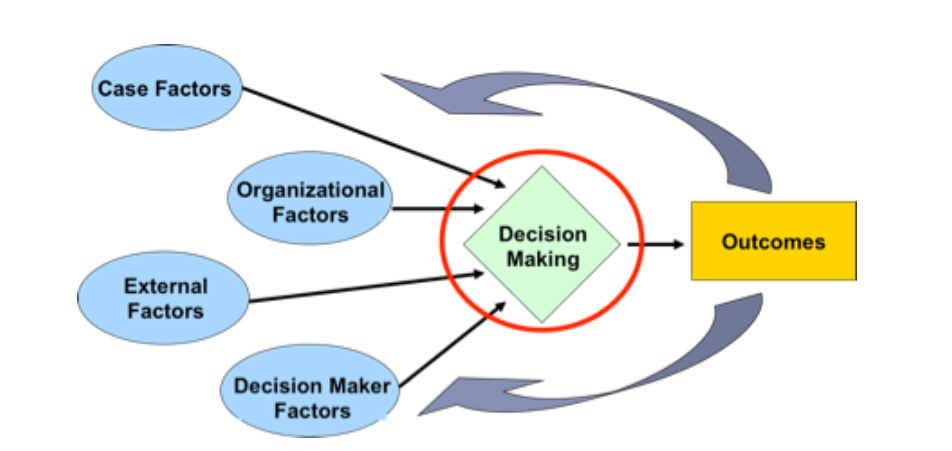
A major goal of our research has been to apply the DME principles to an ever-widening set of research efforts, including international collaborations, aimed at the overall goal of improving decision making in child welfare and other systems. This research agenda continues to present opportunities to generate new hypotheses, develop data collection instrumentation, and implement advanced new methods to conduct research such as multi-level modeling and simulation. The model has been applied to problems in decisional disparities, workforce development, agency policy change, screening threshold analysis and has led more generally to an improved understanding of the influences on decision making.
Theory, Research, and Practice
Edited by John D. Fluke, Mónica López López, Rami Benbenishty, Erik J. Knorth, and Donald J. Baumann
The Kempe Center and Pale Blue., two forces dedicated to societal transformation, have formed an unprecedented partnership and launched Together in Truth. Guided by a shared vision of truth, justice, and empowerment, we have embarked on a creative journey to reimagine the landscape of the U.S. child welfare system. Our collaboration has birthed a unique design process – an ‘un-framework’ that dismantles traditional boundaries and creates a fertile ground for truth-telling and action. This pioneering approach eschews rigid templates and guidelines, inviting open dialogue and organic change.
Together in Truth seeks to transform the child welfare/family policing system and the other ancillary systems that uphold it. We seek justice through truth-telling, beginning with convening communities of impacted persons, service providers, organizations and a broader collective to provide testimony and narratives about the impacts of the system on their lives and the lives of others.
Read the Mother Jones article on the child welfare truth telling movement here.
To learn more, please visit www.truthtellingforjustice.org
Or contact Kempe’s lead:
Lisa Merkel-Holguin
[email protected]