Meet the Team
We have professional research associates, fellows, full-time & summer students.

Dr. Melanie Cree is one of the few researchers in the country focusing on polyendocrine metabolic ovarian syndrome (PMOS, formerly known as polycystic ovarian syndrome (PCOS)) in adolescent girls...
Current research trials are very important for helping to develop an understanding of how the human body works. Trials are also how we figure out new treatment options.
RESTORE Study
Role of Semaglutide in Restoring Ovulation in Youth and Adults with Polycystic Ovary Syndrome (RESTORE Study)
The purpose of the RESTORE study is to investigate the impact of semaglutide and metformin treatment on the ovulation of women and adolescent girls with PCOS. Our overarching hypothesis is that weight loss and metabolic improvements are required to improve reproductive health in individuals with PCOS.
Who are we looking for?
If you join the study, you will receive the following:
Take the questionnaire to see if you qualify:

AMINOS Study
Effect of Amino Acids on Hepatic Fat Content in Adolescents
We are currently recruiting for the AMINOS study. We need volunteers for fatty liver disease research. The purpose of the AMINOS study is to test if an amino acid drink can help reduce fat in the liver.
Who are we looking for?
If you join the study, you will receive the following:
AIRS Study
Role Of Androgens and Obesity in Insulin Resistance and Cardiovascular Disease in Polycystic Ovarian Disease
The AIRS study compared mitochondrial dysfunction related to insulin resistance, markers of cardiovascular disease, and hyperandrogenism in girls with PCOS and with BMI matched controls. Pre NCT req
APPLE Study
Assessment Of Hepatic Glucose and Fat Regulation in Overweight Adolescent Girls
The APPLE study compared hepatic and adipose insulin resistance in girls with PCOS and obesity as compared to girls without PCOS and with obesity. The girls with PCOS were untreated, or treated with birth control pills or metformin. We also examined the effect of 2 doses of exenatide on responses to a drink of glucose.
Button CTA: Learn More
PLUM Study
Post-prandial Liver Glucose Metabolism in Polycystic Ovarian Syndrome (PCOS) and Understanding Standard of Care Medications
The PLUM study investigated the relationship between hepatic steatosis and hepatic glucose metabolism in adolescents with PCOS and obesity.
Button CTA: Read More
MANGO Study
Hepatic Fat Content and Mitochondrial Flux in Obese Youth Before and After Bariatric Surgery
The MANGO study investigated the effects of bariatric surgery on glucose metabolism and metabolic associated steatosis liver disease status in girls and boys with obesity.
Button CTA: Read More
ORANGE Study
Oral Amino Acid Nutrition to Improve Glucose Excursions in PCOS
In the ORANGE study, we tested the effect of a month of essential amino acid drinks on liver metabolism, insulin resistance and post-prandial hyperglycemia in girls with PCOS and obesity.
Button CTA: Read More
https://clinicaltrials.gov/study/NCT03717935?term=melanie%20cree-green%20&rank=3
TEAL Study
Treating PCOS with Semaglutide vs Active Lifestyle Intervention
The TEAL study investigated the difference in weight loss between girls with obesity and PCOS who were taking Semaglutide or receiving intensive dietary counseling.
Button CTA: Read More
Publications and Grants
Melanie Cree-Green | Colorado PROFILES (ucdenver.edu)
ObesityWeek photo
Caption: Dariya Kozlova, Meredith Ware, Melanie Cree, Beza Jobira and Jessie Benson at the Obesity Week Meeting, Las Vegas, NV
On-line presentations:
https://virtual.keystonesymposia.org/p/s/unraveling-metabolic-disease-in-adolescents-with-polycystic-ovary-syndrome-13402
Brian Bergman
Elizabeth parks
Parks Lab // Nutrition and Exercise Physiology (missouri.edu)
Craig Malloy, MD, PhD
URL: Meet the PI | Malloy Lab | UT Southwestern, Dallas, Texas
Cecilia Diniz Behn
Cecilia Diniz Behn | Colorado School of Mines
Stacy Simon
Faculty Profile | School of Medicine | University of Colorado Denver (cuanschutz.edu)
Robert Wolfe

Dr. Cree’s mission is to improve global health care for youth with obesity related complications, in particular polyendocrine metabolic ovarian syndrome (PMOS, formerly known as polycystic ovarian syndrome or PCOS). She is accomplishing this through innovations in clinical care delivery, education for existing and new health care providers and scientists, and clinical trials to understand obesity related physiology and clinical trials with new therapeutic options.
As an MD, PhD with clinical training in pediatric endocrinology, research training in human physiology utilizing stable isotope tracers and MR spectroscopy, and educational and leadership training, she is uniquely poised to perform translational and clinical work in youth with endocrine disorders. Dr. Cree’s lab focuses on the nuances of insulin resistance (IR) in different populations as a means to understand physiology and develop disease-specific therapies.
In addition to her research, Dr. Cree was recognized as one of Denver's 5280 Top Doctors in 2025, highlighting her dedication to her patients.
Dr. Cree was also involved in the global effort to rename PCOS to PMOS. Serving as one of only two U.S.-based pediatric physicians, she was able to bring her adolescent patient's voice and her own expertise to the table.
It's estimated that PMOS effects more than 10% of women in the United States, yet it is largely under-studied.
Meet the Team
We have professional research associates, fellows, full-time & summer students.Research Projects
Read about our currently enrolling, active and completed clinical trials.In the News
Recent interviews and articles with Dr. Cree or describing Dr. Cree’s work. Polyendocrine Metabolic Ovary Syndrome
.png?sfvrsn=14b421b4_0) Steatotic Liver Disease (MASLD)
Steatotic Liver Disease (MASLD)
 Insulin Resistance & Diabetes
 Method Development
 Mitchondrial Studies
Polyendocrine metabolic ovarian syndrome (PMOS) is a health issue that can affect people with ovaries who are of reproductive age. This condition occurs when people with ovaries have extra testosterone (a male hormone) in their body. Due to the increased amount of testosterone, the physical symptoms of PMOS start to show.
PMOS can affect the menstrual cycle, hair growth, skin, weight, and the ability to have children.
Unraveling Metabolic Disease in Polyendocrine Metabolic Ovarian Syndrome
Learn more about our PMOS research studies!
Metabolic Dysfunction-Associated Steatotic Liver Disease (MASLD) is the most common liver disease in the United States and is the leading cause in liver transplant for women. MASLD starts with just extra fat in the liver, which can then develop inflammation, then fibrosis and scarring of the liver, and finally cirrhosis, where the liver develops too much scar tissue to work. Our labs’ focus is on understanding why some adolescents, such as those with PCOS are more likely to develop MASLD, how MASLD relates to pre-diabetes and diabetes, and what treatments can be used to decrease the amount of fat in the liver. Dr. Cree has been conducting this type of work since 2003.
Insulin is a hormone that is secreted into the blood from the pancreas after eating. Insulin acts as a storage hormone and takes sugar from the blood into muscle and fat tissue so that it can be burned for energy and stored. It also helps store fat in our fat cells and helps to build muscle. Insulin resistance occurs when insulin does not work as well as it should, and compensatory increase in insulin can occur which can lead to worsening of the metabolic syndrome, PMOS, cardiovascular disease and eventually type 2 diabetes. The cause of insulin resistance is multi-factorial and incompletely understood.

Dr. Cree uses stable isotope tracers to study human metabolism. Stable isotope tracers include a "heavy" carbon (C13) or hydrogen (H2 or deuterium), which can give us a "heavy" glucose. With these stable isotope compounds, we can measure how someone's body metabolizes sugars, fats, protein or explore kinetics of human metabolism. Dr. Cree is a faculty instructor for the annual NIH funded course in stable isotope tracers. Dr. Cree also works with mathematicians including Dr. Cecilia Diniz Behn to create mathematical models that can describe how different metabolic pathways in the liver, muscle, and fat tissues work in different patient populations.
Mathematical Modeling of Metabolic Dynamics in Adolescent Girls
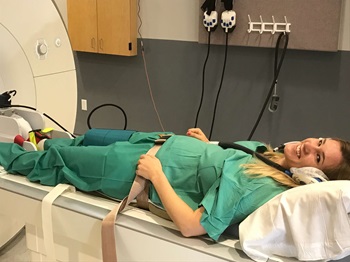
Mitochondria are the “power-house” for creating energy for cells and are involved in the metabolism of sugars, fats and proteins. Measuring mitochondrial function is thus important for the labs metabolic research. 31P-magnetic resonance spectroscopy (31P -MRS) is a tool we have widely used to non-invasively measure phosphorus metabolites in the muscle and liver. For this method, a person is placed in the MRI machine and their leg is put in an exercise device. They then exercise in the MRI machine, and through measuring phosphorus metabolites in the muscle and liver, we can quantitatively estimate mitochondrial function in vivo.
Another method used in conjunction with our collaborator Jane Reusch is to measure mitochondrial function by measuring mitochondrial respiration in pieces of muscle or fat that have been removed through a biopsy procedure through Oroboros from isolated mitochondria.
Icons provided by www.FreePik.com.