

3 Qs for QI
An Interview with Dr. Jillian Cotter
Jul 2, 2026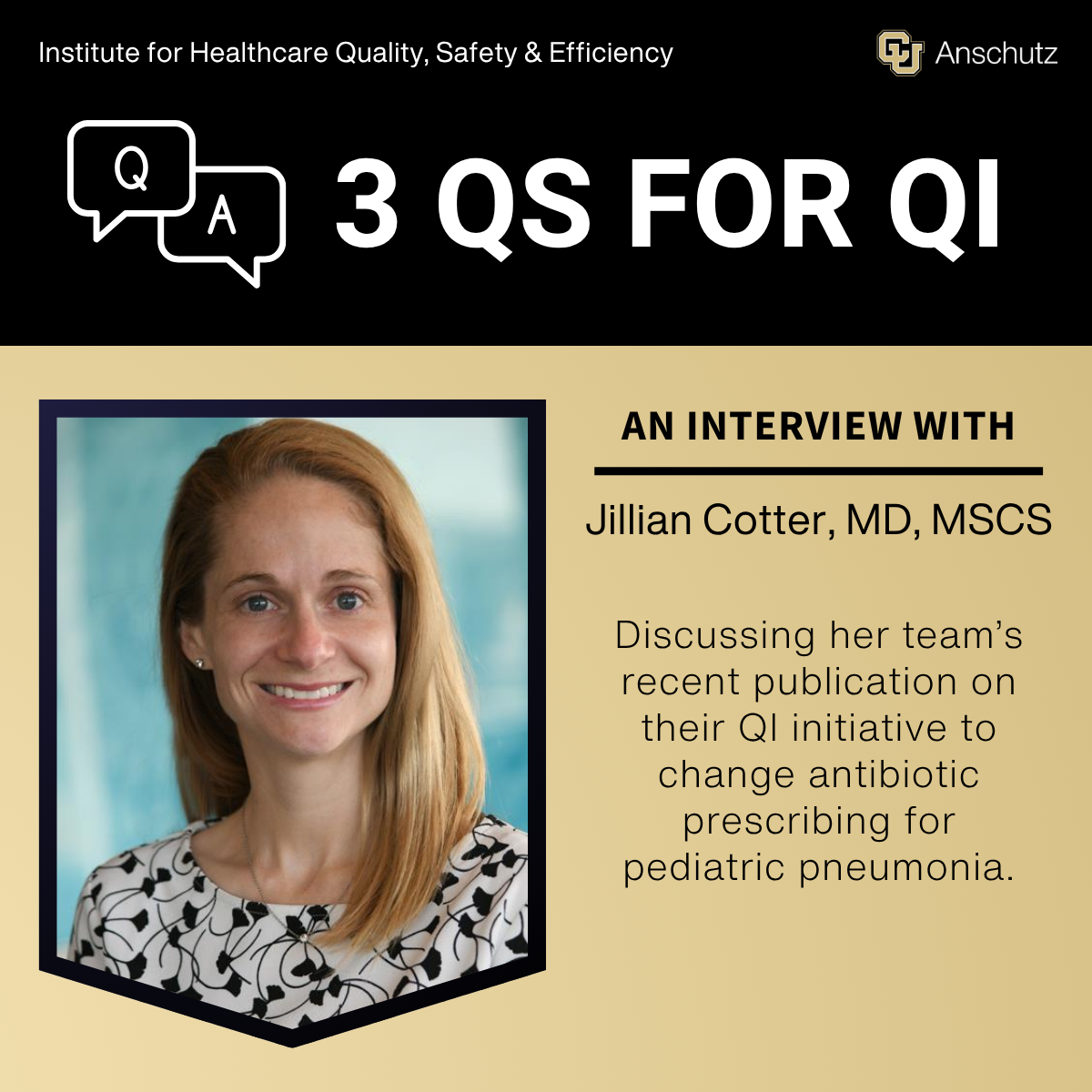
Pneumonia is one of the most common pediatric diagnoses and a leading driver of antibiotic use in ambulatory and acute care settings. Despite clear national guidelines supporting narrow-spectrum antibiotics and growing evidence favoring shorter treatment durations, changing prescribing practices for such a high-volume condition has proved challenging. In a recent study published in Annals of Emergency Medicine, IHQSE faculty and colleagues evaluated a quality improvement initiative that combined an EHR-based clinical decision support tool (a preconfigured order set) with an integrated clinical pathway across multiple emergency departments and urgent care settings. The intervention increased guideline-concordant amoxicillin use, reduced azithromycin prescribing, and substantially increased 5-day treatment durations—without increasing revisits or hospitalizations—demonstrating a scalable approach to delivering evidence-based, high-value care.
1. What was your approach to this project?
This project was a large-scale, multi-site quality improvement initiative conducted across four emergency departments and five urgent care centers within the Children’s Hospital Colorado health system. Our goal was to improve adherence to national guidelines recommending narrow-spectrum antibiotics (i.e., amoxicillin), avoidance of empiric azithromycin, and shorter treatment durations for uncomplicated pneumonia.
We implemented a two-part EHR-based intervention: first, a clinical decision support tool in the form of an order set that preselected 5-day antibiotic durations, and second, a revised clinical pathway embedded directly into the EHR to guide real-time decision-making. A key component of our approach was ensuring both the pathway and order set were integrated into clinician workflow rather than existing as static references.
The pathway was developed with broad multidisciplinary input, including emergency medicine, hospital medicine, pharmacy, and antimicrobial stewardship experts. We paired implementation with targeted education and dissemination efforts to promote uptake. Using statistical process control methods, we evaluated prescribing patterns over time and were able to distinguish the relative impact of each intervention—finding that the integrated clinical pathway, rather than the order set alone, was the primary driver of change.
2. Why is this work important?
Despite longstanding national guidelines, broad-spectrum antibiotics and prolonged treatment durations remain common in pediatric pneumonia, exposing children to unnecessary risks such as adverse drug events and antimicrobial resistance. Emerging evidence supports shorter, 5-day courses of narrow-spectrum therapy, but translating this evidence into routine clinical practice has been particularly challenging in fast-paced environments like emergency departments and urgent care.
This work is important because it demonstrates a practical, scalable strategy to close that evidence-to-practice gap. By embedding both an evidence-based clinical pathway and an EHR-based clinical decision support tool (order set) directly into clinician workflow, we were able to improve already strong baseline prescribing practices and further align care with current recommendations. Importantly, these improvements were achieved without increasing revisits or hospitalizations, reinforcing the safety of shorter, guideline-concordant therapy.
The study highlights how thoughtfully designed EHR-based tools can reduce low-value care, standardize practice, and promote high-quality, evidence-based treatment across diverse clinical settings.
3. How do you think this will impact healthcare?
This study provides a scalable model for implementing evidence-based care through EHR-integrated clinical pathways supported by clinical decision support tools such as order sets. As healthcare systems increasingly rely on digital infrastructure, embedding these tools directly into clinician workflows offers a powerful mechanism to accelerate adoption of best practices. Our findings suggest that integrated pathways—when concise, user-centered, and aligned with current evidence—can meaningfully influence prescribing behavior even in high-throughput, complex care environments.
More broadly, this work has important implications for antimicrobial stewardship. Reducing unnecessary broad-spectrum antibiotic use and limiting treatment duration are critical strategies to combat antimicrobial resistance and minimize patient harm. By demonstrating that these goals can be achieved without compromising clinical outcomes, this study supports wider adoption of similar EHR-based interventions across health systems.
Finally, this approach can extend to inpatient pneumonia care and to other common conditions where gaps between evidence and practice persist. Integrating clinical pathways and clinical decision support into the EHR, combined with multidisciplinary collaboration and local adaptation, represents a sustainable strategy to improve care quality, enhance patient safety, and deliver higher-value healthcare at scale.