109 publications in 2025


109 publications in 2025
26 Operative Neurosurgery Faculty
More than 5,000 OR cases per year
For many, 2020 is remembered as the year of the COVID-19 pandemic. For Steve Fitzgerald, it is the year he was diagnosed with kidney cancer.
That January, he underwent treatment and surgery to remove a third of his kidney. Four years after his initial diagnosis and treatment, the aggressive cancer metastasized in the nodes around the lungs and bones, requiring medication prescribed by his radiation oncologist to treat the area.
“The medication helped, but it seemed to be difficult to control the cancer in my bones,” Fitzgerald says. “It spread to my spine.”
Because of the cancer progression in the spine, Fitzgerald could not undergo a second round of radiation treatment. The case was complex, so his radiation oncologist, Rebekah Maymani, MD, at Longs Peak Medical Center in Longmont, Colorado, turned to a University of Colorado Anschutz School of Medicine multidisciplinary spine tumor board meeting to discuss an effective treatment plan for the spine.
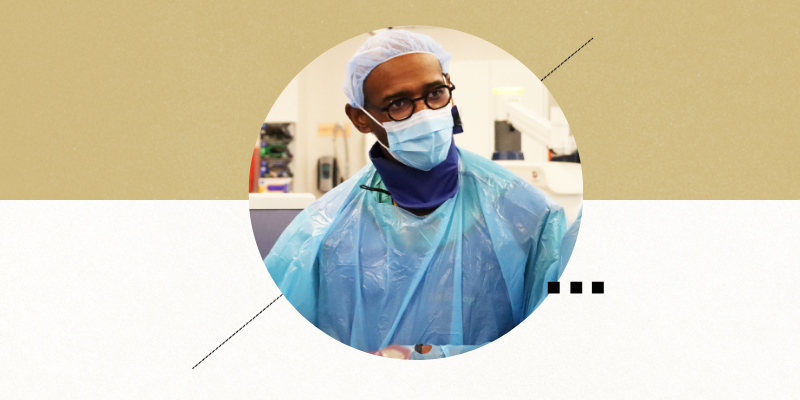
One of the members of the multidisciplinary spine tumor board is Director of Spine Oncology John Berry-Candelario, MD, associate professor of neurosurgery at CU Anschutz.
“His cancer was well-controlled except for the spine-related issue, and our multidisciplinary team thought it would be appropriate to be aggressive in our treatment plan for him,” says Berry-Candelario, who expedited the date of Fitzgerald’s surgery due to worsening symptoms.
Most patients with spine metastases are treated with what Berry-Candelario calls “separation surgery” where a patient undergoes a resection surgery to remove part of the tumor causing neurological symptoms or pressure on the spinal cord. Radiation then treats the remaining cancer in the spinal column.
“The surgeon’s role is to make sure that the patient does not have any structural or neurological problems so radiation can then do its job,” Berry-Candelario says.
Metastatic spine tumors are cancerous growths that develop when cancer spreads, or metastasizes, from another part of the body to the spine. Spinal metastases are the most common tumors of the spine. It is estimated that 20-25% of patients with metastatic cancers develop spine tumors. Like Fitzgerald’s case, spinal metastases are more common in the thoracic region.
Fitzgerald’s cancer diagnosis is renal cell carcinoma, the most common type of kidney cancer. Metastases in the bones occurs in about half of patients with renal cell carcinoma, and of these, 15% occur in the spine.
A multidisciplinary spine tumor approach coordinates care across neurosurgery, oncology, radiation, and radiology to manage complex spine cases. The spine tumor team on the CU Anschutz campus also utilizes the expertise of physical medicine and rehabilitation to manage pain and to help patients improve strength and range of motion after surgery.
A multidisciplinary approach is the standard of care for patients with metastatic cancers.
“Multidisciplinary tumor boards serve as a rubric to bring together subject matter experts to discuss and scale the optimal treatment plans for our most complicated patients,” Berry-Candelario says. “The team I work with at CU Anschutz embodies this expertise and also carries the responsibility to always search beyond what is known to what can be.”
At Fitzgerald’s first consultation appointment, he met with Lawrence Cloutier, PA-C, instructor of neurosurgery, who explained to him that the C6 vertebra was beyond radiation treatment and would need to be removed surgically. The C6 vertebra acts as a crucial weight-bearing pillar and facilitates neck movement. During the appointment, Cloutier explained that a cervical cage would be implanted to support the neck.
“Lawrence seemed real down to earth, like he could be your best friend,” Fitzgerald recalls. “He was a really nice guy and told me straight out what was going to happen.”
Fitzgerald also felt reassured during his first meeting with Berry-Candelario. “Right away I had a lot of confidence in Dr. Berry-Candelario,” Fitzgerald says. “He was very confident and it gave me confidence in him.”
He was also impressed by Cloutier and Berry-Candelario taking the time to explain the procedure and what to expect during recovery.
“They told me exactly what was going to happen and how,” he says. “There were no surprises. I think that is very important. Being up front with the patient is key.”
Leading up to his surgery, Fitzgerald experienced a gradual increase of weakness in his neck that required the support of a soft collar. The discomfort in his neck also increased to a sharp pain.
On January 22, 2026, six years after his kidney surgery, Fitzgerald went in for his spine surgery, which was performed by Berry-Candelario and CU Anschutz orthopedic surgeon CJ Kleck, MD.
Berry-Candelario and Kleck performed a C6 corpectomy to remove the vertebral body with the cancer, then placed a carbon fiber implant — a relatively new treatment modality — in its place.
Most medical implants are made from titanium, but this causes unique challenges for patients with cancer. Metal implants interfere with MRI imaging, making it difficult for neurosurgeons and oncologists to check the area after treatment. The metal also interferes with radiation treatments. Carbon fiber implants are becoming more commonplace for cancer patients because it can survive radiation and mechanical stress and does not interfere with MRI.
After the carbon fiber implant was placed, a plate was implanted extending from the C5 vertebral to the C7 vertebral to stabilize the neck and keep the implant from moving.
“CJ is a master surgeon and together we formulated a plan that we thought would provide the best and most durable outcome for Mr. Fitzgerald,” Berry-Candelario says. “Ultimately, it went smoothly and the patient did well.”
Fitzgerald says he experienced some soreness in his throat immediately after the surgery, but his care team prepared him for that.
After a visit from physical therapy the following morning, he was discharged to go home and told to wear a hard collar for two months along with physical therapy to strengthen his neck. He then spent another month in a soft brace.
“There was a little bit of pain after surgery, but as long as I held my neck in a stationary position and wore the hard collar, I was okay,” Fitzgerald says.
Following his surgery, Fitzgerald underwent radiation treatments to the surgical area at Longs Peak Medical Center under the direction of Maymani, who also manages his radiation therapy to treat the cancer in other areas of his body.
Because of the quick action of his radiation oncologist and the collaboration of the CU Anschutz spine tumor board, the cancer in Fitzgerald's spine is now stable and shows no active progression.
“Currently, the area of disease we treated is in surveillance mode, and his tumor markers and systemic imaging suggests that he is recovering well,” Berry-Candelario says. “We will continue to monitor his progress along with the rest of his team.”
Now, Fitzgerald says he feels ahead of where he thought he would be at this point in his recovery.
“Lawrence and Dr. Berry-Candelario were excellent and everything they said was right on target,” he says. “I couldn’t have asked for a better team.”
For many, 2020 is remembered as the year of the COVID-19 pandemic. For Steve Fitzgerald, it is the year he was diagnosed with kidney cancer.
That January, he underwent treatment and surgery to remove a third of his kidney. Four years after his initial diagnosis and treatment, the aggressive cancer metastasized in the nodes around the lungs and bones, requiring medication prescribed by his radiation oncologist to treat the area.
“The medication helped, but it seemed to be difficult to control the cancer in my bones,” Fitzgerald says. “It spread to my spine.”
Because of the cancer progression in the spine, Fitzgerald could not undergo a second round of radiation treatment. The case was complex, so his radiation oncologist, Rebekah Maymani, MD, at Longs Peak Medical Center in Longmont, Colorado, turned to a University of Colorado Anschutz School of Medicine multidisciplinary spine tumor board meeting to discuss an effective treatment plan for the spine.
One of the members of the multidisciplinary spine tumor board is Director of Spine Oncology John Berry-Candelario, MD, associate professor of neurosurgery at CU Anschutz.
“His cancer was well-controlled except for the spine-related issue, and our multidisciplinary team thought it would be appropriate to be aggressive in our treatment plan for him,” says Berry-Candelario, who expedited the date of Fitzgerald’s surgery due to worsening symptoms.
Most patients with spine metastases are treated with what Berry-Candelario calls “separation surgery” where a patient undergoes a resection surgery to remove part of the tumor causing neurological symptoms or pressure on the spinal cord. Radiation then treats the remaining cancer in the spinal column.
“The surgeon’s role is to make sure that the patient does not have any structural or neurological problems so radiation can then do its job,” Berry-Candelario says.
Metastatic spine tumors are cancerous growths that develop when cancer spreads, or metastasizes, from another part of the body to the spine. Spinal metastases are the most common tumors of the spine. It is estimated that 20-25% of patients with metastatic cancers develop spine tumors. Like Fitzgerald’s case, spinal metastases are more common in the thoracic region.
Fitzgerald’s cancer diagnosis is renal cell carcinoma, the most common type of kidney cancer. Metastases in the bones occurs in about half of patients with renal cell carcinoma, and of these, 15% occur in the spine.
A multidisciplinary spine tumor approach coordinates care across neurosurgery, oncology, radiation, and radiology to manage complex spine cases. The spine tumor team on the CU Anschutz campus also utilizes the expertise of physical medicine and rehabilitation to manage pain and to help patients improve strength and range of motion after surgery.
A multidisciplinary approach is the standard of care for patients with metastatic cancers.
“Multidisciplinary tumor boards serve as a rubric to bring together subject matter experts to discuss and scale the optimal treatment plans for our most complicated patients,” Berry-Candelario says. “The team I work with at CU Anschutz embodies this expertise and also carries the responsibility to always search beyond what is known to what can be.”
At Fitzgerald’s first consultation appointment, he met with Lawrence Cloutier, PA-C, instructor of neurosurgery, who explained to him that the C6 vertebra was beyond radiation treatment and would need to be removed surgically. The C6 vertebra acts as a crucial weight-bearing pillar and facilitates neck movement. During the appointment, Cloutier explained that a cervical cage would be implanted to support the neck.
“Lawrence seemed real down to earth, like he could be your best friend,” Fitzgerald recalls. “He was a really nice guy and told me straight out what was going to happen.”
Fitzgerald also felt reassured during his first meeting with Berry-Candelario. “Right away I had a lot of confidence in Dr. Berry-Candelario,” Fitzgerald says. “He was very confident and it gave me confidence in him.”
He was also impressed by Cloutier and Berry-Candelario taking the time to explain the procedure and what to expect during recovery.
“They told me exactly what was going to happen and how,” he says. “There were no surprises. I think that is very important. Being up front with the patient is key.”
Leading up to his surgery, Fitzgerald experienced a gradual increase of weakness in his neck that required the support of a soft collar. The discomfort in his neck also increased to a sharp pain.
On January 22, 2026, six years after his kidney surgery, Fitzgerald went in for his spine surgery, which was performed by Berry-Candelario and CU Anschutz orthopedic surgeon CJ Kleck, MD.
Berry-Candelario and Kleck performed a C6 corpectomy to remove the vertebral body with the cancer, then placed a carbon fiber implant — a relatively new treatment modality — in its place.
Most medical implants are made from titanium, but this causes unique challenges for patients with cancer. Metal implants interfere with MRI imaging, making it difficult for neurosurgeons and oncologists to check the area after treatment. The metal also interferes with radiation treatments. Carbon fiber implants are becoming more commonplace for cancer patients because it can survive radiation and mechanical stress and does not interfere with MRI.
After the carbon fiber implant was placed, a plate was implanted extending from the C5 vertebral to the C7 vertebral to stabilize the neck and keep the implant from moving.
“CJ is a master surgeon and together we formulated a plan that we thought would provide the best and most durable outcome for Mr. Fitzgerald,” Berry-Candelario says. “Ultimately, it went smoothly and the patient did well.”
Fitzgerald says he experienced some soreness in his throat immediately after the surgery, but his care team prepared him for that.
After a visit from physical therapy the following morning, he was discharged to go home and told to wear a hard collar for two months along with physical therapy to strengthen his neck. He then spent another month in a soft brace.
“There was a little bit of pain after surgery, but as long as I held my neck in a stationary position and wore the hard collar, I was okay,” Fitzgerald says.
Following his surgery, Fitzgerald underwent radiation treatments to the surgical area at Longs Peak Medical Center under the direction of Maymani, who also manages his radiation therapy to treat the cancer in other areas of his body.
Because of the quick action of his radiation oncologist and the collaboration of the CU Anschutz spine tumor board, the cancer in Fitzgerald's spine is now stable and shows no active progression.
“Currently, the area of disease we treated is in surveillance mode, and his tumor markers and systemic imaging suggests that he is recovering well,” Berry-Candelario says. “We will continue to monitor his progress along with the rest of his team.”
Now, Fitzgerald says he feels ahead of where he thought he would be at this point in his recovery.
“Lawrence and Dr. Berry-Candelario were excellent and everything they said was right on target,” he says. “I couldn’t have asked for a better team.”