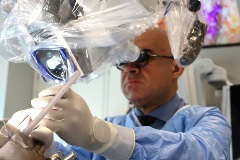
109 publications in 2025


109 publications in 2025
26 Operative Neurosurgery Faculty
More than 5,000 OR cases per year
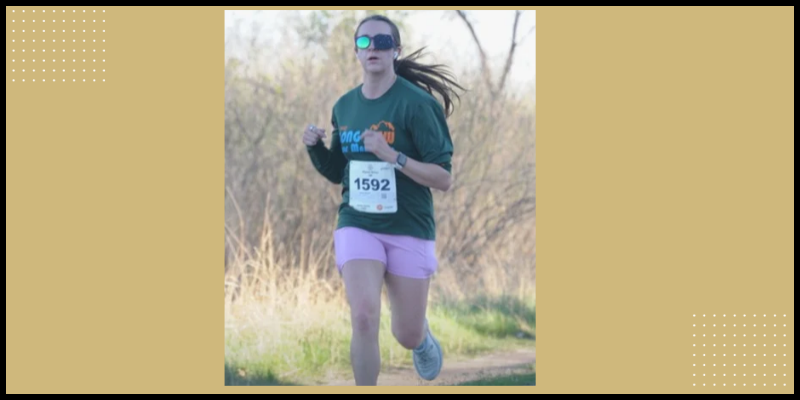
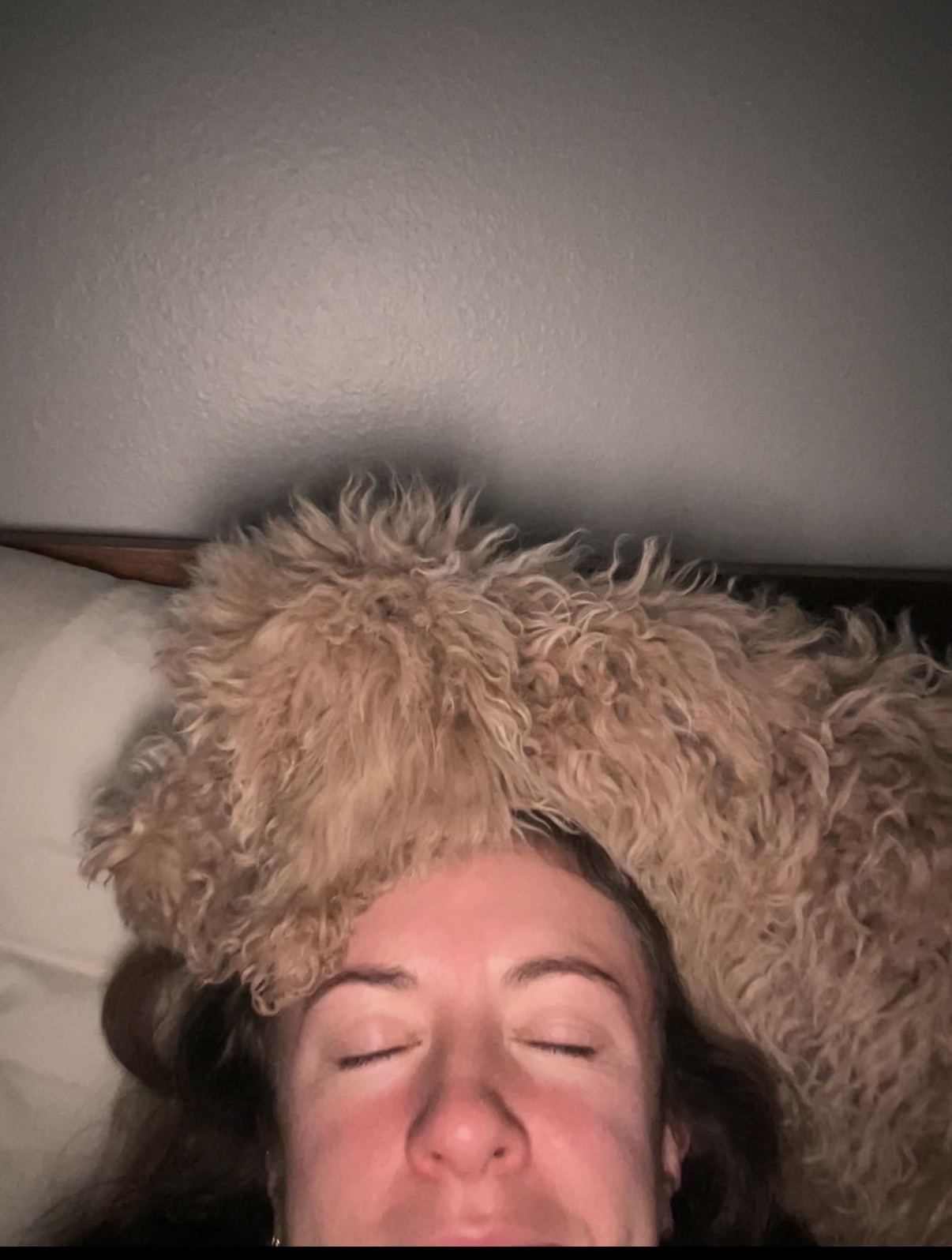
Emily Delzer, an active Coloradan, marathoner, and health care provider, loves her dog Benny, a poodle that sleeps in her bed every night. In 2024, around the same time Delzer began experiencing an “ice pick sensation” behind her left eye, she started waking up to Benny lying on top of her head across her pillow.
She attributed migraines, dizziness, and a disruption to her menstrual cycle to her rigorous marathon training. But in 2025, Delzer noticed that her left eyelid had started to droop. That October, she finally went in for an MRI in hopes of pinpointing the source of her symptoms.
“During the appointment, I noticed the MRI tech’s demeanor change,” Delzer says. “I thought something wasn’t right.”
Later that day, while lacing up her running shoes, she received a call from her ENT physician — Delzer learned she had a large mass at the base of her skull. The diagnosis led her to skull base neurosurgeon Samy Youssef, MD, PhD, professor of neurosurgery at the University of Colorado Anschutz School of Medicine.
During the initial call with her MRI results, Delzer recalls putting the phone on speaker so her now-fiancé could also
hear. Both were shocked by the results, but even amid the grim news Delzer recalls feeling relieved to finally have an explanation for her symptoms.
“At first I was in shock,” she says. “Then I thought, ‘What is the next step? What does this mean? What do we do?’”
Not long after that call, Delzer was referred to Youssef, and from the introductory handshake on the CU Anschutz campus, Delzer felt confident choosing Youssef as her surgeon.
“You can feel how competent he is when he is explaining the MRI and every image,” Delzer says. “He answered all our questions. No pun intended, it was a no-brainer.”
Youssef suspected that the mass was a chondrosarcoma, a rare type of bone cancer that originates in cartilage cells. Chondrosarcoma accounts for less than 1% of skull base tumors, so a biopsy of the brain tumor tissue was needed to confirm the tumor’s biomarkers.
“As a skull base surgeon that has been dealing with these tumors for over three decades, I can recognize chondrosarcomas with reasonable certainty based on radiographic features on MRI and CT scans,” Youssef says.
In addition to being a rare type of tumor, the location added another challenge. “Her tumor was in the cavernous sinus wrapped around the carotid artery and cranial nerves mostly controlling the eye movements,” Youssef says. “Another level of complexity is the tumor being calcified, unlike the majority of these tumors.”
Delzer says Youssef’s advanced practice provider, Helen French, DMSc, PA-C, met with her for over an hour to discuss the first surgery and answer all her questions. The extra time helped her feel calm going into the procedure.
Youssef decided on a staged surgery involving two lesser invasive approaches due to the complexity and extensive nature of the tumor. During stage 1, Youssef used an endoscopic endonasal transcavernous approach to remove the part of the tumor that was medial to the carotid artery and nerves. This surgical approach involves going through the nose and sinuses to access the tumor.
After the surgery, the pathology report confirmed her diagnosis — a grade 1 chondrosarcoma. Delzer, her partner, and her mother were relieved to hear the low-grade diagnosis.
On New Year’s Eve, Delzer and her partner eloped with Benny as their witness. On Jan. 8, Delzer returned to CU Anschutz for stage 2 — an open craniotomy to remove the rest of the tumor located on the other side of the carotid artery.
The day before the surgery, Delzer recalls watching the Taylor Swift Era’s Tour documentary. She was excited to hear that the current skull base fellow had attended the concert. “One of the nurses had all the Taylor Swift album stickers on her badge,” Delzer says. She was also assigned to room 13, a seemingly good omen given that 13 is famously Taylor Swift’s lucky number.
Before surgery, Delzer experienced double vision from partial third nerve palsy. The surgery wasn’t able to improve that symptom, and when Delzer woke up from surgery, she could not open her left eye or move her left eyeball. This was a result of the location of the tumor. By eight weeks post-op, her eyelid could fully open, but she was unable to move her eye.
Three months after her surgery and navigating her vision impairment, Delzer went in for a routine follow-up appointment and MRI scan. This time when she met with Youssef, he told her the tumor had returned.
“Dr. Youssef told me they saw some growth on the MRI and they needed to hit it with radiation,” Delzer says. “This was low-grade. It was not supposed to grow in three months.”
Delzer was referred to meet with neuro radiation oncologist, Timothy Waxweiler, MD, associate professor at CU Anschutz to discuss radiation treatment.
After evaluating the location of the tumor, Waxweiler recommended that she needed proton radiation therapy, a treatment offered at only a select few locations in the country. This would mean that Delzer would have to travel to the Mayo Clinic in Phoenix for her 35 rounds of radiation.
“Most patients receive safe and effective radiation with modern photon radiation techniques and the role for protons remains unclear,” explains Waxweiler. “However, in specific circumstances, protons offer technical advantages in delivering higher doses of radiation while sparing nearby healthy tissue.”
Delzer’s chondrosarcoma required much higher doses of radiation. The tumor’s proximity to cognitive centers and the nerves carrying visual information from the eyes and back to the brain required the technical advantage of proton radiation therapy.
“For the same reason that Dr. Youssef must be very careful about how much surgery can be safely performed without risking injury to important blood vessels, we must be careful about how much radiation goes to normal structures near the tumor,” Waxweiler says.
Waxweiler is hopeful that this technology will one day be available on the CU Anschutz campus. He explains that proton therapy can be especially beneficial for certain patients, including children and young adults, a key reason why Children’s Hospital Colorado supports bringing the technology to campus.
This month, Delzer celebrates the one-year anniversary of her first MRI. She plans to transition back to work while meeting with ophthalmologists at CU Anschutz to see if anything else can be done for her left eye. Her vision is progressing slowly, and she is hopeful to explore ocular surgery options with the CU Anschutz ophthalmology team in
January.
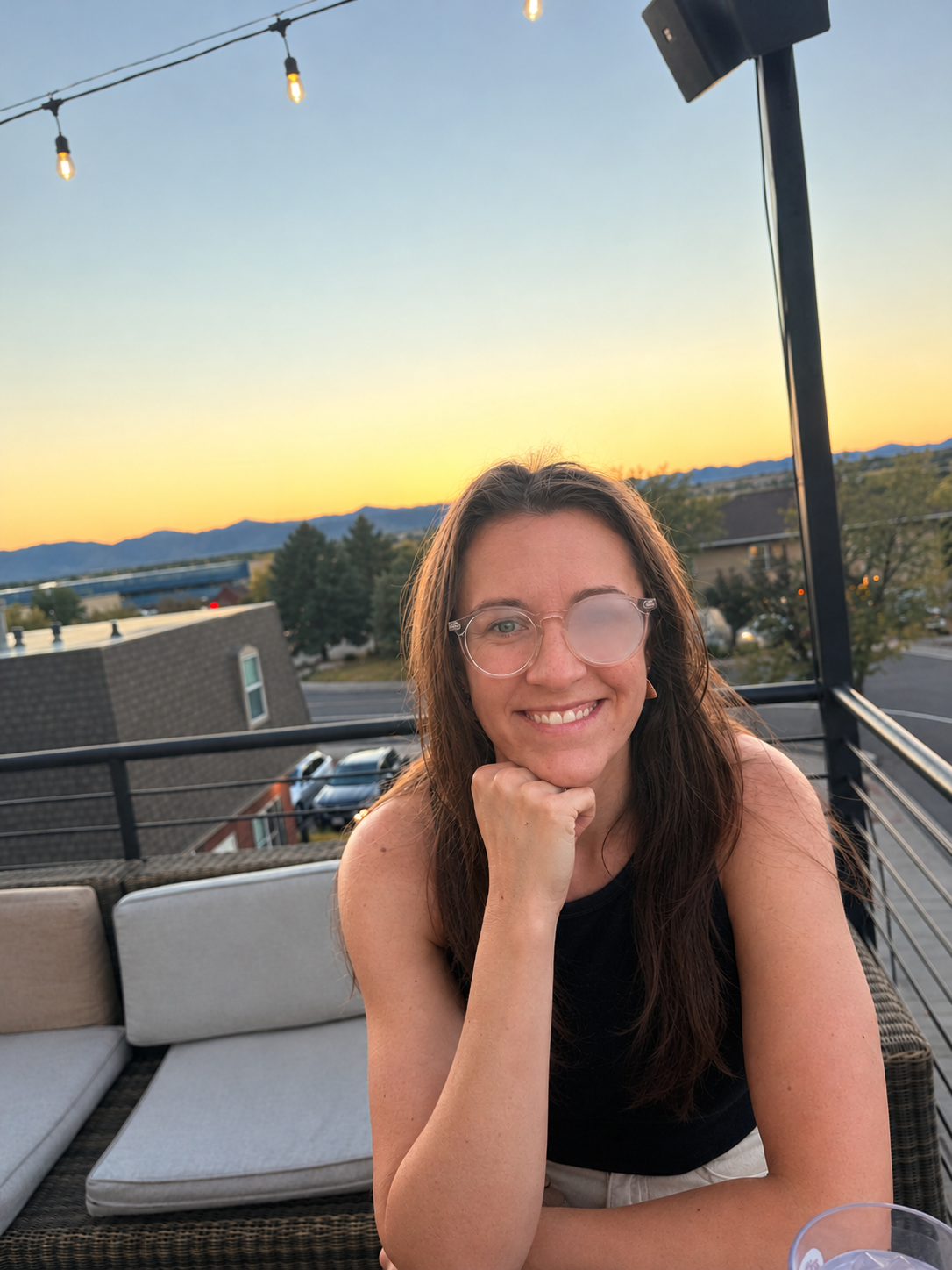
She currently wears special glasses with a foggy lens over her left eye instead of an eye patch. She says she is surprised by how many people ask her about her unique glasses daily, serving as a constant reminder of what she has overcome.
“My eye will never be perfect,” Delzer says. “But I want to stay positive and keep my head up.”
Despite the challenges with her left eye, Delzer says she is relieved to be done with surgery and radiation for the tumor that caused her so many symptoms. “I’m feeling pretty good and I am no longer having migraines or dizziness. I can still run and exercise which has been crucial for my recovery.”
An unexpected change after surgery and radiation treatment was in Benny. Delzer no longer wakes to him sleeping on her head. “He has stopped doing that since my surgery.”
Could Benny detect her tumor? While it’s difficult to know for sure, some academic publications say it is possible.
Delzer says she is relieved to be on the other side of treatment and remains hopeful for her future. “I feel so grateful that Youssef and his team were local. They have taken such great care of me.”
Emily Delzer, an active Coloradan, marathoner, and health care provider, loves her dog Benny, a poodle that sleeps in her bed every night. In 2024, around the same time Delzer began experiencing an “ice pick sensation” behind her left eye, she started waking up to Benny lying on top of her head across her pillow.
She attributed migraines, dizziness, and a disruption to her menstrual cycle to her rigorous marathon training. But in 2025, Delzer noticed that her left eyelid had started to droop. That October, she finally went in for an MRI in hopes of pinpointing the source of her symptoms.
“During the appointment, I noticed the MRI tech’s demeanor change,” Delzer says. “I thought something wasn’t right.”
Later that day, while lacing up her running shoes, she received a call from her ENT physician — Delzer learned she had a large mass at the base of her skull. The diagnosis led her to skull base neurosurgeon Samy Youssef, MD, PhD, professor of neurosurgery at the University of Colorado Anschutz School of Medicine.
During the initial call with her MRI results, Delzer recalls putting the phone on speaker so her now-fiancé could also
hear. Both were shocked by the results, but even amid the grim news Delzer recalls feeling relieved to finally have an explanation for her symptoms.
“At first I was in shock,” she says. “Then I thought, ‘What is the next step? What does this mean? What do we do?’”
Not long after that call, Delzer was referred to Youssef, and from the introductory handshake on the CU Anschutz campus, Delzer felt confident choosing Youssef as her surgeon.
“You can feel how competent he is when he is explaining the MRI and every image,” Delzer says. “He answered all our questions. No pun intended, it was a no-brainer.”
Youssef suspected that the mass was a chondrosarcoma, a rare type of bone cancer that originates in cartilage cells. Chondrosarcoma accounts for less than 1% of skull base tumors, so a biopsy of the brain tumor tissue was needed to confirm the tumor’s biomarkers.
“As a skull base surgeon that has been dealing with these tumors for over three decades, I can recognize chondrosarcomas with reasonable certainty based on radiographic features on MRI and CT scans,” Youssef says.
In addition to being a rare type of tumor, the location added another challenge. “Her tumor was in the cavernous sinus wrapped around the carotid artery and cranial nerves mostly controlling the eye movements,” Youssef says. “Another level of complexity is the tumor being calcified, unlike the majority of these tumors.”
Delzer says Youssef’s advanced practice provider, Helen French, DMSc, PA-C, met with her for over an hour to discuss the first surgery and answer all her questions. The extra time helped her feel calm going into the procedure.
Youssef decided on a staged surgery involving two lesser invasive approaches due to the complexity and extensive nature of the tumor. During stage 1, Youssef used an endoscopic endonasal transcavernous approach to remove the part of the tumor that was medial to the carotid artery and nerves. This surgical approach involves going through the nose and sinuses to access the tumor.
After the surgery, the pathology report confirmed her diagnosis — a grade 1 chondrosarcoma. Delzer, her partner, and her mother were relieved to hear the low-grade diagnosis.
On New Year’s Eve, Delzer and her partner eloped with Benny as their witness. On Jan. 8, Delzer returned to CU Anschutz for stage 2 — an open craniotomy to remove the rest of the tumor located on the other side of the carotid artery.
The day before the surgery, Delzer recalls watching the Taylor Swift Era’s Tour documentary. She was excited to hear that the current skull base fellow had attended the concert. “One of the nurses had all the Taylor Swift album stickers on her badge,” Delzer says. She was also assigned to room 13, a seemingly good omen given that 13 is famously Taylor Swift’s lucky number.
Before surgery, Delzer experienced double vision from partial third nerve palsy. The surgery wasn’t able to improve that symptom, and when Delzer woke up from surgery, she could not open her left eye or move her left eyeball. This was a result of the location of the tumor. By eight weeks post-op, her eyelid could fully open, but she was unable to move her eye.
Three months after her surgery and navigating her vision impairment, Delzer went in for a routine follow-up appointment and MRI scan. This time when she met with Youssef, he told her the tumor had returned.
“Dr. Youssef told me they saw some growth on the MRI and they needed to hit it with radiation,” Delzer says. “This was low-grade. It was not supposed to grow in three months.”
Delzer was referred to meet with neuro radiation oncologist, Timothy Waxweiler, MD, associate professor at CU Anschutz to discuss radiation treatment.
After evaluating the location of the tumor, Waxweiler recommended that she needed proton radiation therapy, a treatment offered at only a select few locations in the country. This would mean that Delzer would have to travel to the Mayo Clinic in Phoenix for her 35 rounds of radiation.
“Most patients receive safe and effective radiation with modern photon radiation techniques and the role for protons remains unclear,” explains Waxweiler. “However, in specific circumstances, protons offer technical advantages in delivering higher doses of radiation while sparing nearby healthy tissue.”
Delzer’s chondrosarcoma required much higher doses of radiation. The tumor’s proximity to cognitive centers and the nerves carrying visual information from the eyes and back to the brain required the technical advantage of proton radiation therapy.
“For the same reason that Dr. Youssef must be very careful about how much surgery can be safely performed without risking injury to important blood vessels, we must be careful about how much radiation goes to normal structures near the tumor,” Waxweiler says.
Waxweiler is hopeful that this technology will one day be available on the CU Anschutz campus. He explains that proton therapy can be especially beneficial for certain patients, including children and young adults, a key reason why Children’s Hospital Colorado supports bringing the technology to campus.
This month, Delzer celebrates the one-year anniversary of her first MRI. She plans to transition back to work while meeting with ophthalmologists at CU Anschutz to see if anything else can be done for her left eye. Her vision is progressing slowly, and she is hopeful to explore ocular surgery options with the CU Anschutz ophthalmology team in
January.
She currently wears special glasses with a foggy lens over her left eye instead of an eye patch. She says she is surprised by how many people ask her about her unique glasses daily, serving as a constant reminder of what she has overcome.
“My eye will never be perfect,” Delzer says. “But I want to stay positive and keep my head up.”
Despite the challenges with her left eye, Delzer says she is relieved to be done with surgery and radiation for the tumor that caused her so many symptoms. “I’m feeling pretty good and I am no longer having migraines or dizziness. I can still run and exercise which has been crucial for my recovery.”
An unexpected change after surgery and radiation treatment was in Benny. Delzer no longer wakes to him sleeping on her head. “He has stopped doing that since my surgery.”
Could Benny detect her tumor? While it’s difficult to know for sure, some academic publications say it is possible.
Delzer says she is relieved to be on the other side of treatment and remains hopeful for her future. “I feel so grateful that Youssef and his team were local. They have taken such great care of me.”