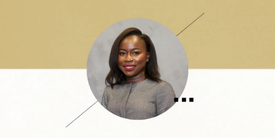
We received incredibly sad news last Wednesday morning that our talented and respected colleague, Jason Stoneback, MD , Professor of Orthopedics, had unexpectedly passed away.
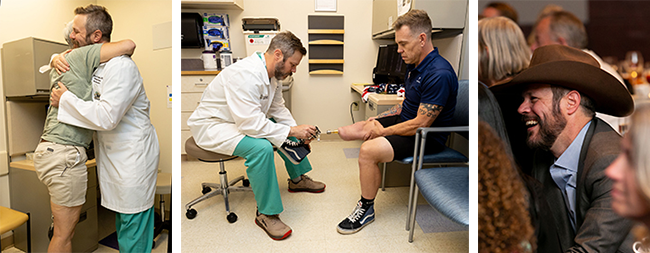
Dr. Stoneback was an exceptional physician, educator, and leader. In his roles as Executive Vice Chair of Clinical Affairs, Chief of Orthopedic Trauma and Fracture Surgery, and leader of the Limb Restoration Program, Dr. Stoneback transformed the lives of numerous patients through innovative and compassionate care. You can see his life-changing impact in this article and video about his work with the osseointegration surgery team and patient Paul Nozell.
Our Limb Restoration Program is a world leader and Dr. Stoneback was its champion. Last summer, our team delivered multiple scientific presentations at the 2025 International Society for Prosthetics and Orthotics World Congress in Stockholm, Sweden.
Dr. Stoneback’s impact extended far beyond the operating room. He was deeply respected by his patients, students, trainees, faculty, and staff for his extraordinary skill, unwavering compassion and commitment to advancing orthopedic care.
Dr. Stoneback worked through his undergraduate years at Middle Tennessee State University by competing in the National Intercollegiate Rodeo Association and by breaking and training horses. Dr. Stoneback grew up around horses so going into rodeo made sense. He started by riding bulls, then picked up saddle bronc to become an all-around cowboy. He loved the camaraderie and the friendliness of the competition.
In this article in the School of Medicine newsroom, Dr. Stoneback recalled the rodeo experience: “I won several buckles and competed in a lot of rodeos for five or six years. Then at some point I decided I wanted to go to medical school to be a surgeon. I tried to quit to keep myself healthy, but basically, for lack of a better term, I relapsed in my first year of medical school.”
Finally weaned from rodeo by his second year at University of Tennessee College of Medicine, Dr. Stoneback concentrated on medical school, then did his residency at University of Colorado Hospital. When he and his wife Gin Stoneback, who was Miss Rodeo Tennessee 2000, returned to Colorado after his fellowship at St. Louis University, they settled in Weld County where they could have horses.
We will share additional information in the coming days, including opportunities to honor Dr. Stoneback’s life and legacy, as it becomes available. Please keep Dr. Stoneback’s family and everyone in our orthopedics community in your thoughts during this incredibly difficult time.
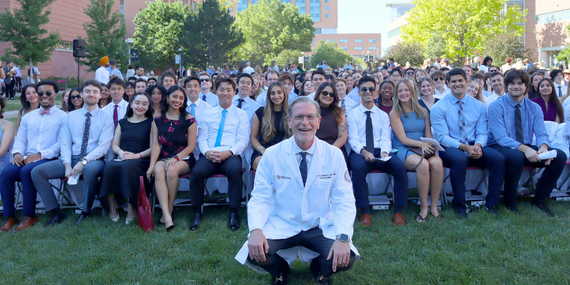
We welcomed our new medical students on July 24 at the matriculation ceremony where they received white coats, stethoscopes, lots of love from family and friends, and advice from classmates and school leaders.
What an outstanding — and very hot — event!
Check out the coverage on our Matriculation Ceremony – Class of 2030 webpage and in our Matriculation news article. The class of 2029 offered an anthology, One Year Later, of art and advice for the new students. Our Instagram post turned out to be one of our best-performing ever, with 1,300 likes, 76,000+ views, and generating more than 100 new followers.
A few details about the class of 2030: more than 10,440 people applied to the CU Anschutz School of Medicine for this academic year. Collectively, the selected 188 students represent 30 states, including 91 Colorado residents, and 19 different countries.
Our new class is 54% female and 46% male, with ages ranging from 20 years old to 41 years old. Twenty-five of our new students were born outside the United States and 90% were science majors as undergraduates.
Welcome to the Class of 2030! We’re excited you’re here.
A $12 million gift from the Zarpet Family Foundation will fuel polycystic kidney disease (PKD) research at the University of Colorado Anschutz PKD Center within the CU Anschutz School of Medicine’s Division of Renal Diseases and Hypertension.
“This gift will allow us to expand our research, clinical, and educational mission in PKD,” says PKD center director Michel Chonchol, MD, Professor of Medicine. “We want to develop new imaging biomarkers, launch phase II studies with potential new compounds, and look into repurposing drugs that have been approved by the FDA that potentially could work to halt PKD progression.”
PKD is a genetic disease that causes progressive decline in kidney function. It is the fourth most common cause of end-stage kidney disease, meaning patients need either chronic dialysis or a kidney transplant. There is one FDA-approved drug to treat the disease — Jynarque (tolvaptan) — but treatment often primarily involves managing comorbidities such as hypertension, urinary tract infections, and chronic lower back pain due to enlarged kidneys.
The Zarpet Family Foundation PKD funds will create a thorough, enduring structure of support for all facets of research and clinical management of this condition. The gift will spark innovative pilot programs, enhance operational capacity, ensure recruitment of top talent, expand data collection to strengthen applications for external funding, and drive consistent improvements across the continuum of care.
“One promising direction that we have identified is a metabolic reprogramming for PKD patients,” Dr. Chonchol says. “These patients tend to have a higher prevalence of obesity, and we have done a lot of work on dietary interventions, caloric restrictions, and weight loss to halt the progression of the disease.”
The School of Medicine Research Office has revamped one of our school’s funding mechanisms, Across the Finish Line, or AFL, to help address concerns about federal funding changes, including recent changes at the Agency for Healthcare Research and Quality.
AFL supports faculty whose research programs would benefit from targeted resources to generate preliminary data, adapt to changing funding landscapes, or navigate temporary funding gaps. The Research Office recently expanded the scope of the AFL funding mechanism to include the option of ‘Pivot’ funding to help faculty who have received termination notices for their research grants.
We recognize that a grant termination can be a significant disruption, both professionally and personally, and we want faculty navigating this to know that support is available. The AFL program is one concrete way our school is working to help affected faculty regain momentum.
Beginning July 1, AFL will operate through three distinct funding tracks, each addressing a specific barrier to research advancement. These funding tracks are:
Of note, scoring for AFL support nodes requires documentation from the faculty member’s department chair. The chair letter must specify protected time commitment, salary support commitment, space and/or resources, and mentorship or infrastructure support. Protected time may substitute for direct financial match.
This is an important way our school is supporting our faculty who need financial assistance to pivot their research in new directions. The next deadline for AFL applications is September 30, 2026. More information about the AFL program is available on the Research Office website.
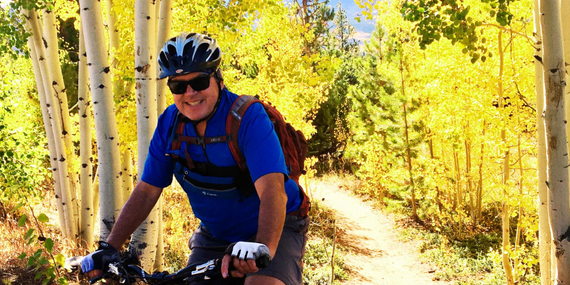
The tightness in his chest and difficulty breathing seemed like a heart attack to Peter Wessel, but the Colorado resident soon learned in October 2020 that he actually had a large tumor inside his chest.
The cancer was a sarcoma, a rare type of cancer that can form in various locations in the body, including the bones and the soft tissue that connects, supports, and surrounds other body structures.
Few options for treatment existed for Wessel, so he opted for an immunotherapy clinical trial at CU Anschutz led by Breelyn Wilky, MD, Associate Professor of Medical Oncology and Deputy Associate Director of Clinical Research at the CU Anschutz Cancer Center.
Five years after starting the treatments, Wessel counts himself lucky to have had access to the trial. “...it was a success for me,” he says.
Read More About the Clinical Trial
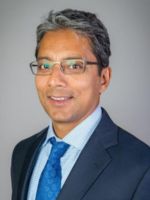
Sourav Poddar, MD , Associate Professor of Family Medicine, is the inaugural recipient of the 12th Man Award from the American Orthopaedic Society for Sports Medicine. The newly established award recognizes non-orthopedic professionals whose exceptional contributions have helped advance the field of Sports Medicine. In addition to receiving this award, Dr. Poddar delivered the American Medical Society for Sports Medicine Exchange Lecture during the meeting as the organization’s Publications Committee Chair and a member of its board of directors.
The Office of Faculty Affairs has announced the Faculty Officers for 2026–2027. They are:
Wednesday, August 12, 4:30 p.m.–7 p.m.
Elliman Conference Center, Anschutz Health Sciences Building
The Academy of Medical Educators will induct new members and host a reception. All faculty and guests of the honorees are welcome. Register to attend the AME Induction Ceremony.
Thursday, August 20, from 3–5 p.m.
Mt. Oxford, Children’s Hospital Colorado Conference Center
A Tale of Two Hearts is a film exploring the intersection of medicine, identity, and artistic expression featuring Jaime Belkind-Gerson, MD, MSc, Professor of Pediatrics. Dr. Belkind-Gerson is a pediatric gastroenterologist, researcher, and visual artist whose work bridges the gap between clinical precision and human emotion. A live Q&A with Dr. Belkind-Gerson will follow the screening.
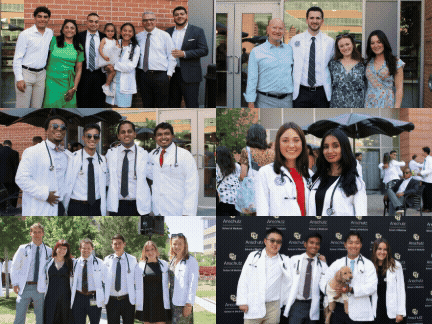
On Friday, July 24, we welcomed a new class of medical students with three gifts: a white coat, stethoscope, and gratitude journal. This tradition represents their new professional identity, the importance of wellness on their journey, and the impact they will make on future patients. View more photos from the event on LinkedIn.
Have a good week,
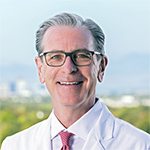
John H. Sampson, MD, PhD, MBA
Richard D. Krugman Endowed Chair
Vice Chancellor for Health Affairs
Dean, University of Colorado Anschutz School of Medicine
The Dean’s weekly message is an email news bulletin from John H. Sampson, MD, PhD, MBA, Dean of the CU Anschutz School of Medicine, that is distributed to inform CU Anschutz School of Medicine faculty members, staff, students and others about issues pertaining to the school’s mission of education, research, clinical care and community service.
Subscribe to the Dean's Message