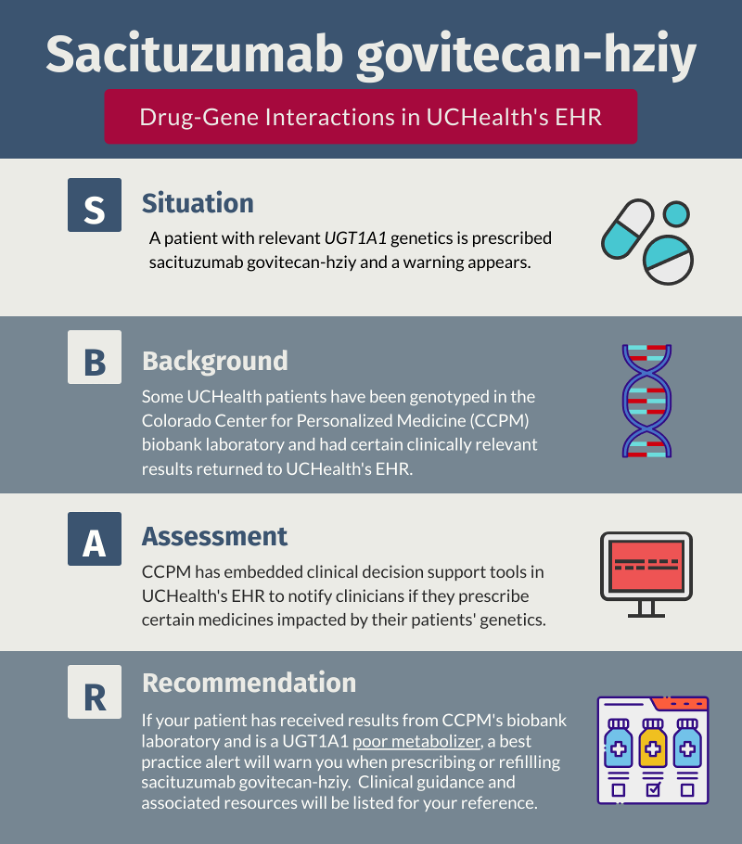
Click below to learn more about the use of UGT1A1 genetics in the prescribing of sacituzumab govitecan-hziy.
Sacituzumab govitecan-hziy is an antibody–drug conjugate that delivers the active cytotoxic agent, SN-38. SN-38 is then metabolized by a protein, UGT1A1, to its inactive form.
UGT1A1 is the gene that encodes the UGT1A1 liver enzyme. Genetic variation in UGT1A1 results in normal, intermediate, and poor metabolizer phenotypes. Of these, the poor metabolizer phenotype is associated with decreased UGT1A1 activity and an increased risk of drug toxicity with sacituzumab govitecan-hziy.
Patients who are UGT1A1 poor metabolizers have reduced metabolism of sacituzumab govitecan-hziy’s active metabolite, SN-38, leading to higher drug levels of the active metabolite. This may increase the risk of side effects and toxicity which may necessitate closer monitoring. The FDA has provided recommendations to monitor for adverse reactions and tolerance to treatment for UGT1A1 poor metabolizers being prescribed sacituzumab govitecan-hziy.
At UCHealth the use of pharmacogenetics when prescribing sacituzumab govitecan-hziy will occur in patients who meet the following conditions: 1) The patient is being seen in a clinic which is currently using pharmacogenetic testing as part of standard care (e.g., as part of the UCHealth Clinical Oncology PGx initiative). 2) Prescribed sacituzumab govitecan-hziy.
If you are a provider AND your patient is a UGT1A1 poor metabolizer, an inline medication warning will appear if you attempt to prescribe or refill sacituzumab govitecan-hziy in UCHealth's EHR. If the inline medication warning is visible, links to resources will be listed for your reference. There is patient education text available for UCHealth providers to use in discharge paperwork or the after visit summary (AVS).
Visit our Provider FAQs page here. For immediate questions, secure chat Groups: Pharmacogenomics Service in UCHealth's EHR.


 Request an edit to this webpage here.