

A rapid and rigorous test of an intervention working with patients, staff, settings, and conditions that are like those intended to use the intervention every day
Review the guidance organized by the elements below. Being clear on these details from the outset will limit future setbacks.
We recommend using the Prioritization Check-in and the worksheet to help teams gather and reconcile the information quickly and clearly.
Now that you have developed your intervention rapidly and with strong engagement, you need to test it- rapidly and rigorously using pragmatic research methods.
Pragmatic pilot trials test whether an intervention can work under real-world conditions using usual staff, settings, and systems/workflows. The guidance below contains 7 elements highlighting the most important design considerations and tradeoffs, organized to support clear decision-making without requiring that every element be addressed in every study. Using this Detailed Guidance will help you prioritize implementation elements and give you guidance to effectively design and test your pragmatic pilot trial.

[VIDEO COMING SOON]
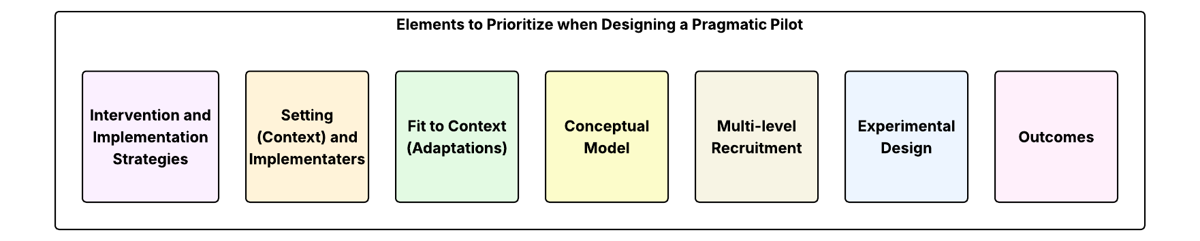
Pragmatic Trials Prioritization Check-In: which elements are most important to you?
CLICK HERE to complete the PRIORITIZATION CHECK-IN
The example here is longitudinal through the Pragmatic Trials Detailed Guidance to help you make connections to one use case example throughout.
A health system and patient partners co-developed a brief, plain-language decision aid to support shared decision-making about implantable defibrillators for patients with heart failure. The tool was designed quickly with clinician and patient input and integrated into routine cardiology visits. The team now plans a pragmatic pilot trial to test whether the intervention works under real-world clinic conditions using usual staff and workflows. The following examples show how the team applied pragmatic design principles across the study.
Intervention - define the problem: Clearly Define the Problem, cite supporting evidence for your intervention’s previous effectiveness, and describe its key features to assess its fit for addressing the health gap.
Intervention - streamline: Consider if there are components that might be removed or streamlined without losing effectiveness.
Identify which components of the intervention can be modified or simplified without losing effectiveness in a pragmatic setting.
Implementation strategies – review: We recommend reviewing previous studies through a rapid literature review or your own assessments to determine which strategy best fits your intervention in the context you are working in.
Implementations strategies – specify: Try to clearly specify the details of your strategy, including how you plan to implement the intervention, using strategy specification tools. Below are links to commonly used strategies and tools for specifying them.
Consider efficiency, burden, adaptability, and alignment with existing workflows (in the intervention delivery setting) – this helps plan ahead for sustainability. (see Implementation Strategies Detailed Guidance)
Impact Summary
Clearly outlining the intervention and implementation strategies will help you better align your project with the specific context in which it is intended to be used, ultimately improving outcomes, feasibility, adoption, and sustainability.
Tools and Resources
Why it Matters
Interventions that are developed or tested in highly controlled environments often do not translate well to routine practice because they fail to reflect the realities of the settings and people responsible for delivering
them. Context strongly influences feasibility, effectiveness, implementation success, and sustainability. Designing and testing interventions in real-world settings with the people who would normally deliver them helps ensure that results are relevant,
actionable, and more easily sustained over time.
At the same time, contexts are not static. Organizational priorities, workflows, staffing, resources, and patient needs change. Interventions that cannot adapt to these changes often fail
to sustain, even when they are initially successful. Building flexibility while maintaining core intervention components allows programs to remain effective and relevant across diverse settings and over time.
Example
A pilot is conducted in three routine cardiology clinics that vary in size and patient demographics. Usual clinic staff, including medical assistants and clinicians, deliver the intervention as part of standard visits, without adding research-specific
personnel or workflows.
During implementation, some clinics request a digital version of the decision aid for patient portals, while others prefer printed handouts. The team identifies the intervention's core components, key messages and visual risk communication, and allows flexibility in delivery format. Adaptations are documented along with the reasons for the changes and relevant contextual factors. This approach helps ensure that findings reflect real-world practice while supporting local fit and cross-site learning.
Action Steps
Select and Understand the Context
Assess Local Workflows and Readiness
Impact Summary
By designing for context, you can better understand how an intervention
performs across diverse settings and populations. Staff are more likely to support and continue programs that fit their workflows and local needs, and organizations are better positioned to sustain interventions as contexts evolve.
Tools
and Resources
Why it Matters
Models help teams align on goals, make design choices explicitly, and communicate decisions clearly to partners and funders. Some teams may choose to use an existing theory, model or framework (TMF) that they know
fits well with their project plan. Other teams may find it valuable to start with a simple logic model, add complexity and then decide on whether to use their own logic model or choose/adapt an existing TMF. Using a model, like a logic model or other
TMF, to clarify assumptions, pathways, and outcomes can help you decide upon outcomes and key intervention functions. Also, it may help you later to generalize your findings to other context with some potential adaptation. We do not suggest developing a new TMF for the field. There are many. Your logic model may suffice or adapting/combining existing TMFs should fit your needs.
Example
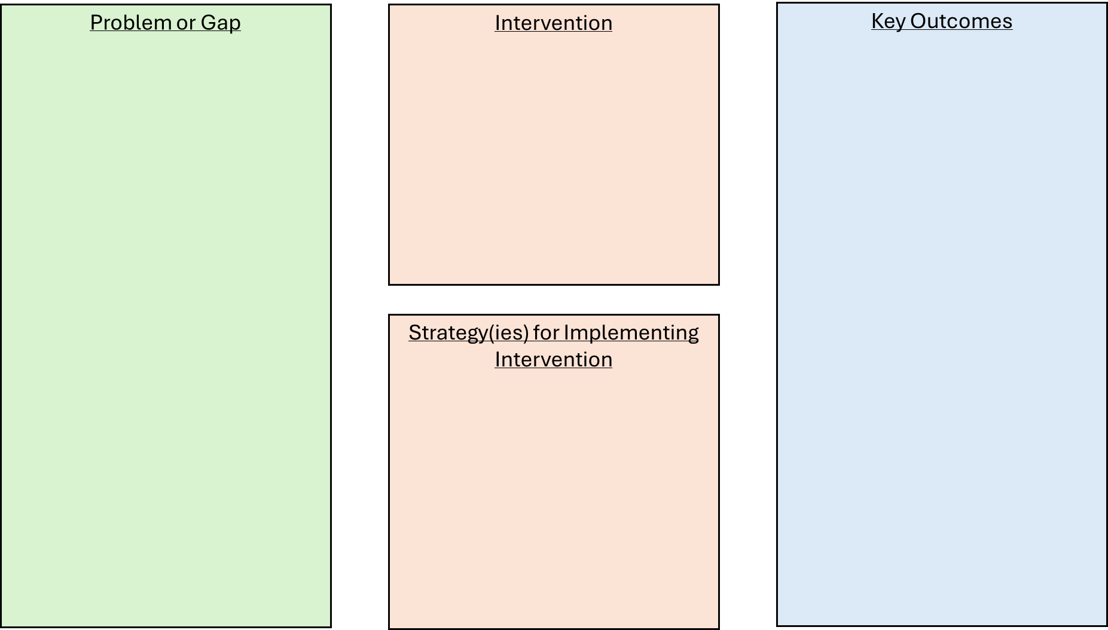
1. The team starts with a simple implementation logic model linking the decision aid, limited visit
time, staff delivery, and patient engagement. As the study evolves, they map this logic model to RE-AIM constructs to clarify outcomes and reporting. The model helps the team explain why uptake varies across clinics. It also guides outcome selection
and interpretation for partners and funders.
This more basic logic model template, in this case, sped up the project by quickly identifying and targeting the problem with pointed action:
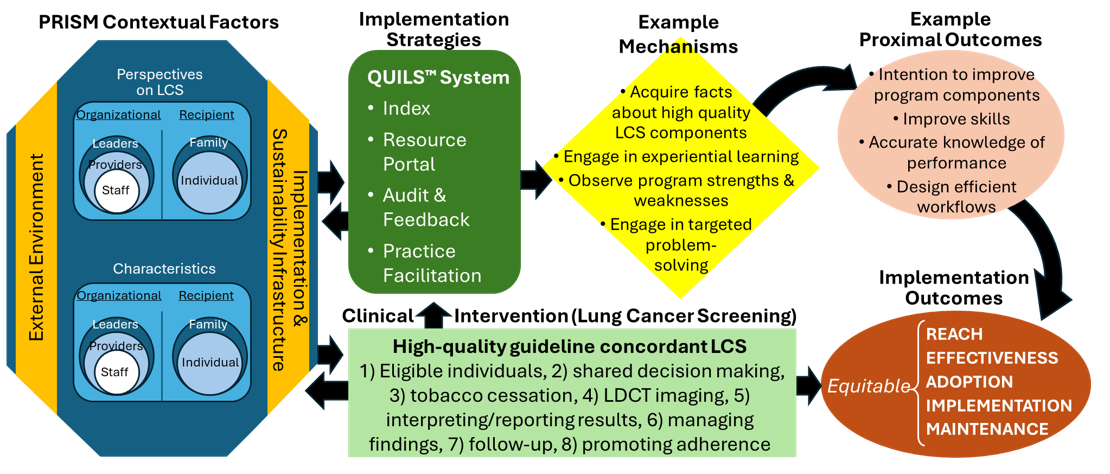
2. Below is an example of a more detailed logic model that may fit your needs without a more formal framework. Alternatively, the concepts in this logic model can be used to help you select a framework.
Actions Steps
Start simple. Use the simpler logic model and add complexity only if needed.
Consider the partners involved and develop logic models with appropriate complexity for them. You may need several versions ranging from simple to very complex.
For complex projects or if you want to submit implementation science papers or a grant, you very likely need a more formal framework such as CFIR, PRISM, EPIS or RE-AIM
Your initial logic model should be amended iteratively to fit your project needs and periodically as your project proceeds.
Use models to clarify outcomes, mechanisms, and assumptions.
Revise the model as the project evolves.
Impact Summary
Stronger alignment across the team and clearer justification for design and measurement choices
Tools and Resources
Why it Matters
Recruitment is the first step to ensuring a project that has strong reach and representation. Multi-level recruitment means considering all the steps including deciding what health systems clinicians, staff and patients to recruit, and how to do this in ways that maximize participation and representativeness of participants at these various levels. By strategically deciding who to include, recruiting and engaging participants, you are much more likely to reach the intended audiences and have a bigger impact.
Example
Clinics are recruited through existing health system leadership channels. Clinicians are invited during routine staff meetings, and patients are identified through the electronic health record. Eligible patients are both invited as part of pre-visit materials and approached during regular visits using standard clinic communication practices. This multi-level approach improves reach while minimizing burden.
Actions to Consider
Think about multiple levels. Which settings need to or can be involved? Who is involved from all levels from system leaders and delivery staff to patients and caregivers. Things may be constrained by your resources available and level of trial you are attempting to design.
Minimize exclusion criteria where possible (e.g., low-resource clinics; anyone having comorbid conditions) and remove barriers to participation (e.g., requiring lots of staff time or in person visits).
Consider using recruitment strategies that are already in place. Learn from who is already being reached and expand or modify as needed.
Identify who is not being reached and adjust strategies accordingly. Engaging partners can help enhance representation.
Meet participants and partners where they are. Select methods, with your partners, that allow you to track progress (See Engagement Tips). This will allow for future adaptations.
Impact Summary
Ending up with recruitment strategies that are broadly applicable, feasible, and sustainable in your partner settings.
Tools and Resources
What This Focuses on
Selecting a study design that balances speed and rigor with feasibility in real-world conditions. Your experimental design is the basis for evaluating the effects of your intervention and/or implementation
strategies. There are many designs to choose from, which depend on the questions you want to answer:
Why it Matters
Traditional, highly controlled, randomized designs may be impractical or unethical in routine care settings. Pragmatic pilots often require more flexible approaches
Example
The team selects a stepped-wedge
design, so all clinics eventually receive the decision aid. Clinics transition from control (no intervention) to the intervention at staggered time points based on operational readiness. This design balances rigor with feasibility and helps understand
replication (or lack of such) across settings. It also aligns with leadership priorities to avoid withholding a potentially beneficial tool.
Actions Steps
Consider Pragmatic Designs: such as cluster randomization, stepped wedge, time-series, or quasi-experimental approaches.
Optimize Standardization: Decide which elements must be standardized and which can vary.
Define Comparators: Ensure comparator conditions are meaningful to real-world decision-makers.
Impact Summary
Designs that produce credible, actionable evidence without disrupting care delivery.
Tools and Resources
Why it Matters
Measuring pragmatic outcomes that matter to patients, teams, and decision-makers in everyday practice increases the likelihood that findings are used, sustained, and scaled.
Pragmatic Measures*
| Required Criteria | Additional Criteria |
| Important to key partners- helps them address priority issues | Low probability of harm |
| Brief, burden is low to moderate | Address public health or quality of care goal(s) |
| Broadly applicable | Related to a theory or model |
| Sensitive to change- can show intervention effects | “Maps” to “gold standard” metric or measure |
| Actionable: key partners see it as feasible and helpful |
*Note- these criteria are adapted from Glasgow and Riley. There are also other pragmatic criteria (e.g., Stanick & Lewis et. al.) and we encourage you to think creatively about what best fits your project
Key Pragmatic Outcome Types
| Outcome Type | Definition | Example |
| A. Implementation Outcomes | Observable effects of integrating interventions, explaining contextual success or failure | reach, adoption, fidelity, cost, maintenance |
| B. Patient-centered Outcomes | To ensure that interventions are meaningful to patients and support personalized care, enhancing engagement and uptake by aligning with what patients value most | quality of life, goal alignment, experience of care |
| C. Clinical Effectiveness Outcomes | Evidence that interventions improve health under real-world care conditions | health status, symptoms, disease status |
| D. Mechanisms (Other) | Processes and contextual factors explaining how and why outcomes occur | approval workflows, existing resources |
Example
Implementation outcomes include reach, adoption by clinicians, time required to deliver the aid, adaptations made, costs of implementation, and sustainment (or intent to sustain or adapt at study end). Patient-centered outcomes
focus on perceived alignment with patients’ goals and satisfaction with the decision process. Clinical effectiveness outcomes assess decision quality and downstream treatment alignment as well as traditional biomedical outcomes. Mechanisms such
as workflow fit and increased confidence in addressing the problem are examined to explain variation in outcomes.
Actions Steps
Include both implementation and patient-centered outcomes in all pragmatic pilots.
Use brief, low-burden measures when possible.
Rely on routine data sources (e.g., EHRs) where feasible.
Use mixed methods to understand what worked, how, and why.
Impact Summary
Results that are actionable, generalizable, and useful for future implementation decisions.
7A. Implementation Outcomes
Example
A project team uses the RE-AIM framework to prioritize implementation outcomes in a study in the VA. Since the intervention is
mandatory, Adoption is irrelevant, and Cost reporting is unnecessary because the health system will cover expenses indefinitely. The team evaluates Reach and Representativeness, ongoing Effectiveness,
fidelity and adaptations to the Implementation plan, and long-term Maintenance. Findings show clinic staff did not implement with fidelity, requiring adaptations for successful implementation.
Actions Steps
Select an implementation framework (e.g., RE-AIM; PRISM; CFIR; EPIS; NPT – more on D&I Models Webtool and section on models above for help) and outcome measures that align with your study goals and context.
Measure feasibility or acceptability in planning, but actual reach, adoption and implementation during the trial.
Use mixed methods to capture both quantitative and qualitative insights into implementation processes.
Pragmatic Use of RE-AIM Implementation Outcomes
| RE-AIM Dimension | Key pragmatic questions to consider and answer |
| Reach (Individual level) | WHO is intended to benefit and who actually participates or is exposed to the intervention? (Participation rate and representativeness) |
| Effectiveness (Individual level) | WHAT is the most important benefits you are trying to achieve and what is the likelihood of negative outcomes? (Main and subgroup (equity) effects on multiple outcomes and unintended consequences) |
| Adoption (Setting and Staff levels) | WHERE is the program or policy applied and WHO applied it? (Beginning participation rate and representativeness of settings and staff) |
| Implementation (Setting and Staff levels) | 1-HOW consistently is the program or policy delivered, 2-HOW is it adapted, 3-HOW much will (did) it cost, and 4-WHY will the results come about? |
| Maintenance (Individual and Setting levels) | HOW LONG will it be sustained (Setting level); and how long are the results sustained (Individual level)? |
Most of the issues in the table above are straightforward, but there are a few issues related to collecting RE-AIM (and other implementation outcomes) that are often overlooked. See the table below for more information on these issues.
Potential Pitfalls when Collecting Implementation Outcomes and How to Address Them
| Often Overlooked | Actions to Address |
| Narrowly defined or undocumented reach or representativeness | Assessing Representativeness or similarity of those participating or benefitting compared to those who do not is important for all RE-AIM dimensions |
| Using single method approaches | Multiple and mixed methods are encouraged for all dimensions to understand what, how, and why your results come about. Think creatively- there are tons of other qualitative assessment methods besides focus groups; AI can increasingly help with evaluation. |
| Implementation is the most complex and multi-faceted RE-AIM dimension | It consists of three parts:
|
| Limited time to observe the long-term impact of your intervention or its continued delivery | Assess if it can continue to be delivered after completing the study, and if implementing clinics and staff are intending to do so if your study is not long enough to measure actual maintenance. |
Tools and Resources
Effectiveness Outcomes
In good pragmatic trials, effectiveness outcomes measure what matters to patients and decision-makers in everyday settings. There are 1) patient-centered effectiveness;
and 2) more traditional clinical effectiveness outcomes. You might also consider 3) mechanisms if you are interested in the theoretical reasons or processes through which results are obtained.
7B. Patient-Centered Outcomes
Example
A project included patient-centered outcomes on satisfaction with care and alignment of treatment with personal goals. Assessing what mattered most to the patients allowed the team to ensure optimal patient success
in the program.
Actions Steps
Use validated patient-reported outcome measures (PROMs) such as those recommended in the SPIRIT-PRO extension (Ref).
Engage patients and clinicians early to identify outcomes important to them.
Some examples include decisional regret/satisfaction, knowledge questions about the condition/intervention, value concordance, health outcomes
Include outcomes that are sensitive to change and actionable by care teams.
Tools and Resources
7C. Clinical Effectiveness Outcomes
What We Mean
These are traditional health outcomes such as symptom improvement, disease progression, hospitalization rates, or
mortality, assessed in real-world settings.
Example
A project focused on physical activity used a pragmatic trial to assess cardiovascular outcomes including improved resting heart rate and VO2 max scores. These markers
showed substantial improvement in a relatively short period of time, suggesting that the intervention was working as intended across diverse populations and settings.
Tools and Resources
7D. Mechanisms (Other)
Optional; primarily for research grants planning an NIH proposal or strong interest in theoretical issues
Example
An expanded logic model can illustrate how specific strategies
are expected to influence outcomes via underlying mechanisms. See the resources below on logic models that provide examples of comprehensive logic models that include mechanisms.
Realist analysis is a leading approach to studying mechanisms,
focusing on Context-Mechanism-Outcome (C-M-O) relationships. (See Pawson book reference below).
Realist analysis asks complex questions about timing, context, delivery, and population to uncover causal pathways. A realist approach attempts
to answer questions of the form:
“What intervention and implementation strategy functions produce what outcomes under what conditions for what populations in what contexts when delivered by what persons/modalities at what time frames,
and how to these results come about?”
Tools and Resources