

Understanding the resources required to implement, sustain, replicate, and scale programs or interventions. Costing and economic evaluations help decision-makers assess affordability, feasibility, value, and long-term sustainability.
Review the guidance organized by the elements below. Being clear on these details from the outset will make your efforts more successful.
We recommend using a tool to help guide your costing efforts and have created a worksheet to help teams gather and reconcile the information quickly and clearly.
Effective costing starts with clarity about the purpose of the analysis, the intended audience, the perspective being used, the costs that matterrelavent costs, and the resources available for data collection and analysis. Aligning these elements early improves decision-making and reduces confusion later.
Why It Matters
Decision-makers often need information about costs, affordability, sustainability, and value before adopting, funding, or expanding a program. Cost information can support decisions about implementation, replication, scale-up, and long-term sustainment.
An important question for your team to consider is: how formal of a cost analysis is needed to support future scale up, sustainability, and dissemination? Some projects have the resources and need for a more formal analysis, including an economist and aiming for high-level replicability. Other projects may have fewer resources and less need of replicability, and therefore look at a more informal costing analysis.
If you do not have the resources or need for a more formal cost analysis, we recommend at least holding a team meeting and going through the Costing Worksheet questions together to estimate the impact of cost on program implementation, success, and sustainment. We recommend focusing on the questions: (1) Given these time/burden estimates: how likely is it that settings like (those you want to adopt this program) can consistently deliver this program AND (2) given the resources and expertise required, how likely is it that participating settings would be able to continue the program after the active research/funding has completed?” If you cannot answer these questions definitively, then discuss how the intervention can be modified to make it more feasible and likely to be adopted and sustained.
Whether you conduct a formal or informal economic analysis, it is still important to think about the feasibility of how what you are proposing will fit with the reality of settings in which you want it to be adopted. See our Costing Guidebook page 18 for Table 5 explaining the levels of rigor, strengths and drawbacks to a variety of approaches.
Action Steps
Identify the decision you want to inform. Determine whether the analysis will support adoption, funding, sustainment, replication, and/or scale-up.
Define the intended audience. Consider whether the primary users will be organizational leaders, clinicians, patients, policymakers, or community partners.
Match the analysis to the research question. Decide whether implementation costing alone is sufficient or whether a more formal economic evaluation is needed.
Consider involving an economist, finance expert, or health services researcher early in project planning.
Example
A community organization considering whether to adopt a diabetes prevention program may only need an estimate of staffing and technology requirements. In contrast, a health system deciding whether to expand the program across multiple clinics may need information about return on investment, sustainability, and long-term budget impact to justify adoption. These goals require different approaches.
Impact Summary
A clear purpose keeps costing efforts focused and useful. Defining the Why behind costing aligns costing activities with project goals, produces information that is useful to decision-makers, and improves planning for sustainability and replication.
Tools and Resources
Why It Matters
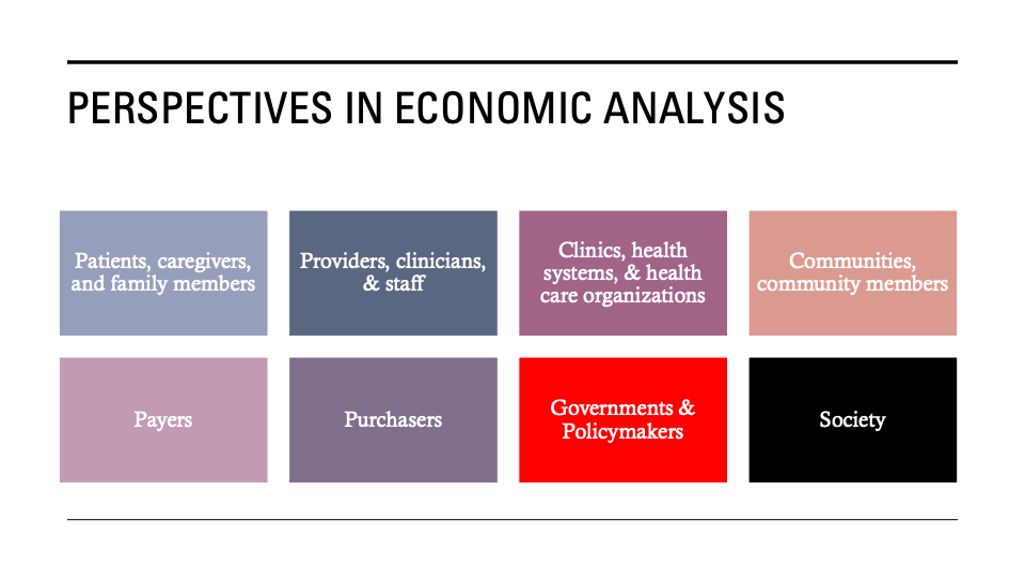
The costs and benefits included in an analysis depend on whose perspective is being considered. Different stakeholders value different outcomes and resources. A cost to one group may be a benefit to another.
Action Steps
Identify the primary audience for the analysis. Determine who will use the findings and what decisions they are trying to make.
Select the perspective most relevant to decision-making. Select the patient, provider, health system, payer, community, or societal perspective that best aligns with those decisions.
Determine which costs and benefits matter most to your audience. Consider time, effort, staffing, technology, travel, financial expenditures, and opportunity costs from the selected perspective.
Align measures with stakeholder priorities.
Example
A payer may focus on reimbursement and healthcare utilization costs, while a health system may focus on staffing, technology, quality metrics, and revenue. Patients may be more concerned with time, travel, and out-of-pocket expenses.
| Perspectives | Costs | Effects and Benefits |
| Patient/Individual | Co-pays, opportunity cost of missing work | Improved clinical outcomes and associated change in QALYs |
| Providers/Clinicians | Labor, opportunity cost of other work activities | More efficient collection, documentation, and management of health information |
| Health Systems | Labor, technology, EHR integration | Improved quality measures, increased revenue, reduced need for patient follow-up |
| Payers (Insurers) | Claims & reimbursement expenditures | Reductions in emergency department use or hospital readmissions |
Impact Summary
Choosing the right perspective improves the relevance and usefulness of economic analyses. Stakeholder-centered costing helps decision-makers understand how interventions affect the people and organizations responsible for implementing and sustaining them. It also helps focus data collection on meaningful measures.
Tools and Resources
The design of your economic analysis should be appropriate for your research or evaluation question and should produce the information you aim to disseminate to stakeholders. Some methods focus only on costs (e.g., implementation costing or financial burden of disease analysis). Other methodologies incorporate measures of value that assess the relationship between costs and benefits (e.g., cost-effectiveness analysis or return on investment analysis). The table below summarizes different methods used in economic analyses.
| Economic Evaluations | ||
|---|---|---|
| Evaluations | Description | Resources to get you started |
| Implementation Cost Analysis | Measures the resources required to implement and sustain a program. | Cronin, J., Gritz, R. M., Eisman, A., Panattoni, L., Ritzwoller, D., Wagner, N., & Glasgow, R. (2024, June 6). A Costing Guidebook for Implementation Scientists. ACCORDS Dissemination & Implementation Science Program. https://medschool.cuanschutz.edu/accords/CoresResources/dissemination-implementation-core/implementation-science-costing-guidebook. Eisman, A. B., Cronin, J., Ritzwoller, D. P., Murphy, S. M., Saldana, L., & Glasgow, R. E. (2026). Making implementation costing more accessible: Initial transdisciplinary guidance for researchers and Practitioners. Implementation Research and Practice, 7. https://doi.org/10.1177/26334895261438501. |
| Cost of Care Analysis | Measures healthcare utilization and healthcare costs associated with an intervention. | Health Economics Resource Center (HERC) (2026). Retrieved from https://www.herc.research.va.gov/include/page.asp?id=analyzing-cost-data. Barber J, Thompson S. Multiple regression of cost data: use of generalised linear models. Journal of Health Services Research & Policy. 2004;9(4):197-204. doi:10.1258/1355819042250249. Pickens GT, Moore B, Smith MW, McDermott KW, Mummert A, Karaca Z. Methods for estimating the cost of treat-and-release emergency department visits. Health Serv Res. 2021;56(5):953-961. doi:10.1111/1475-6773.13709. |
| Cost-Effectiveness Analysis | Compares costs and outcomes of alternative programs or interventions. | Neumann, P. J., Ganiats, T. G., Russell, L. B., Sanders, G. D., & Siegel, J. E. (2017). Cost effectiveness in health and medicine. Oxford University Press. |
| Cost-Benefit Analysis | Assigns monetary values to both costs and benefits to determine overall value. | Drummond, M. F., Sculpher, M. J., Claxton, K., Stoddart, G. L., & Torrance, G. W. (2015). Methods for the economic evaluation of Health Care Programmes. Oxford University Press. Brent RJ. Cost-Benefit Analysis versus Cost-Effectiveness Analysis from a Societal Perspective in Healthcare. Int J Environ Res Public Health. 2023;20(5):4637. Published 2023 Mar 6. doi:10.3390/ijerph20054637. |
| Return on Investment Analysis (ROI) | Compares financial returns with program costs. | Grazier, K. L., Trochim, W. M., Dilts, D. M., & Kirk, R. (2013). Estimating return on investment in translational research: methods and protocols. Evaluation & the health professions, 36(4), 478–491. https://doi.org/10.1177/0163278713499587. |
| Budget Impact Analysis (BIA) | Estimates the financial effect of a program on an organization's budget. | Estimating Downstream Budget Impacts in Implementation Research. Wagner TH, Dopp AR, Gold HT. Med Decis Making. 2020 Nov; 40(8):968-977. doi: 10.1177/0272989X20954387. Epub 2020 Sep 19. PMID: 32951506. Smith NR, Levy DE. Budget impact analysis for implementation decision making, planning, and financing. Transl Behav Med. 2024;14(1):54-59. doi:10.1093/tbm/ibad059. Mauskopf JA, Sullivan SD, Annemans L, et al. Principles of good practice for budget impact analysis: report of the ISPOR Task Force on Good Research Practices— Budget Impact Analysis. Value Health. 2007;10(5):336-347. |
| Cost of Illness Analysis | Estimates the burden and costs associated with a disease or condition. | Jo C. Cost-of-illness studies: concepts, scopes, and methods. Clin Mol Hepatol. 2014;20(4):327-337. doi:10.3350/cmh.2014.20.4.327 |
| *Table adapted from our (1) Costing Guidebook13; and (2) Rabarison KM, Bish CL, Massoudi MS, Giles WH. Economic Evaluation Enhances Public Health Decision Making. Front Public Health. 2015;3:164. Published 2015 Jun 24. doi:10.3389/fpubh.2015.00164. 2 | ||
Why It Matters
Different economic methods answer different questions. The appropriate method depends on your research question, audience, available data, and resources.
Action Steps
Match the method to the decision you are trying to inform.
Consider available expertise and data sources.
Consult an economist or experienced collaborator when possible.
Select the simplest method that adequately answers the question.
Examples
| Analysis | Example Publication(s) |
|---|---|
| Cost-Effectiveness Analysis | Liang X, Malone DC, Tan CJ. Cost-effectiveness analysis of capivasertib plus fulvestrant in the PIK3CA/AKT1/PTEN-altered subgroup with HR+/HER2- advanced breast cancer: a United States payer perspective. J Med Econ. 2026;29(1):1213-1229. doi:10.1080/13696998.2026.2656072. |
| Cost-Benefit Analysis | Park M, Jit M, Wu JT. Cost-benefit analysis of vaccination: a comparative analysis of eight approaches for valuing changes to mortality and morbidity risks. BMC Med. 2018 Sep 5;16(1):139. doi: 10.1186/s12916-018-1130-7. PMID: 30180901; PMCID: PMC6123970. Romano PS, Waitzman NJ, Scheffler RM, Pi RD. Folic acid fortification of grain: an economic analysis. Am J Public Health. 1995;85(5):667-676. doi:10.2105/ajph.85.5.667. |
| Return on Investment Analysis (ROI) | Matthews SD, Jackson JT. Application of a return of investment analysis for public health training by case study. Am J Infect Control. 2021;49(12):1522-1527. doi:10.1016/j.ajic.2021.07.002. McQueen RB, Gritz M, Kern D, et al. Cost and Return on Investment of a Team-Based Palliative Care Program for Parkinson Disease. Neurol Clin Pract. 2022;12(6):429-437. doi:10.1212/CPJ.0000000000200103. |
| Budget Impact Analysis (BIA) | Volpi JJ, Tiozzo G, Neervoort J, et al. Enhanced patient outcomes and improved budget impact from increased PFO diagnostic testing in cryptogenic stroke workup: a US hospital perspective. J Med Econ. 2026;29(1):620-634. doi:10.1080/13696998.2026.2630603. Blonigen DM, Hyde J, Smith J, et al. Employing Peer Outreach and Whole Health in Recovery (EMPOWER) for homeless-experienced veterans: protocol for a hybrid type 3 implementation trial. Implement Sci. Published online April 8, 2026. doi:10.1186/s13012-026-01499-y. |
| Cost of Illness Analysis | Kazi DS, Elkind MSV, Deutsch A, et al. Forecasting the Economic Burden of Cardiovascular Disease and Stroke in the United States Through 2050: A Presidential Advisory From the American Heart Association. Circulation. 2024;150(4):e89-e101. doi:10.1161/CIR.0000000000001258. |
| Implementation Cost Analysis | Grover T, Bennett IM, Campbell M, Vredevoogd M, Saldana L. Implementation cost analysis of collaborative care for perinatal mental health in community health centers. Preprint. Res Sq. 2024;rs.3.rs-5256122. Published 2024 Nov 27. doi:10.21203/rs.3.rs-5256122/v1. |
| Cost of Care Analysis | Stevens M, Shenoy AV, Munson SH, et al. Healthcare utilization and costs of cardiopulmonary complications following cardiac surgery in the United States. PLoS One. 2019;14(12):e0226750. Published 2019 Dec 19. doi:10.1371/journal.pone.0226750. |
Tools and Resources
Why It Matters
Not every cost belongs in every analysis. Cost estimates intended to support replication should focus on costs that future adopters would need to adopt, implement, and sustain the intervention. This means distinguishing implementation costs from research costs and carefully considering which resources are essential for replication.
Action Steps
Define where the intervention begins and ends.
Develop a process map. Identify the implementation activities, workflows, personnel, and resources involved in delivering a program or intervention.
Identify resources needed for implementation and sustainment.
Exclude activities that are purely research related.
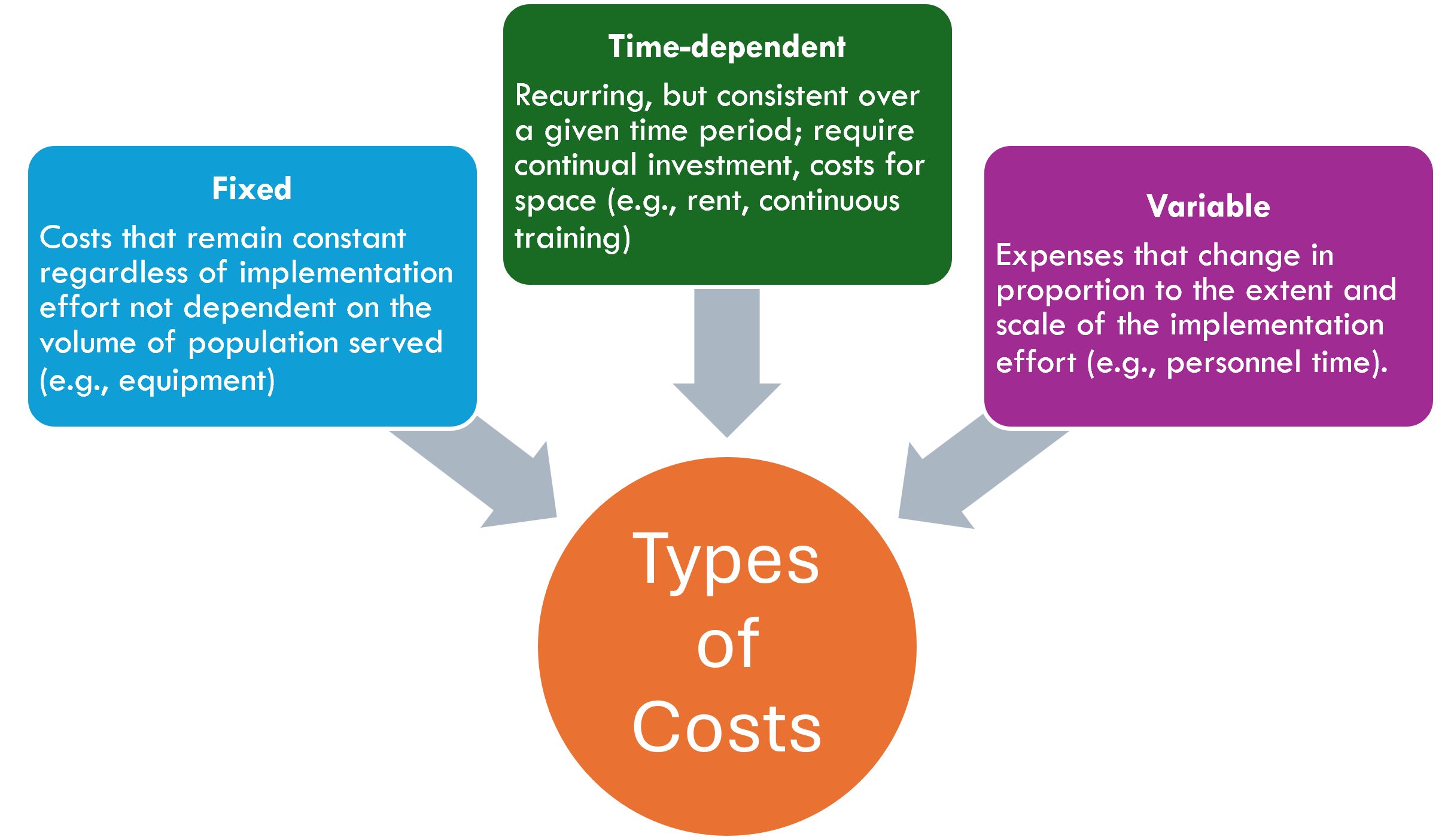
Categorize costs as fixed, time-dependent, or variable.
Cost Categories
Fixed / Startup Costs
One-time investments that do not change with program size.
Examples: training materials, equipment, intervention development.
Time-Dependent Costs
Recurring costs that continue over time.
Examples: subscriptions, licenses, space rental, ongoing training.
Variable Costs
Costs that increase or decrease with program scale.
Examples: staff time, facilitation, participant-facing technology, travel.
It is important but can be difficult to differentiate between research and non-research costs. The following table can help you distinguish between which costs would be included and excluded in an academic study.
| Include | Exclude |
| Planning and preparation meetings to coordinate implementation | Research team meetings to develop training curriculum and other intervention materials (if curriculum is intended to become publicly available) |
| The work done to deliver and support the intervention | Labor conducting research protocols and collecting research data |
| Equipment, materials, and supplies necessary to deliver the intervention | Cost of research-only materials, such as consent forms, interview guides |
| Subscriptions to mandatory delivery platforms, curriculums, or services | Costs of research-based platforms, such as REDCap and Zoom |
Research and Engagement Costs: As you consider costs relevant to your project, you will want to exclude research-exclusive activities. These include costs such as data collection, that would not be replicated outside of your study.
What you include and exclude depends on the focus of your economic analysis. For example, the table above does not include engagement costs. Engagement costs are generally not included in implementation costing analysis because not all projects engage with partners to design or adapt the intervention. However, engagement time and costs may be central to program effectiveness and also relevant to sustainment and replication. If your project is studying engagement, those costs could (and potentially should) be included. To see more about what qualifies as engagement, please visit the Engagement Tip Sheet.
Examples
A clinic implementing a depression screening program included training, staff time, software subscriptions, and workflow redesign costs. Research-only expenses such as data collection, consent procedures, and investigator meetings were excluded because future adopters would not incur those costs. The resulting estimates provided a realistic picture of what it would take to replicate the screening program.
Tools and Resource
Why It Matters
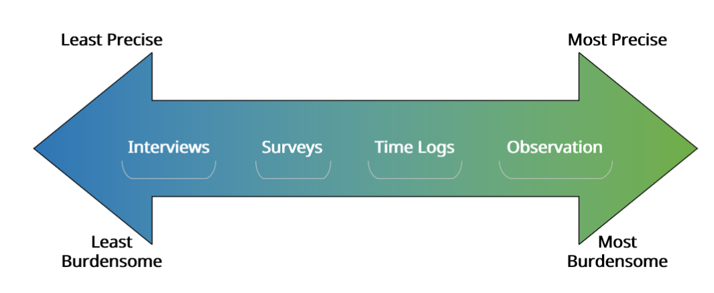
Data collection methods affect both the accuracy of cost estimates and the burden placed on project teams and implementation partners. The best costing method is the most precise approach your team can realistically support. Every data collection strategy involves tradeoffs between accuracy and burden. More precise methods generally require greater effort and resources. Observation generally produces the most detailed information but requires substantial staff effort. Interviews and surveys are less burdensome but provide less precise estimates. The goal is not perfect measurement - it is obtaining information that is accurate enough to support meaningful decisions.
Common Data Collection Approaches
Observation: Most precise method for measuring activities and staff time, but requires substantial research effort.
Time Logs: Detailed staff tracking of time and effort. Generally precise but can be burdensome.
Surveys: Less burdensome than time logs but less detailed and more vulnerable to recall bias.
Interviews: Useful for gathering summary information but provide less precise estimates.
Gross-Costing / Administrative Data: Uses existing accounting, budget, claims, or expenditure data to estimate costs.
Action Steps
Use process mapping first. Identify the activities and resources that need to be measured before selecting data collection methods.
Select a data collection method appropriate for your resources and goals. Consider observation, time logs, surveys, interviews, or administrative data based on project needs.
Use existing tools and templates whenever possible.
Conduct routine data quality checks.
Report results in a way that supports replication and decision-making.
Consider sensitivity analyses to test alternative assumptions.
Example
A community health program initially considered detailed observation of all implementation activities but lacked the resources to support it. Instead, the team combined brief staff surveys with periodic interviews and existing budget reports. Although less precise than observation, the approach generated actionable information while minimizing burden on implementation sites.
Impact Summary
Thoughtful measurement strategies improve both data quality and stakeholder participation. Selecting methods that balance precision and feasibility increases the likelihood that costing efforts can be completed successfully and replicated in future projects. They also support consistent and transparent reporting.
Tools and Resources
Why It Matters
Costing plans create alignment across researchers, implementation partners, and stakeholders. They also reduce rework, improve transparency, and increase the likelihood that findings will be useful for future implementation and sustainment decisions. Many costing challenges occur because teams begin collecting data before agreeing on the purpose, perspective, methods, and responsibilities for the analysis. Costing is most successful when the team agrees on the purpose, audience, perspective, methods, and responsibilities before data collection begins.
Action Steps
Use the Costing Worksheet to guide team discussions.
Confirm the purpose and audience for the analysis.
Agree on perspective, cost categories, and methods.
Assign responsibilities. Determine who will collect, manage, and analyze cost data.
Document decisions. Record assumptions, methods, and rationale for future reference.
Revisit the plan periodically. Update assumptions as implementation evolves and new information emerges.
Agree on perspective, cost categories, and methods.
Example
One project team began collecting cost data without agreeing on whether the analysis would focus on patient costs or organizational costs. As a result, data collection became inconsistent and difficult to interpret. Establishing a costing plan at the outset would have created alignment and prevented delays.
Impact Summary
Costing plans strengthen efficiency, understanding across the team, economic analyses, and support for implementation. Teams that align early are more likely to produce findings that stakeholders can trust and use to guide implementation, sustainment, and scale-up efforts. By making the effort up front to develop a Costing Plan, you ultimately save time across the project and in future implementations.
