Including patients, policy makers, community organizations or other partners to work with you in the phases of design, implementation, and/or sharing of results for your study/project
Review the guidance by the elements below. Being clear on these details from the outset will limit future setbacks.
We recommend using a tool to help guide defining the problem and have created a worksheet to help teams gather and reconcile the information quickly and clearly.
Partners can include patients, policy makers, community organizations, or other people/organizations with an invested interest in a project.
Why It Matters
Partner engagement ensures that research and projects are relevant, feasible, and acceptable to those most affected. By involving diverse partners, you enhance the quality, credibility, and impact of your work.
Example
In a community health study, researchers collaborated with local organizations and patient advocates to co-develop survey questions. This led to higher participation rates and more actionable insights because the questions reflected community concerns.
Types of Partners (Table 1)
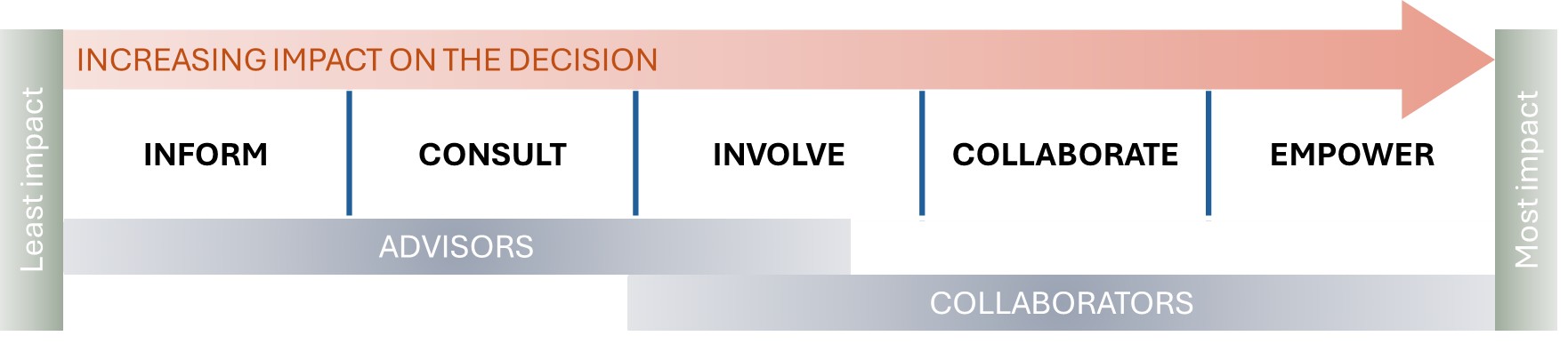
By partners we mean individuals or organizations with an ongoing relationship with the research team. Their role may vary from advisor to collaborator. For example, a local health department may work with researchers across multiple projects, shaping goals and sharing results with the community.
| Type | Definition | Example |
| Advisors | Provide guidance, feedback, or expert input to inform the research process, often through advisory boards or consultations. | A patient advisory board reviews recruitment materials to ensure they are culturally appropriate. |
| Collaborators | Actively participate in the research process and co-design the study. They share responsibility and decision-making in the project. | A community organization co-develops the study protocol and helps analyze and interpret findings. |
Figure 1. Spectrum of participation – Talk about power sharing and how it increases as you move to the empower. There are reasons to use each of the different levels in participation, it’s not always needed for every partner to be collaborators. Think about why you are engaging each partner individually and decided their level of engagement based on that.

Actions to Consider
Anticipated Impact
Ready to dive deeper?
Why It Matters
Engaging partners in research and program development enhances the quality, relevance, and impact of the work. When those most affected by the outcomes help shape the project, it becomes more aligned with real-world needs and values, increasing its effectiveness and adoption.
Example
A public health initiative invited community leaders and patient advocates to co-design an intervention targeting chronic disease management. Their input led to culturally tailored strategies and improved community participation, ultimately boosting health outcomes.
Actions to Consider
Anticipated Impact
Ready to dive deeper?
A few guiding principles can help you decide when and how to involve partners meaningfully
There’s no one-size-fits-all approach to partner engagement. The timing and methods should reflect the specific goals, resources, and context of your project or study.
Early involvement is ideal. Bringing partners in at the very beginning (e.g., planning or design phase) helps ensure that the project addresses meaningful problems; Partners are included before and while decisions are made, not after, and that the team is not overlooking critical perspectives.
Engagement should be ongoing. Consider assessing and revisiting engagement at multiple points in the project: at the start, in the middle, and at the end. You do not need to always create a new group. You can tap into existing groups!
Flexibility matters. Partners can be engaged during different and multiple phases: intervention or program design, planning, implementation, or dissemination; depending on capacity and project needs. Even if resources are limited, involving partners in at least one key phase can significantly improve the relevance and usability of your work and the team can learn from partners (mutually beneficial).
Dedicate resources and an allocated budget to support your partners’ engagement: See our R2P2 costing tool and PCORI's guidance below.
Ready to dive deeper?
Why It Matters
Intentional partner engagement strengthens the relevance, quality, and impact of research and programs. Thoughtful planning around who to engage, how, and when ensures that the process is inclusive, efficient, and aligned with the goals of your project. Clear roles and expectations help build trust and foster meaningful collaboration.
Example
A research team developing a mental health intervention identified the need for input from both patients and clinicians. They used the engagement continuum to define roles – patients served as collaborators in co-design sessions, while clinicians acted as advisors. The team created a visual summary of the project and shared it with a professional network to recruit partners. Regular meetings and feedback loops helped refine the intervention and build strong relationships.
Actions to Consider
1. Identify Needed Expertise
Determine which types of partners (e.g., patients, healthcare professionals, policy makers) are most relevant. Use tools like the 7Ps Table (Spell out and make clear why 7 Ps relevant) to guide selection.
2. Define Engagement Roles
Use the engagement continuum (Figure 1) to clarify the type and level of input needed. Be transparent with partners about their roles. (Table 1)
3. Access Networks
Identify contacts or networks (e.g., friends, colleagues, organization allies) to reach expert partners. Prepare a visual summary (minimal text) to introduce your project before engaging network members.
Framing the ask. You may feel unsure how to ask different group leaders to be engagement partners. You may feel they’re too busy or not interested. Most people want to help. Here are some pro tips on how to frame your ask:
4. Plan Meeting Frequency
Align meeting schedules with your budget and timeline.
5. Establish Group Processes
Decide how decisions will be made and how suggestions will be prioritized during meetings.
6. Monitor Engagement Quality
Check in with partners informally or through surveys at key points (early, mid-way, end) to assess how well the group is working together.
7. Track and Respond to Feedback
Document partner recommendations and your response:
Anticipated Impact
Why It Matters
Building strong relationships with partners and fostering meaningful engagement is essential for trust, collaboration, and long-term success. Clear, consistent communication helps partners feel valued and informed, which increases their willingness to contribute and stay engaged throughout the project.
Example
In a community-based research project, the team sent monthly newsletters, held informal coffee chats, and used both email and text to communicate with partners. These efforts created a welcoming environment and helped partners stay informed and involved, leading to more authentic input and stronger outcomes.
Actions to Consider
Anticipated Impact
How to reach consensus
Reaching consensus in research requires structured processes that maximize representation of diverse viewpoints and are conductive towards transparent decision making. You may not reach complete consensus, but as close to it as possible will benefit your results of engagement. Two approaches are Nominal Group Technique (N) and prioritization exercises. Below are guides and fillable pdfs for both
Ready to dive deeper?
Use Polls to Gather Input
Create short, focused polls to capture partners’ opinions or preferences on key decisions.
Keep questions simple and clear to encourage quick participation.
Use multiple response formats (e.g., multiple choice, rating scales) to make input easy and comparable.
Consider anonymous polls to promote candid feedback.
Facilitate Prioritization Exercises
Invite partners to rank or categorize options based on importance, feasibility, or urgency.
Encourage partners to explain their rankings to provide context.
Look for patterns to identify areas of consensus or divergence.
Other Engagement Processes:
Discuss Results Together
Share poll results and prioritize outcomes in a transparent, visual format.
Facilitate group reflection on the results, encouraging partners to add context.
Highlight areas of agreement and disagreement and collaborate on next steps.
Document key decisions and follow-up actions to show that input was acknowledged and used.
Close the Feedback Loop
After decisions are made, communicate how partner feedback influences the outcome.
Clearly explain which suggestions were adopted, which weren’t, and why. This transparency builds trust and encourages continued engagement.
Add a Dedicated Observer
Capturing all feedback during discussions can be challenging—especially in dynamic settings.
Assign a note-taker or observer whose sole role is to listen and document input.
If appropriate and with consent, record sessions to revisit and verify contributions.
Use an observation checklist to capture non-verbal cues (e.g., nodding, hesitation, agreement), which can reveal support or concerns not expressed verbally.
Ready to dive deeper?