

IHQSE Model for Change
Hone the Intervention

Hone the Intervention
Background
Once you have fully investigated your problem and understand both WHAT it is and WHY it is happening, you can start to ideate and design interventions that address the root causes. By engaging in this stepwise comprehensive approach, you will be equipped to implement meaningful changes.
Recall Vilfredo Pareto, who observed that in his pea garden 20% of his plants produced 80% of the peas. This concept is referred to as ‘The Vital Few.’ 20% of the contributing factors (plants) produced 80% of the outcome (peas). This principle will hold true for your project work: a small number of the contributing factors or root causes will account for the majority of your problem. These are the root causes that you want to identify, in order to address with an intervention.
Return to your Affinity Diagram, and consider the Pareto Principle:
- What are the Vital Few factors that contribute to most of the problem?
- Which domains or themes did your team agree were the most impactful, or most problematic?
Example:
- Problem Statement: Providers are compliant with evidence-based assessment forms to measure anxiety and depression in their patients 5% of the time.
- Pareto Principle: The team agreed that most of the compliance problems were due to two key root causes: 1) Lack of automatization of the form in the Electronic Health Record, and 2) Lack of time in the clinic appointment for patients to complete the form. Addressing these two factors would increase compliance with forms significantly, and fix most of the problem.
- Intervention based upon Pareto Principle: The team embedded the patient forms within Epic and sent them to patients in advance of their appointment, such that they were automatized, completed in advance, and integrated into the provider note seamlessly to guide decision making.
- Result: Compliance increased from 5% to >90%.
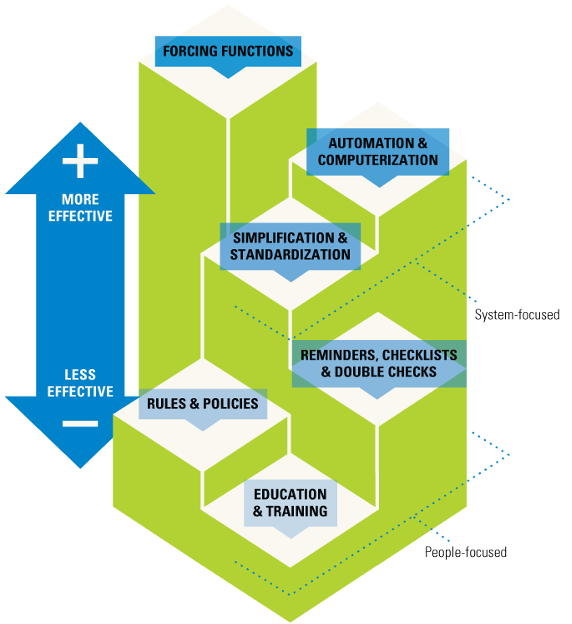
Recall the Hierarchy of Interventions, where more effective changes are System-focused, rather than People-focused. Consider how you can integrate standardization, automatization, or a forced function, instead of telling people to work harder, or do more.
How will you move up the Hierarchy of Interventions?
- Example: Avoid education-based initiatives (providing a pocket card to remind people of how to treat XYZ)
- Example: Instead, embed clinical decision-making support within the EHR for real time integration into provider workflow.
Design Thinking is an approach to problem solving anchored in human centered design. It is a creative process that leads to innovative solutions, and it begins with connecting deeply with your user, to understand their needs, wants and wishes about your product. It was founded by a company called Ideo in Silicon Valley and led to such innovations as the original Apple computer mouse.
In process improvement, we often use Design Thinking to redesign processes with the User in mind: for example, designing a new order set in the EHR, or a new workflow.
Consider the core tenets of Design Thinking:
- Step 1: Empathizing with your User.
- Who will use your new product and what are their needs / wants / wishes? You should seek to understand these when you engage in the Voice of the Customer.
- Who will use your new product and what are their needs / wants / wishes? You should seek to understand these when you engage in the Voice of the Customer.
- Step 2: What is their problem that needs to be solved (Define)?
- This is the same as your Problem Statement.
- This is the same as your Problem Statement.
- Step 3: Consider how you will Ideate different solution ideas.
- These should be creative, fun, and sometimes not realistic (but may help you understand the core needs of your user).
- For example, if you were considering how to redesign the EHR to support your project, you may come up with different order sets, pathways, or Best Practice Advisories, to offer to your user.
- These should be creative, fun, and sometimes not realistic (but may help you understand the core needs of your user).
- Step 4: How can you turn each of these ideas into a Prototype for your users to Test and provide feedback?
- For example, create mockups of different EHR order sets on paper or in an Epic Sandbox, and show them to providers to get feedback.
Plan a Design Thinking Event: Engage your coach to help facilitate this activity.
- Invite the User of your new product to this event.
- Share your Problem Statement with them.
- Create tangible or visual images of your new product. This might be a picture of a new order set, or a process map of a new workflow.
- Provide each user a copy of the product prototypes. Share a prompt requesting feedback on the product. Provide the user with a pen and paper to mockup the prototype with their ideas.
- Thank them for their input.
The concept of Positive Deviance is that there are individuals or groups who have uncommon behaviors leading them to better solutions, with a similar set of resources. For the problem you are tackling, it is likely that someone else has already solved this problem – your goal is to find out who they are – your Positive Deviant! Then, you should engage this person / team in an open-ended conversation to understand their approach and their uncommon solutions.
- Step 1: Identify the Positive Deviants
- First, consider local teams on your campus - other clinics, units, or hospitals that may have faced a similar problem, and already solved it.
- Then, return to your literature review – has anyone published their work on this problem and their solution?
- Step 2: Connect
- How will you connect with the Positive Deviant to learn more? People generally love to share their ideas and successes. Consider a phone call or email with a request to discuss in more detail.
- How will you connect with the Positive Deviant to learn more? People generally love to share their ideas and successes. Consider a phone call or email with a request to discuss in more detail.
- Step 3: Create an interview guide
- This should include a small number of open-ended questions. You may also request to witness the solution or process in action in a site visit.
- Identify the uncommon solution that led to a better outcome.
- Step 4: Reflect on your own environment
- How might you incorporate these solutions into your own interventions?
Once you have considered the Hierarchy of Interventions, engaged in a Design Thinking exercise, and connected with your Positive Deviants, you likely have multiple ideas for solutions. What will you implement first?
Consider the Effort / Impact concept – how can you maximize impact while minimizing effort?
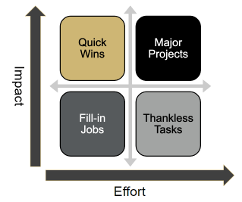
- Step 1: Do you have any Quick Wins?
- These are ideas that can be implemented quickly, with minimal resources. If so, do it!
- Examples of Quick Wins:
- A simple change to an order set that already exists
- Adding a low energy task to a role that already exists and is well integrated
- Removing wasted steps / tasks
- List ideas on an Effort / Impact matrix.
- Examples of Quick Wins:
- These are ideas that can be implemented quickly, with minimal resources. If so, do it!
- Step 2: Consider higher effort ideas, that will have considerable impact.
- These may include changes to the EHR, creating a new unit or team, or significantly restructuring a process. Focus most of your energy on these ideas, knowing you will need to approach Change Management thoughtfully and systematically.
- List ideas on an Effort / Impact matrix.
- These may include changes to the EHR, creating a new unit or team, or significantly restructuring a process. Focus most of your energy on these ideas, knowing you will need to approach Change Management thoughtfully and systematically.
After you have decided upon which intervention you will implement first and designed it with your team – you should engage in a Pre-Mortem Activity. The goal of a Pre – Mortem is that you learn from your team about their concerns and insight into possible failure points, BEFORE you start, such that you can address them and prevent the future failure of your intervention.
Pre-Mortem Activity:
Step 1: Gather a group that includes your frontline people who will be impacted by the change.
Step 2: Introduce and explain the intervention in detail.
Step 3: Then, offer the following prompt: “This change has been implemented for 3 months, and it is a failure. Tell me why.”
Step 4: Ask your team to brainstorm and write their ideas on paper. Then, exchange a paper with another team member, review, and add additional ideas. This should occur quietly.
Step 5: Thank your team, gather the feedback, and identify:
- Are there barriers you can remove or fix? Do it!
- Are there any dealbreakers that may delay your implementation? If so, consider if this is not the right time to start your intervention.
Before you start, you also want to understand if your intervention has the potential to impact different groups of people or patients in a way that exacerbates healthcare inequity.
First, return to your problem statement.
- Stratify data by groups experiencing health disparities (gender, race, ethnicity, language, insurance status, zip code)
- Characterize the problem: identify a comparator group, and analyze relative and absolute differences between the two groups
- Uncover gaps in existing high performing areas
Then, return to your voice of the customer.
- Are any groups not represented?
- Where might you incorporate a more diverse voice?
- Engage in another VOC event if needed!
Now, consider your intervention.
- Are there any unintended equity consequences for your idea?
- How can you augment your intervention before deployment to uplift all, and not just some?
Finally, you want to ensure you understand the impact of your interventions on your people. Improvement work is meant to enhance your team culture, not detract from it or cause more burnout
Existing models of burnout and wellbeing cite multiple factors that drive negative experiences of work.
- Many of these factors (health policy, payment models, IT systems) are beyond the exclusive control of individuals, teams, and even leaders.
- Despite this, all leaders have sources of agency to infuse their work with actions that support wellbeing, positive culture and effective performance at the same time.
There is an underlying mindset in much of healthcare that performance and wellbeing are handled separately.
- We drive people to improve productivity with feedback, public display of metrics, and setting stretch goals. This generates suitable performance.
- Then, when people are burned out or at a breaking point, we provide them recovery spaces or activities to re-energize (team lunch, yoga.)
- Then we return them to performance-based systems that deplete them. The cycle repeats.
Neuroscience and positive psychology research support the idea that helping people tap into positive emotions, in small doses frequently during work, is vital to enhancing well-being and performance. These emotions are:
- Joy, Hope, Gratitude, Inspiration, Awe, Interest, Amusement, Pride, Serenity, Love
Consider how your project work can create a culture of wellbeing and performance, by infusing positive emotions into your interventions.
- Design structures and processes to deliberately tap into and highlight positive emotions, not only efficiency and outcomes.
- When understanding a process, usually during the Voice of the Customer and Process Map activity, ask people what steps in the process allow them to tap into joy, excitement, meaning, purpose (rather than just the pain points). Figure out how to do more of this, and do NOT remove these moments from your future state!
- Create proactive structures for highlighting actions that evoke positive emotions, such as shouts outs and examples of great performance, rather than solely areas for improvement.
- What team member / role is doing something differently?
- What are they doing?
- How are they doing it?
- When are they doing it?
- How are we monitoring the new process? (see Data Plan)
The Data Collection Plan should include:
- Identify your process, outcome, balancing and structural metrics
- Identify any additional metrics you need to support your Business Case
- Where can you find each of these metrics? (ie Epic, chart review, financial data)
- Who will collect each metric?
- At what frequency will they collect the data and share with the team?
- Where will the data be stored?
With a detailed Implementation and Data plan, you are almost ready to start your intervention! Now, we need to ensure you are prepared to lead your people through Change.
Pro Tips
These materials are developed and created by IHQSE faculty and are the property of the Institute for Healthcare Quality, Safety and Efficiency (IHQSE). Reproduction or use of these materials for anything other than personal education is strictly prohibited. Please contact [email protected] for questions or requests for materials.