

3 Qs for QI: An Interview with Mikita Fuchita, MD
Apr 6, 2026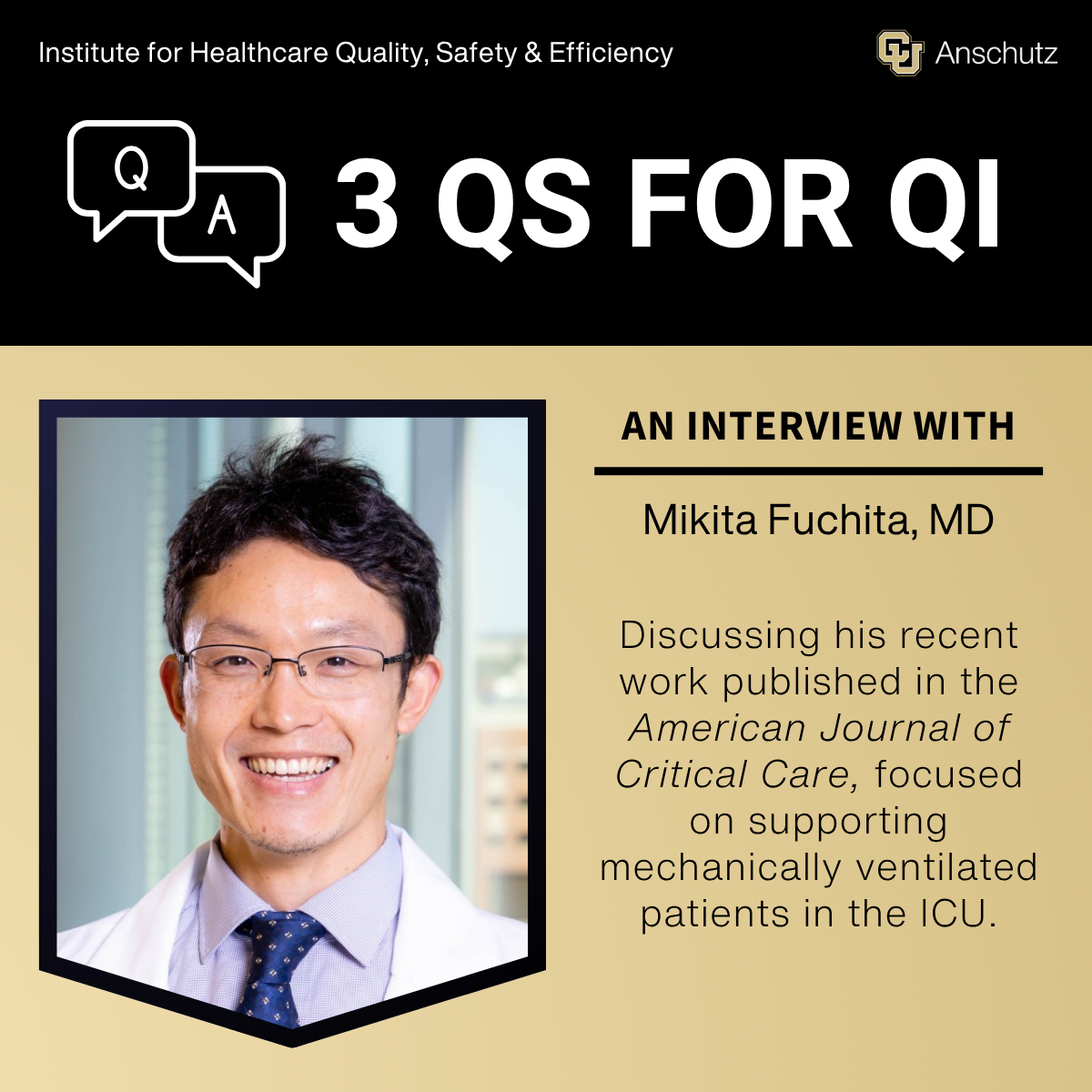
Overview of the Study
Deep sedation remains widely practiced in ICUs worldwide, despite decades of evidence demonstrating harm. IHQSE alumni member Dr. Mikita Fuchita, who launched the Sedation Off, Awake, and Rehabilitate (SOAR) initiative at the University of Colorado Hospital Cardiothoracic ICU, led an interprofessional, simulation-based training to promote implementation of the ABCDEF Bundle, an evidence-based framework designed to support sedation minimization, delirium prevention, and early mobilization for critically ill patients. Findings from this quality improvement initiative were recently published.
Tell us about your approach to this project
When we launched the SOAR initiative in 2022, we began by assessing clinicians’ perspectives on sedation through surveys and interviews. We identified important misalignments across ICU disciplines in how “best practices” were understood. Many clinicians favored deep sedation out of concern that wakefulness might be uncomfortable or even unethical, while fewer recognized the downstream harms associated with prolonged deep sedation.
Because care for mechanically ventilated patients is delivered by an interprofessional team—including nurses, physicians, advanced practice providers, respiratory therapists, physical and occupational therapists, pharmacists, and others—we recognized that improving care would require a shared vision and coordinated teamwork. Delivering evidence-based care at the bedside, particularly sedation minimization, delirium prevention, and early mobility, depends on teams working toward clearly aligned goals.
We therefore designed a simulation-based training that brought all relevant ICU disciplines together to work through realistic clinical scenarios. Teams practiced managing challenges such as agitation, delirium, and hypoxia while applying the principles of the ABCDEF Bundle in real time. This project was conducted as part of a quality improvement effort, and we partnered with experts in simulation-based education to evaluate the training’s impact on clinicians’ attitudes, comfort, and confidence in applying the ABCDEF Bundle in daily ICU care.
Why is this work important?
Deep sedation, delirium, and immobility are closely interconnected and difficult to address in isolation. Decades of research have shown that deep sedation is associated with increased risk of delirium, post-traumatic stress disorder, prolonged mechanical ventilation, and death. These factors also contribute to long-term cognitive, psychological, and functional impairments after hospital discharge, collectively known as post-intensive care syndrome (PICS), which affects an estimated 50–70% of ICU survivors.
Advances in critical care have improved survival, with approximately 80–90% of ICU patients now surviving critical illness. In the United States alone, roughly five million people are admitted to ICUs each year, resulting in a large and growing population living with the long-term consequences of critical illness. Because there are limited proven treatments for PICS once it develops, prevention is especially critical.
Sedation practices, delirium prevention, and early mobilization are modifiable aspects of ICU care, and the ABCDEF Bundle offers a strong, evidence-based framework to address them together. Despite this, a substantial gap persists between evidence and routine practice. Interprofessional teamwork is widely recognized as essential for successful ABCDEF Bundle implementation, yet there is limited evidence on how to effectively strengthen teamwork and align care delivery across disciplines. This work directly addresses that gap.
How do you think this will impact healthcare?
This study suggests that interprofessional simulation-based training may be an effective strategy for strengthening ICU teamwork and supporting ABCDEF Bundle implementation. Our findings provide early empirical evidence that training focused on sedation minimization, delirium prevention, and early mobilization can positively influence clinician attitudes to facilitate practice change.
While conducted in a single ICU setting, this approach has the potential to be adapted to other units and healthcare systems seeking to improve ABCDEF Bundle adoption. We hope this work supports broader use of interprofessional training as a practical tool to close implementation gaps, promote consistent delivery of evidence-based ICU care, and ultimately improve recovery and outcomes for critically ill patients.