

Dear Colleague:
Pausing to Acknowledge the Week
Last week brought a number of difficult moments both nationally and here in Colorado — from the anniversary of September 11 to the shooting death of Charlie Kirk and the Evergreen High School shooting, which deeply affected our local community.
I know many of us are carrying a lot beyond what appears in the headlines — personal losses, worries, or just the heaviness of the times. As we return to our work this week, let's all strive to act with compassion and patience — to approach difficult conversations with curiosity, to seek understanding rather than make assumptions, and to support one another.
Our campus offers valuable mental health support, and I encourage you to reach out to trusted colleagues or to utilize institutional resources at https://www.cuanschutz.edu/mental-health-resources. You are not alone.
Transforming Pancreatic Cancer Care
Chancellor Don Elliman and I last week announced the creation of a groundbreaking data science program in pancreatic cancer at the University of Colorado Anschutz Medical Campus, made possible through the philanthropy of Tom and Cydney Marsico. This initiative, launched with $15 million in support from the Marsico family, represents a bold step forward in transforming care for one of the deadliest and least understood cancers.
In partnership with CU Innovations and the University of Colorado Cancer Center, this program will harness the power of artificial intelligence and next-generation data science to uncover the biological drivers of pancreatic cancer and accelerate the development of personalized therapies. Together, these tools will enable CU Anschutz researchers to build a comprehensive picture of pancreatic cancer at the cellular level, leading to more precise and effective treatments.
We are deeply grateful to Tom and Cydney Marsico for their commitment to advancing pancreatic cancer research. This gift goes beyond funding; it reflects a visionary partnership. The Marsicos’ support, guidance, and belief in the power of data and collaboration are instrumental in making this work possible.
Milestone at CCPM
The Colorado Center for Personalized Medicine (CCPM) recently reached a major milestone – the discovery of 1 million pharmacogenetic results or drug-gene indicators. These indicators uncover how a person’s genetics may influence how their body breaks down medications, why some treatments work well, why others may not, and what triggers side effects.
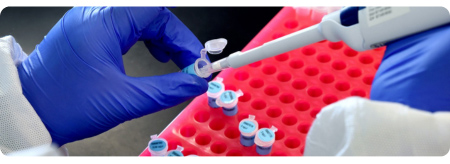
Since it launched in 2014, CCPM’s biobank has grown to become one of the largest in the country. Researchers use blood and saliva donations, combined with participants’ health information, to personalize care, study diseases, and develop new medical treatments.
CCPM is a partnership between UCHealth and the University of Colorado Anschutz Medical Campus. Casey Greene, PhD, Chair of Biomedical Informatics, who has served as interim director for four years was recently appointed Director of CCPM.
Among the 1 million pharmacogenetic results returned are five new genes that interact with common household-name medications for pain management, high blood pressure, and anti-nausea like codeine, tramadol, metoprolol, and Zofran. Discovering these genetic insights helps explain medication responses, ensures proper dosing for patients, and enables clinicians to personalize treatment plans.
UCHealth patient and biobank participant, Jim Jensen, experienced serious adverse reactions to several medications, one that significantly affected his heart. After receiving results from the biobank, Mr. Jenson’s care team was able to adjust medications for blood thinning and pain medications post-surgery to better suit his genetic profile.
“Knowledge is truly power when it comes to your health,” said Mr. Jensen. “The biobank gave me an understanding into how my body works, what it needs, and what it can’t tolerate. This changed everything. Instead of reacting to illness, I can now understand my genetics to focus on preventing it. That shift has been life-changing,” he added.
DoD Grant to Emergency Medicine Team
Adit Ginde, MD, MPH, Professor of Emergency Medicine, Interim Senior Associate Dean for Clinical Research, and PI of the ATLAS Research Program, has received a $4.7 million U.S. Department of Defense award to advance autonomous medical innovation with the CU Center for COMBAT Research.
In partnership with the U.S. Air Force and an industry collaborator, the team will evaluate autonomous oxygen titration technology in the Autonomous Unmanned Resuscitation and Oxygen Research for Austere Operations (AURORA) project.
This work addresses the critical prehospital challenge of reducing the cognitive burden on medics while conserving limited oxygen supplies and improving care for both military and civilian emergencies. The CU team, based in the Department of Emergency Medicine, will lead a multisite clinical trial in conjunction with our CU EMS faculty. Results will provide the evidence required for regulatory approval and future widespread adoption.
This collaboration and clinical trial between CU, government, and industry exemplify how we are shaping the future of emergency care and defense health research through pioneering prehospital innovation.
Fighting Lung Cancer
D. Ross Camidge, MD, PhD, Professor of Medicine, who has spent his career researching and caring for people with lung cancer, describes his life after being diagnosed with advanced lung cancer himself in an extraordinary article published in the CU Cancer Center newsroom last week.
During his 20 years at CU, Dr. Camidge has had a remarkable career, publishing nearly 400 articles, receiving multiple awards, and mentoring dozens. As Director of the Thoracic Oncology Program, he has led the center to remarkable heights, accruing about 40% of lung cancer patients into clinical trials—more than double the rate of the next best academic lung cancer program in the country and more than 10 times the national average.
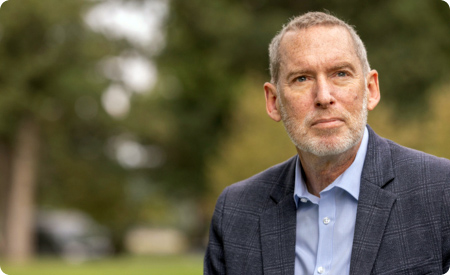
While Dr. Camidge was diagnosed in 2022, he disclosed it to only a small group of people and he kept working. After his diagnosis, he also started a podcast with OncLive, How This Is Building Me, interviewing many different people around the world who have experience of, or who work with, cancer across the full spectrum of life experiences. Again, he did not tell the organizers of the podcast, or any of his guests, about his diagnosis.
“I remember one episode where I interviewed a hospice chaplain,” Dr. Camidge said. “Some of the questions I am asking are clearly coming from a different place of knowledge than the audience really appreciates.”
After a recent progression, he said he feels it is time to share publicly that he is also a patient. And always an educator, Dr. Camidge is prioritizing being a mentor. “You get to a point in your career where another presentation, publication, or award doesn’t have the tingle it used to. But seeing people you have helped find their version of success still does that for me,” he said.
Faculty Update
Ronald J. Sokol, MD, Distinguished Professor of Pediatrics and Director of the Colorado Clinical and Translational Sciences Institute, has been awarded the Lifetime Achievement Award by the American Liver Foundation. This prestigious recognition reflects his enduring dedication to patients and families affected by liver disease and his pioneering contributions to pediatric liver research. The award will be presented at the National Legacy Gala in New York City on October 29.
Recent Publications
Sarah K. Schmidt, MD, MSHI, Associate Professor of Pediatrics, is a co-author of an original investigation, “Gonorrhea and Chlamydia Screening for Adolescents and Young Adults in Emergency Departments,” published September 8 by JAMA Pediatrics.
Eric G. Campbell, PhD, Professor of Medicine and Director of Research for the CU Center for Bioethics and Humanities, is co-author of a research letter, “Physician Perspectives on Pharmaceutical Promotion,” published September 5 by JAMA Health Forum.
The Department of Medicine has published its annual report, Stronger Together. In sharing the book of achievements with the department, Vineet Chopra, MD, MSc, Interim Executive Vice Dean - Clinical | Research | Quality and Chair of Medicine, wrote: “In many ways, academic medicine finds itself directly in the crosshairs of shifting federal government priorities. The impact on our faculty, trainees, and staff cannot be overstated. And yet, our department has come together not only to survive, but in many ways, to thrive. This is possible only because of the strength and dedication of each of you, and this report encapsulates that perseverance.”
Big Brain Fun
Four women scientists walk into Denver’s Bug Theatre . . . and a few jokes later, the audience gains a bit more knowledge about women’s brain health.
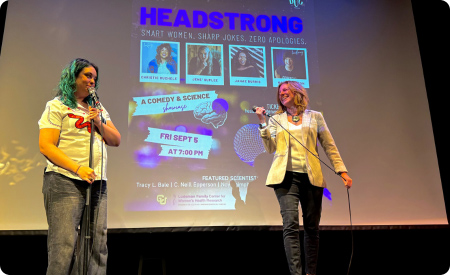
Christie Buchele and Tracy L. Bale, PhD, on stage at the Bug Theatre
The event, “Headstrong,” was billed as a comedy and science showcase and it played to a sold-out crowd at the Bug. Four women comedians were paired with four women scientists from our campus on Friday, September 5, to discuss the importance of scientific research and issues around women’s brains across the lifespan.
The stars from our campus were Tracy L. Bale, PhD, Professor of Psychiatry; C. Neill Epperson, MD, Chair of Psychiatry; Noy Phimphasone-Brady, PhD, Associate Professor of Psychiatry; and Barbara Stranger, PhD, Professor of Biomedical Informatics.
Sharing the stage were sculptures of brains from the summer Brain Camp for kids that was also organized by Dr. Bale’s Laboratory of Translational Psychiatry, the Department of Psychiatry, and the Ludeman Family Center for Women’s Health Research. Those sculptures – the Cortex Collection – were created at the Brain Camp by elementary school students, where they learned the fundamentals of the brain. The sculptures are on display this month at Stanley Marketplace, 2501 Dallas St., Aurora, before they are sold at auction.
In Memoriam
Giacomo Meschia, MD, Professor Emeritus of Physiology and Biophysics, passed away Thursday, September 4, at the age of 99. Dr. Meschia earned his medical degree at the University of Milan, where his earliest laboratory experience involved studying lead poisoning in the workplace. In 1953, Dr. Meschia joined Yale University before coming to the University of Colorado, where he became a professor of physiology and concluded his remarkable career. In honor of his contributions, CU Medicine established the Giacomo Meschia, MD, Endowed Distinguished Professorship in Neonatal-Perinatal Research in 2023. Dr. Meschia is survived by his beloved wife, Irene, who is the sister of Frederick Battaglia, MD, a perinatologist and pediatrician with whom he had decades of productive research collaborations. Additional survivors include his sons James, Steven, and Philip; seven grandchildren; and two great-grandchildren. A memorial service was held last Friday.
Have a good week,
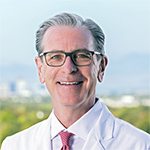
John H. Sampson, MD, PhD, MBA
Richard D. Krugman Endowed Chair
Vice Chancellor for Health Affairs and
Dean, University of Colorado School of Medicine
The Dean’s weekly message is an email news bulletin from John H. Sampson, MD, PhD, MBA, Dean of the CU School of Medicine, that is distributed to inform
Subscribe to the Dean's Message