


Imagine your body as a huge, vibrant city, full of different neighborhoods, like Skin Street, Nose Avenue, Mouth Market, Lung District, and Intestine Town. Living throughout this city are trillions of human cells alongside trillions of tiny bacteria and other microorganism ‘citizens’ that make up your microbiome.
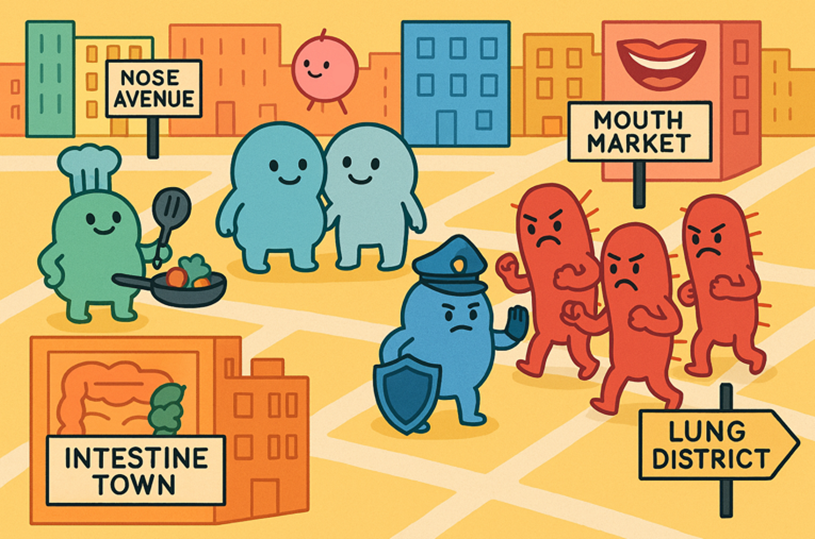
Most of these microbiome citizens are friendly ‘commensal’ neighbors who help keep the city running smoothly. Some of them act as chefs in Intestine Town, helping to break down food and make vitamins the city can’t produce on its own. Some of them support your immune system by training it and keeping it strong. Others work as security guards, pushing out dangerous troublemakers that try to move in.
Now, imagine a dangerous gang of bacteria (a pathogen), like Streptococcus pneumoniae, trying to invade the Lung District neighborhood, where they want to grow uncontrollably and cause damage to the area. This case of harmful, uncontrolled growth in the lungs is called bacterial pneumonia, and it’s a major cause of hospitalization and death in human beings.
Dr. Sarah Clark is a scientist on the CU Anschutz campus who studies a variety of factors that influence a person’s chance of getting sick with bacterial pneumonia. It turns out that one of these factors is how diverse the microbiome – that friendly community of microbes – within a person’s respiratory tract is.
The Clark research team acts like detectives, studying how the friendly ‘commensal’ neighbors inside your bustling city send signals, leave clues, and help us understand how to stop the Streptococcus pneumoniae gang from causing pneumonia. By studying these helpful microbes, Sarah and her team can learn how the city defends itself and how we can strengthen those defenses.
Streptococcus pneumoniae (called S. pneumoniae for short) is a type of bacteria that is the most common cause of lung infection, or pneumonia. Bacterial pneumonia is a major clinical problem, as it is the leading cause of death in young children and the most frequent cause of infection-related death in the elderly.
Interestingly, S. pneumoniae lives in the noses of many healthy people but only a fraction of these people becomes sick with bacterial pneumonia. Why? This is the mystery that the Clark lab is interested in solving: How does our body, particularly our lungs, protect us from developing bacterial pneumonia?
The respiratory tract microbiome resides in our upper airway, particularly in our nose and mouth. Prevotella is a very common bacteria that lives in the mouth and is often associated with health, meaning that it is more commonly found in people who are healthy. Because Prevotella lives in the mouth, it is frequently inhaled into the lungs, where they interact with immune cells.
Several large clinical studies on humans have discovered a striking finding - having lower amounts of Prevotella in the lungs was associated with higher mortality from critical illnesses including bacterial pneumonia. Basically, people with less Prevotella in their lungs were found to die more often from bacterial pneumonia.
These studies are exciting and suggest that some members of the respiratory tract microbiome (perhaps Prevotella?) help to protect us from becoming sick with bacterial pneumonia. The Clark lab is interested in learning more about how breathing Prevotella into the lungs alters your immune system in ways that may improve your defenses against bacterial pneumonia.
To better understand why having Prevotella in your lungs is linked to increased survival from bacterial pneumonia, the Clark lab has developed a mouse infection model where they expose half of their mice to Prevotella and then infect all their mice with S. pneumoniae. They then compare the immune response in the lungs of mice with or without Prevotella before S. pneumoniae infection to determine how these friendly bacteria alter immune defense against bacterial pneumonia.
It turns out that S. pneumoniae uses a lot of tricks to reduce the effectiveness of the immune response, which is why it is such a successful pathogen. However, Sarah and her team have found that when the lungs are exposed to Prevotella before S. pneumoniae, the immune response looks very different. Essentially, many of the tricks employed by S. pneumoniae are no longer effective, and the immune system is better at eating and killing these bacteria!
The immune system is the body’s built-in mobile defense system, like calling 911 for an emergency. Immune cells called neutrophils and macrophages are the “first responders” to infection. These cells play a critical role in the early hours after infection with S. pneumoniae by working to eat and kill the bacteria. This helps to control the growth of S. pneumoniae and protect the lungs from damage caused by the infection. Even after the infection is gone, macrophages continue to patrol the lungs, ready to respond to the next insult. The Clark lab has found that neutrophils and macrophages called to the lungs after Prevotella exposure are better at controlling early S. pneumoniae infection.
This research has significant clinical impacts that can help doctors make decisions when treating pneumonia patients with antibiotics. Currently, hospitalized patients are treated with different antibiotic regimens including some which kill off bacteria like Prevotella. Research from the Clark lab suggests that such antibiotics should be used with caution, as they may be killing off bacteria which aid the immune defense against bacterial pneumonia. The Clark lab is also interested in innovative therapeutic approaches, like using Prevotella - like a probiotic for the airway - in people recently treated with antibiotics!
There are many potential future directions for this research! Bacteria like Prevotella are classically understudied because they aren’t major causes of disease like Streptococcus pneumoniae. However, the Clark lab thinks bacteria like Prevotella have a lot to tell us about defense mechanisms that help to protect against infection.
An important next step for this research is to look beyond the early immune responses and focus on longer-term effects on the lungs, as it is unknown how frequently a person needs to be exposed to Prevotella to maintain improved immune system defense against bacterial pneumonia.
The research in the Clark lab highlights that studying overlooked microbes like Prevotella can reveal powerful, long‑term immune defense strategies that offer new insight into how we might better prevent, detect, and treat bacterial pneumonia and other human diseases.