


Every day, your brain is bombarded with tons of sensory information, such as sounds, sights, smells, and touches. If you paid attention to everything equally, it would be overwhelming!
Your brain has a clever way of deciding what matters and what doesn’t.
Think of it like moving into a house near a train track. At first, every passing train is loud and distracting. But after a while, you barely notice the noise anymore. That’s because your brain has learned that the sound isn’t important and it’s safe to ignore through a process called habituation.
It’s your brain “filtering out” the things that happen over and over but don’t matter. Over time, this raises your “sensory threshold,” meaning it takes more for something to grab your attention.
So instead of reacting to every little thing, your brain focuses on what’s new, important, or potentially meaningful, helping you stay focused and not overwhelmed.
TL;DR: Your brain is like a smart filter, learning what to ignore so you can pay attention to what really matters.
Dr. Jessica Nelson is a scientist who runs a research lab in the Department of Cell & Developmental Biology at the University of Colorado Anschutz in Aurora. Her research group is studying how the brain filters sensory stimuli, like sights and sounds, and decides which stimuli we need to pay attention to and which we can ignore through a process called habituation. This is a critical skill as some sensory stimuli in our environment signal information that’s crucial for our survival.
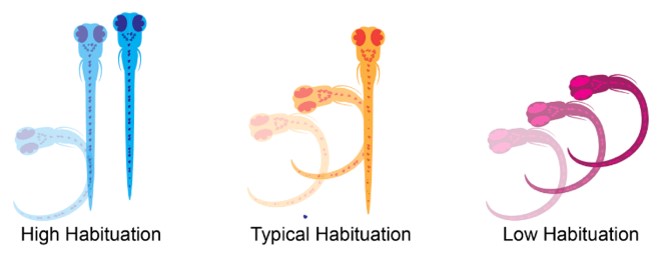
To uncover how sensory thresholds are built and regulated in the brain, the lab used a powerful approach called a forward genetic screen. In this method, they introduced random mutations into otherwise healthy animals – in this case zebrafish – and then carefully observed their behavior.
The goal was simple: find individuals that don’t behave the way they should. For these studies, the team was looking for animals that couldn’t properly habituate.
Great news - they found them! Some animals were hypersensitive to even low-level stimuli and kept reacting over and over again instead of learning to ignore repeated, harmless signals. Something in their biology was preventing their brains from “filtering out” the harmless stimuli.
At first, they didn’t know what gene was responsible, they just knew something was wrong. When they sequenced the animals’ genomes, Jessica and her team made a surprising discovery and found that an unexpected gene helps control sensory sensitivity. They discovered mutations in a gene called cadherin 16. Finding the gene was just the beginning…
To answer this, the team turned to a powerful model system: larval zebrafish. These tiny, transparent animals are ideal for studying brain function and behavior in real time. Using zebrafish, the researchers discovered that Cadherin-16 doesn’t just act in the brain (drum roll) but works through a body-wide signaling system.
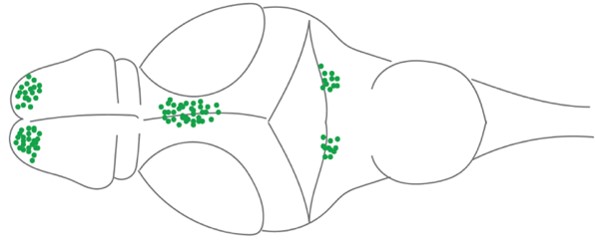
The team found that Cadherin-16 controls sensory thresholds through endocrine organs called the corpuscles of Stannius, which help regulate calcium levels in the body.
This was a surprising twist. Instead of acting within neural circuits, Cadherin-16 influences behavior through hormones and whole-body regulation. Specifically, it helps control calcium balance (Ca²⁺) in the body, a hormone called Stanniocalcin, and a regulatory protein involved in growth signaling.
Together, these systems shape how sensitive the brain is to incoming stimuli. It turns out that your brain’s ability to ignore background noise is a whole-body process.
Calcium isn’t just important for bones. Calcium has been found to play a critical role in how neurons communicate. Small changes in calcium levels can influence how easily neurons fire and respond to signals and may ultimately determine whether a stimulus is ignored or demands attention. Our working hypothesis is that Cadherin-16 helps regulate calcium levels in the body, which could influence how easily cells in the nervous system or inner ear become “excited,” or activated.
To study how sensory thresholds are built and regulated in the brain (and body) the lab combines several powerful tools and approaches:
By combining genetics, physiology, and behavior, the team can connect molecules to whole-body function.
Understanding how the brain filters information is essential for understanding human health. If sensory thresholds are too low, the world can feel overwhelming. If they are too high, important signals might be missed. Either imbalance can affect behavior and perception. By uncovering how genes, like cadherin 16, regulate these processes, this research provides insight into sensory processing differences, neural circuit function, brain–body communication, and disorders involving altered sensory sensitivity.
Dr. Nelson and her team are continuing to explore how Cadherin-16 and related pathways fine-tune sensory filtering. Their work is revealing that the brain doesn’t work in isolation. Instead, it relies on constant communication with the rest of the body to decide what matters and what can safely be ignored.
By understanding this system, scientists are getting closer to answering a fundamental question: How does the brain stay focused in a noisy world?
Dr. Nelson and her research team will continue to look for and identify genes that control behavior. The team will also continue to investigate how Cadherin-16 regulates the corpuscle of Stannius (CS) and how calcium homeostasis influences behavior. They hope to use this knowledge to improve human diseases that link brain function and behavior, like anxiety, autism and sensory processing disorders.
If you want to learn more about the scientist, check out their official CU Webpage
To learn more about the Nelson Research Lab, check out the website here: Nelson Lab