

Have you ever worn a different hat for different activities? A helmet while biking? A sun hat while gardening? A beanie when walking in the snow? There is a protein complex in our cells, called cohesin, that does the same thing! Each cell in the human body contains about 6 feet of DNA. Given how small the average cell is, you can imagine that there is a huge amount of effort that goes in to organizing and packing DNA in a way that also keeps it easily accessible by the cell. DNA is like a cell’s instruction manual, with guidance on how to carry out all the processes essential to life. Accordingly, keeping DNA stored safely and neatly is extremely important to life as we know it!
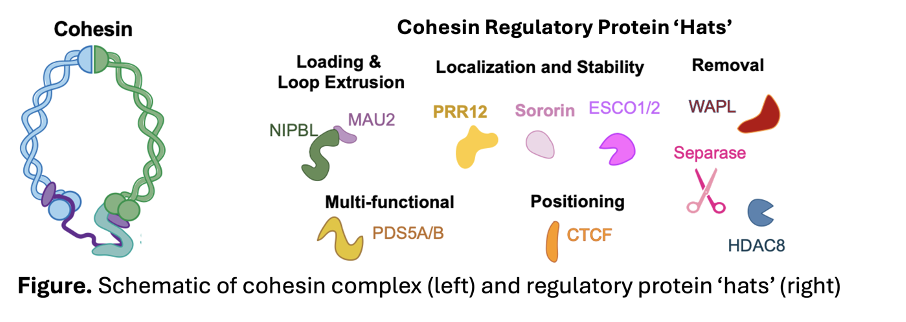
This is where cohesin comes in. You can think of cohesin as a person with a vast array of worldly experience that wears many hats. Each hat reminds cohesin of a different job that it has learned how to do over the course of its life. Some of these jobs include repairing broken DNA, organizing stretches of our DNA into big loops, assisting the copying and holding together of newly made DNA strands when you want to make new cells, and determining what parts of the DNA are open or closed to other proteins, all important functions that to keep the cell tidy and organized. These tasks are all critical to the life of the cell. When wearing any given hat, cohesin can tap into its expertise at the associated task and help to maintain our DNA’s structure and integrity.
These "hats" are actually different proteins that interact with cohesin, giving it the ability to carry out numerous important tasks in our body’s cells. Dr. Ally Nguyen and her lab are interested in identifying unknown “hats” that cohesin wears and better understanding the roles of the “hats” we know about. By focusing on the "hats", the Nguyen team hopes to broaden our overall understanding of DNA organization, especially as mediated by cohesin in the contexts of evolution and different diseases.
Cohesin is a ring-shaped protein complex with many different roles in maintaining the integrity of DNA. Different roles of cohesin are conferred by various proteins that interact with it; when bound to different proteins, cohesin will be able to fulfill different tasks, similar to the way human swear different hats for different activities.
The Nguyen lab uses multiple techniques to find new proteins that interact with different parts of the cohesin complex. One approach is called co-immunoprecipitation (IP) coupled with mass-spectrometry (IP-MS), which is kind of like fishing. IP-MS works by baiting a specific piece of the protein that you’re interested in studying and tugging on it to pull it out of its environment. Other proteins that are tightly attached to your target also get pulled out with it and can then be identified. A second technique, called BioID, aims to identify proteins that are only associated with cohesin in passing. BioID essentially works by giving the protein of interest a marker pen and allowing it to make a little dot on every other protein that it interacts with during a short window of time. The result is a list of proteins that have the mark of interest and can then be closely studied for potential roles related to cohesin.
With methods like these, Ally and her team were able to identify a completely novel protein that interacts with cohesin, called PRR12! Her team has found that PRR12 functions in stabilizing cohesin and is important in maintaining the organization of open and closed DNA domains as well as protecting against genomic instability, where the DNA can become damaged. This is just one example of how identifying new interactors of cohesin will help us to better understand how this critical protein complex completes its many jobs.
An instance of the cell’s life cycle that requires special attention to DNA organization is cell division. Inside every cell, DNA is neatly bundled into packages called chromosomes. When a cell is preparing to divide, it first makes a copy of all its chromosomes—kind of like using a photocopier. This creates two identical copies of each chromosome, called sister chromatids, that are connected to each other at a single point (think “joined at the hip”). Sister chromatids are then lined up at the middle of the cell pulled apart by rope-like proteins called microtubules as the cell buds into two. Failure to keep a cell’s DNA properly organized during this very complex and specific process can lead to major problems. Having too much or too little DNA in cells can lead to disease or developmental deficits.
With their interest in DNA integrity, the Nguyen lab also researches components involved in DNA organization during cell division. By selectively removing individual cellular pieces that are involved in this process, they have been able to identify how two important proteins, called CENP-U and BUB1, work in parallel to recruit another protein, called PLK1, to the point of connection between sister chromatids so that the two copies of DNA can be correctly and evenly separated.
Defects in cohesin are responsible for approximately 20% of all cancers, so improving our understanding of how this protein complex works increases the chances of finding new cancer treatments. Cohesin misregulation is also a key driver of developmental disorders, age related disorders, and infertility. However, it is not well understood how cohesin is targeted to specific places in the genome to perform specific functions and how disruptions in these processes lead to disease.
Similarly, errors in how chromosomes are pulled apart during cell division can leave cells with too much or too little DNA, a state called aneuploidy, that is strongly linked to cancer and birth defects. Understanding systems like the CENP-U/BUB1/PLK1 pathways not only clarifies a basic mechanism of accurate cell division but also helps to explain why some cells are more vulnerable than others to having problems in these pathways. Our knowledge of this vulnerability could potentially be used for the development of the new targeted treatments.
Dr. Nguyen and her team hope to continue to identify different proteins that associate with the cohesin complex and then determine how these proteins function in the cell using systems that can specifically remove the protein of interest, such as targeted knockout and knockdown approaches including CRISPR/Cas9 gene editing and auxin-degron systems. This will allow them to better understand the exact function of each protein by seeing what happens and what goes wrong without it.
Additionally, Ally and her team are interested in further investigating broader applications of DNA organization, including duplicating and separating DNA in cell division (and what factors can lead to this going wrong). Identifying additional proteins that are always present in DNA organization processes versus those that become essential only in certain contexts (such as in cancer) will help researchers develop treatments for cancers as well as many other developmental disorders.
If you want to learn more about the scientist, check out their official CU webpage
To learn more about the Nelson Research Lab, check out the website here: Nguyen Lab