

Alert: Canvas Outage Update
Canvas access has been restored for our users, but the service reliability remains uncertain. Due to recent events, Canvas has had intermittent outages which are at the discretion of the vendor and may occur during a final exam. Faculty and staff may continue to use Canvas, but we strongly advise faculty and students to prepare a contingency plan for turning in assignments and final exams in the event Canvas access becomes unavailable again.
Instructure, the company that owns Canvas, has provided an FAQ about the incident, which may not answer all your questions. We will share more information if it becomes available.
Instructure, the company that owns Canvas, has provided an FAQ about the incident, which may not answer all your questions. We will share more information if it becomes available.
Learn More
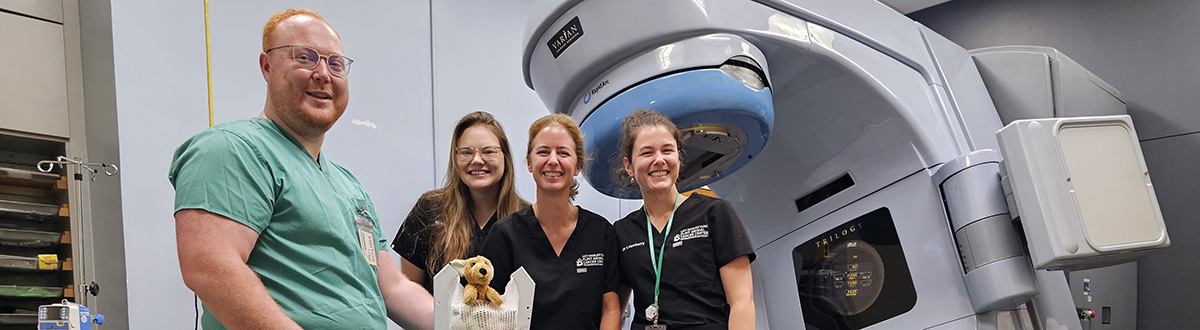
Tristan Seawalt poses with radiation oncology residents/fellows at CSU’s Flint Animal Cancer Center at a LINAC radiation-therapy machine used to treat veterinary patients.
A Course in Comparative Oncology
Training medical students at CSU’s Flint Animal Cancer Center
May 2026
By Mark Harden
Tristan Seawalt discovered he was the first University of Colorado Anschutz medical student to take a comparative oncology course at Colorado State University’s renowned Flint Animal Cancer Center when someone asked to take his picture.
They snapped the photo a couple of days into the course saying,” We’ve never had a human medical student before.”
The two-week elective course gives students of human medicine a glimpse of how the Flint Animal Cancer Center (FACC) uses medical, surgical, and radiation oncology in a veterinary setting, and exposes students to the center’s comparative oncology research.
The experience often leads to better treatment for both animals and humans. It’s also a specialized training opportunity for students at the CU Anschutz School of Medicine’s Fort Collins Regional Medical Campus at CSU.
Several of FACC’s researchers – including its director, Susan Lana, DVM – are CU Anschutz Cancer Center members, collaborating on one of the most advanced comparative oncology research programs in the world. They seek to translate research on prevention, diagnosis, and treatment of naturally occurring cancer in pet animals to benefit both pets and people.
The FACC course was a great fit for Seawalt, who is focused on radiation oncology. “It’s been one of the best courses I’ve ever taken,” he says. “It was an amazing rotation. It was just a couple weeks, but the experience will be very long lasting for me. I would highly recommend it for anyone, even if they’re not thinking about going into oncology specifically.”
The big driver: father’s cancer diagnosis
Seawalt grew up in the Denver area and earned his bachelor’s and master’s degrees at Colorado School of Mines. His master’s was in quantitative biosciences and engineering. He also did neurology research work on the CU Anschutz campus.
His says the “big driver” of his path into medicine – and his focus on cancer – was the experience of helping to take care of his father, who was diagnosed with early-onset prostate cancer. Radiation was part of his father’s treatment.
“Thankfully, it was caught early and all the right steps were done,” Seawalt says. “But that journey motivated me to advance the field and be part of an amazing medical system. I feel like a lot of people don’t know how much goes on behind the scenes with oncology.”
When it came time to go to medical school, CU Anschutz seemed an obvious choice, he says, “but I wanted a bit of a change of scenery, and my partner was doing her PhD in Fort Collins at CSU, so it seemed like a great opportunity for me to go up there.”
Academic advantage
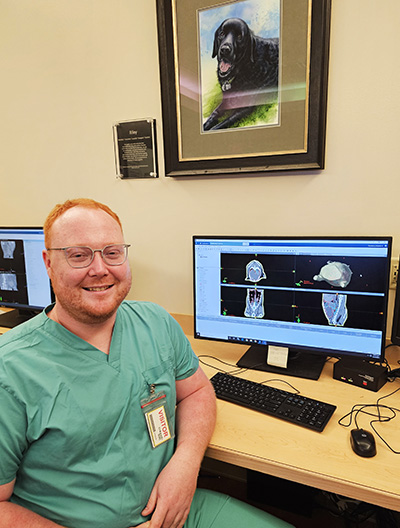
Tristan Seawalt with the radiation plan he created for treating a thymoma in a rabbit.
Seawalt was one of 12 students in the Class of 2026 at the School of Medicine’s Fort Collins branch campus, the second class there since the outpost opened in July 2021. The program is housed in the Health and Medical Center at CSU, a university recognized as one of the top veterinary science schools in the nation.
“With the small class size, I’ve felt very connected to the other students. It’s a great community,” he says. “And as for the academic advantage, the professors and education are top notch. With our small class size, we’re able to ask more questions of the lecturers and really understand the material.”
Seawalt already had been doing research work involving FACC through CSU’s Translational Medicine Institute. “It was amazing to see the similarities between animals and humans. So, I was already looped into the system when I heard of their comparative oncology course, and I thought, ‘I have to do this. I have to see what it’s like to treat cancer in cats and dogs and rabbits.’”
Hands-on experience
The course enabled Seawalt to get more hands-on experience with radiation therapy than he had previously. In particular, he was able to go deeper into contouring, the process of outlining a tumor using medical images to more precisely target radiation delivery and protect healthy tissue nearby.
“That had not been something I’d done in human medicine up to that point, but I did it regularly at the veterinary hospital,” he says.
Seawalt says there’s much to take away from the experience.
“The first thing I’ll carry with me is respect for the veterinarian medicine practitioners, because what they do is almost exactly the same as what we do,” he says. “And in some ways, it may be a little bit harder, because they have to know several different species, and also their patients can’t talk about how they’re feeling, which is such a big part of human medicine.”