

Alert: Canvas Outage Update
Canvas access has been restored for our users, but the service reliability remains uncertain. Due to recent events, Canvas has had intermittent outages which are at the discretion of the vendor and may occur during a final exam. Faculty and staff may continue to use Canvas, but we strongly advise faculty and students to prepare a contingency plan for turning in assignments and final exams in the event Canvas access becomes unavailable again.
Instructure, the company that owns Canvas, has provided an FAQ about the incident, which may not answer all your questions. We will share more information if it becomes available.
Instructure, the company that owns Canvas, has provided an FAQ about the incident, which may not answer all your questions. We will share more information if it becomes available.
Learn More
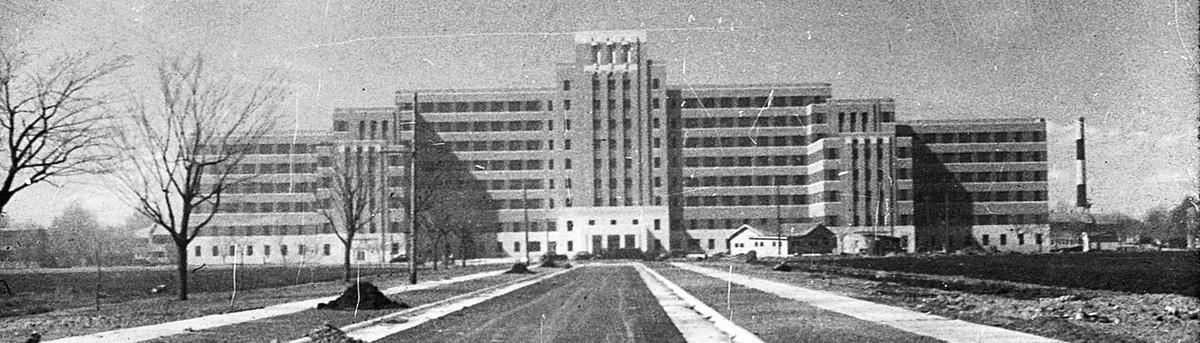
A Home Base for the CU Anschutz School of Medicine
20 years ago, the Fitzsimons Army Hospital Became CU Anschutz. Today, advancements continue to soar.
May 2026
By Kara Mason
On a warm February afternoon, the atrium of the state-of-the-art Anschutz Health and Sciences Building (AHSB) buzzes with quiet energy. Students study outside a cafe, faculty members meet at the ground-level restaurant, and an afternoon conference lingers on the second floor.
On the six floors above, researchers in lab coats sit at microscopes, clinicians welcome patients, and educators help chart the future for the University of Colorado Anschutz School of Medicine.
It was here in early 2025 where Dean John H. Sampson, MD, PhD, MBA, outlined his goal of becoming a top 10 medical school in 10 years at his first State of the School address. A year later, the school boasts its best National Institutes of Health funding ranking in 20 years.
“Our Top 10 in 10 vision is not simply about rankings,” Sampson said at this year’s address. “It is about building a roadmap that positions the School of Medicine as a national leader across all our missions.”
That future sits on a solid foundation.
Twenty years ago, the School of Medicine was just settling into its new campus in Aurora — a place that only a decade prior had been an anchor for military health — and leaders were designing the culture of collaboration they believed would be the difference.
Early history
In 2006, the campus once home to the country’s largest Army hospital officially donned the name “Anschutz” after philanthropist Philip Anschutz’s generous donations paved the way for growth. Since then, the campus has swelled in size, in employees, and in impactful research.
With two hospital partners, six schools, more than a dozen clinics that serve the community, and 60-plus health science centers and institutes, the 256-acre campus is almost unrecognizable from its former life as the Fitzsimons General Hospital.
“I love wandering around this campus,” says Richard Krugman, MD, who was dean of the School of Medicine when it made the move from Denver to Aurora in the early 2000s.
When his tenure began in 1992, the school was still located in Denver and the campus was tight for space. Meanwhile, five miles down the road in neighboring Aurora, Fitzsimons was bracing for possible closure.
It wasn’t the first time threats of closure had hit the base.
In 1933, General R. U. Patterson sent a radiogram stating that Fitzsimons would be abandoned 15 years after being established to care for injured troops in World War I. Then-Congressman Lawrence Lewis led the charge in opposition. After three years of back and forth on closure, President Franklin D. Roosevelt visited the hospital and vowed to keep it open.
In 1938, the federal government approved $3.75 million to construct a new hospital at the base. At 290,000 square feet, it was deemed Colorado’s largest structure. The hospital, dubbed Building 500 and now known as the Fitzsimons Building on the CU Anschutz campus, was reported to house up to 2,252 beds, making it the largest Army hospital in the country.
Today, the former hospital houses various administration, school, and department offices.
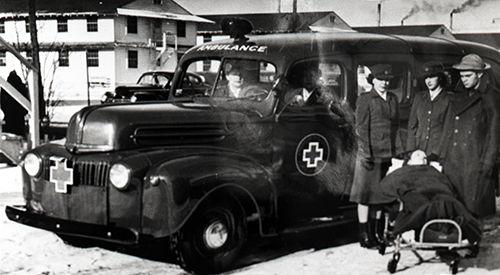
In December 1941, just days after the new hospital’s dedication and the attack on Pearl Harbor, the first patients from World War II arrived at the updated Fitzsimons hospital. Soon, a camp was established near the hospital for Italian, anti-Nazi Germans, and Japanese prisoners of war, especially those with tuberculosis. The camp was razed in 1946.
In 1955, President Dwight D. Eisenhower famously spent seven weeks at Fitzsimons recovering from a heart attack. A lot about the campus has changed since then, but the Eisenhower Suite remains a time capsule. It’s been renovated to reflect the former president’s stay.
Living history
Decades later, the Fitzsimons military history still anchors important research.
In 2019, the CU Anschutz Combat Medicine Research Center launched at the School of Medicine to address the U.S. military’s toughest clinical challenges and translate them into improved civilian care.
COMBAT Center co-founder Vik Bebarta, MD, professor and chair of emergency medicine, says the crucial work he and his colleagues do reflects the same mission of the former campus.
“This campus has a history of medical military innovation,” Bebarta says. “There’s no better place where we can do cutting-edge research, work with students, train them for a career in medicine, and engage in our community.”
Despite constructing new barracks, a training center, and other facilities on the base, Fitzsimons continued to teeter on and off closure lists. Finally, in 1995, the hospital was slated for closure by a Base Realignment and Closure (BRAC) Commission decision, and the hospital closed its doors a year later.
In the early 90s, Fitzsimons stood out as the largest employer in Aurora with its 1,500 jobs, a reason local officials lobbied hard for remaining open.
Thirty years following the closure, economic activity has skyrocketed on the campus. In 2025, CU Anschutz contributed $5.7 billion to Colorado’s economy — more than the ski industry — and supported 27,400 jobs.
Hospital partners, research funding, and a culture of collaboration support crucial scientific breakthroughs, patient care, and education at the School of Medicine.
The big move
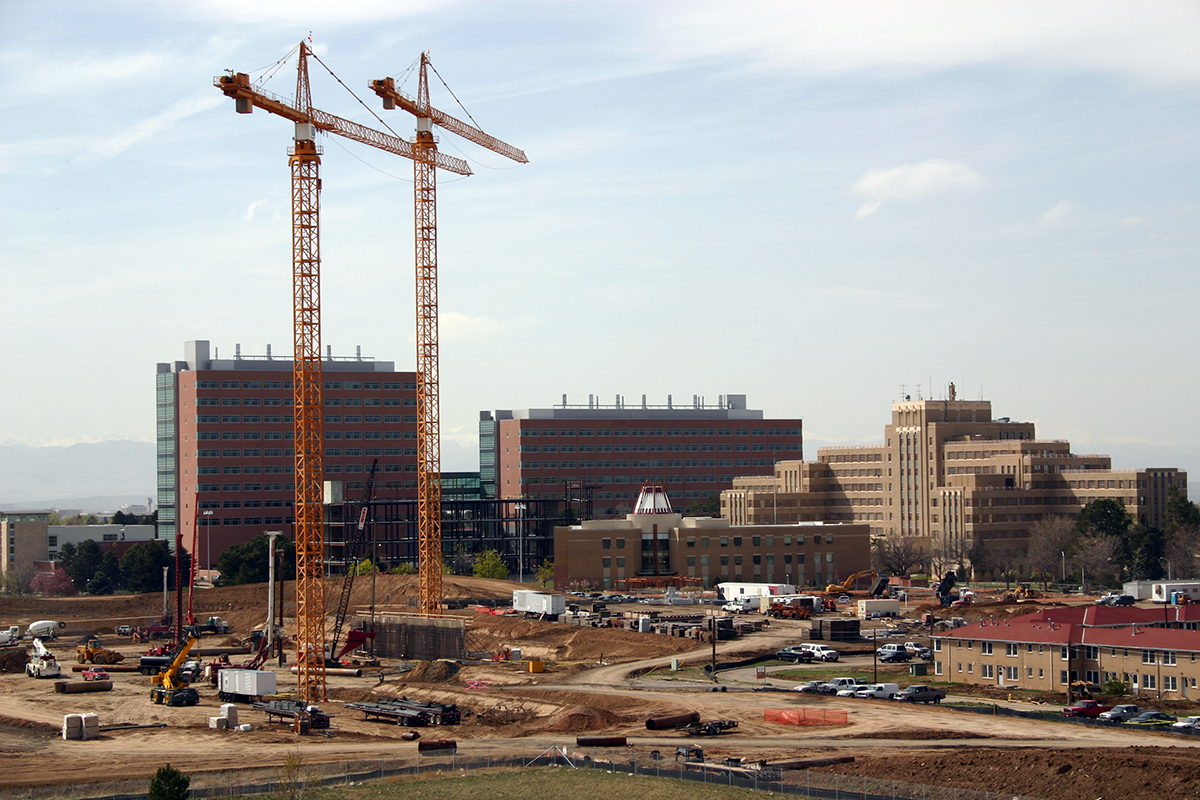 In 1994, the University of Colorado Health Sciences Center (UCHSC), which included the CU medical school, was brainstorming how it would continue its operations at 9th Avenue and Colorado Boulevard in Denver.
The campus needed more space, but surrounding residents in the neighborhood protested expansion, and when Denver City Council members voted against a plan for a new eye clinic, leaders accelerated their plan to relocate and build a new hospital. The school had been offered 55 acres at the former Lowry Air Force Base in Denver for $6 million. Lacking funds, university leaders passed on the opportunity. Fortunately, another was on the horizon.
UCHSC then asked the federal government and the city of Aurora for the 186 acres of the defunct Army hospital. The plan was approved and in 1997, the School of Medicine leased a building at Fitzsimons with plans to totally relocate within 20 years.
“As our staff crunched the numbers, they figured we could probably get 80% of what was on 9th Avenue moved out here by 2012, and when I heard that, I said, ‘Well, let's do it.’ And that led to a bit of an explosion. There were, of course, some department chairs who were opposed,” says Krugman, who was the last of the School of Medicine faculty and staff to make the move from the old campus to Fitzsimons.
By 2001, the new campus was home to a new cancer center, the Rocky Mountain Lions Eye Institute, and new outpatient clinics. Children’s Hospital Colorado announced plans for a new hospital next to the University of Colorado Hospital. Redevelopment was rolling and expenses were starting to pile up.
The Anschutz Foundation stepped in with a $25 million grant to the cancer center and then $30 million more in 2001 to help with campus construction.
By 2006, Anschutz and his foundation had contributed an estimated $91 million to various developments around the campus. That year, the site was officially named for the philanthropist.
Modern times
When John J. Reilly, Jr., MD, assumed the role of dean in 2015, most of the infrastructure pieces for the CU Anschutz campus were in place. He saw the opportunity and trajectory of the campus and knew significant growth was on the horizon.
Reilly focused on partnerships, working especially close with Children’s Hospital Colorado and UCHealth University of Colorado Hospital. The Rocky Mountain Regional VA Medical Center opened adjacent to the CU Anschutz campus in 2019.
Today, many School of Medicine faculty members have appointments across the separate entities.
“We have one of the largest faculty practices in the country now, certainly the largest physician practice in the state of Colorado,” Reilly says.
That culture of collaboration has bolstered research projects, enhanced patient care, and provided the foundation for a robust medical education. Various partnerships allow medical students to train across Colorado, and the new Trek Curriculum prioritizes clinic time earlier.
“I’m proud of what our faculty, researchers, and students have accomplished at the CU Anschutz School of Medicine,” Sampson says. “We have incredibly dedicated people who care about our future and the innovation it will take to get there. With a strong history, we can continue building.”
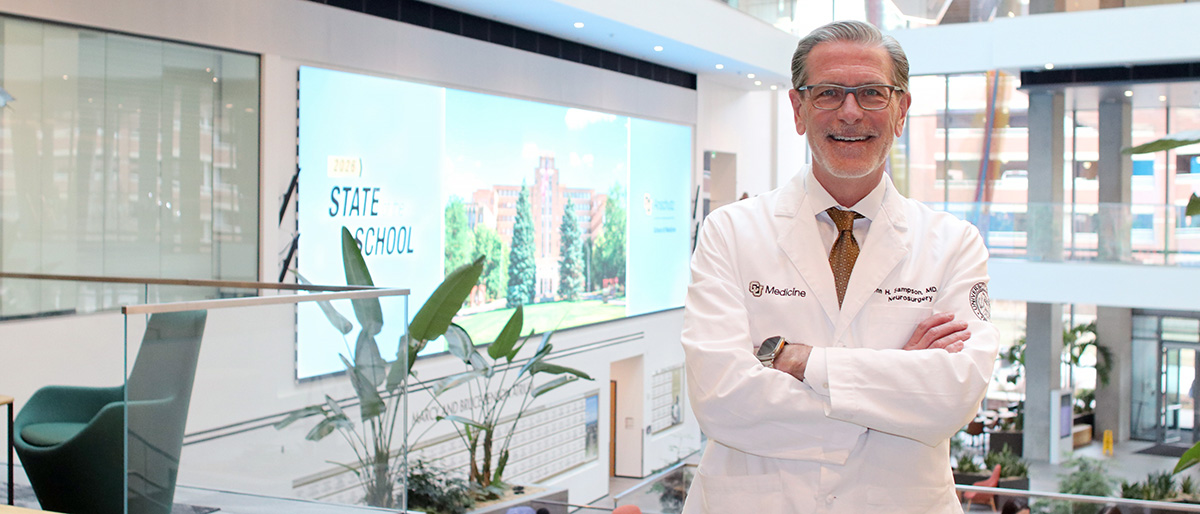
Dean John H. Sampson, MD, PhD, MBA