

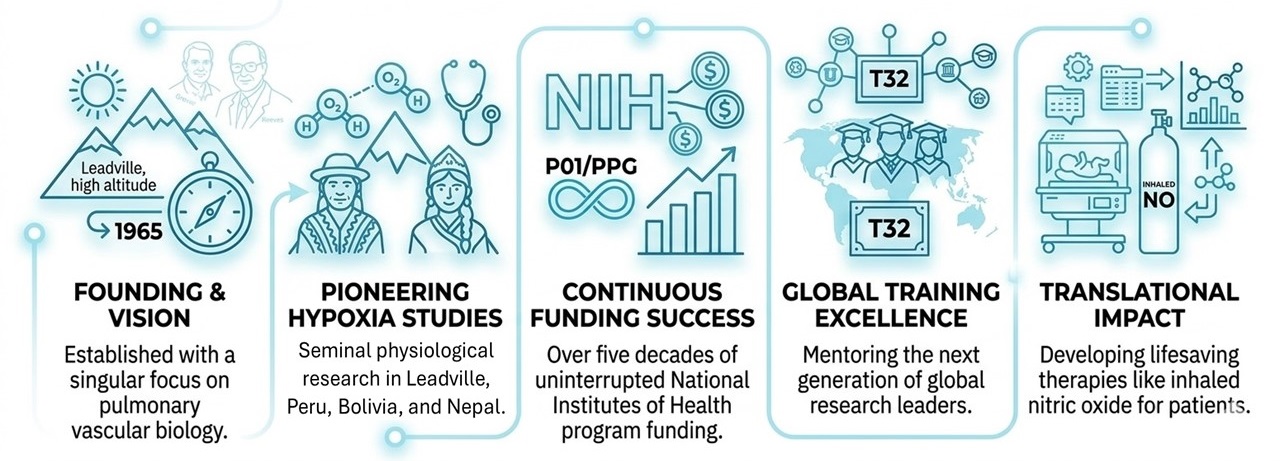
For more than half a century, the Cardiovascular Pulmonary Research Laboratory (CVP) at the University of Colorado Anschutz Medical Campus has served as one of the world’s leading centers for research on pulmonary vascular biology and pulmonary hypertension. Since its founding in 1965, the CVP has pursued a singular mission: to understand the fundamental mechanisms that regulate the pulmonary circulation and to translate those discoveries into therapies that improve the lives of patients with cardiopulmonary disease.
Over the decades, the laboratory has achieved an extraordinary record of sustained scientific productivity, marked by more than 50 years of continuous National Institutes of Health Program Project Grant (PPG) funding and nearly five decades of NIH-supported training through the CVP T32 Cardiovascular–Pulmonary Research Training Program. These programs have supported generations of investigators whose discoveries have fundamentally reshaped our understanding of pulmonary vascular disease.
The CVP’s enduring success reflects a unique combination of scientific vision, multidisciplinary collaboration, and a deep commitment to mentoring the next generation of physician–scientists and biomedical researchers.
The Origins of the CVP Program
The Cardiovascular Pulmonary Research Laboratory was established in 1965 at the University of Colorado as an extension of the Cardiothoracic Research Center. From its earliest days, the laboratory focused on understanding diseases of the pulmonary circulation, particularly pulmonary hypertension, a condition characterized by elevated pressure within the pulmonary arteries that ultimately leads to right heart failure.
Early leaders of the program, including Drs. Robert Grover and Jack Reeves recognized that Colorado’s unique geography provided an extraordinary opportunity to study how chronic hypoxia affects the pulmonary circulation. Investigators conducted pioneering physiological studies of residents living at high altitude in Leadville, Colorado, as well as collaborations with researchers studying populations in Peru, Bolivia, and Nepal, where people live for generations under conditions of reduced oxygen tension.
These early investigations demonstrated that prolonged exposure to hypoxia causes progressive structural remodeling of the pulmonary vasculature, including smooth muscle hypertrophy and increased vascular resistance. These observations helped establish the concept that pulmonary hypertension results not simply from vasoconstriction but from long-term structural changes within the pulmonary arteries.
Another landmark research area involved studies of high-altitude pulmonary hypertension in cattle, commonly known as “brisket disease.” Working with veterinary scientists and ranchers across the Rocky Mountain region, CVP investigators showed that animals exposed to chronic hypoxia developed severe pulmonary hypertension and right ventricular hypertrophy. These studies provided one of the first clear experimental models linking environmental hypoxia to pulmonary vascular remodeling and heart disease.
Together, these early discoveries established the scientific foundation for the field of hypoxia-induced pulmonary hypertension and positioned the CVP as a leading center for pulmonary vascular research.
A Remarkable Legacy of Continuous NIH Program Project Funding
One of the defining features of the CVP laboratory has been the extraordinary continuity of its NIH Program Project Grant (P01) funding, which has supported the program since 1973.
The original program, titled “Adaptations to Hypoxia,” brought together investigators from multiple scientific disciplines, including physiology, pathology, molecular biology, and clinical medicine, to address fundamental questions about how the pulmonary circulation responds to low oxygen environments. Over time, the scientific themes of the program evolved to incorporate emerging areas of biomedical science while maintaining a central focus on pulmonary vascular disease.
Across successive renewals, the program has expanded from studies of vascular physiology to investigations of cellular signaling, vascular remodeling, inflammation, metabolism, and immune regulation in pulmonary hypertension. The most recent program iterations integrate advanced genomic technologies, systems biology, and spatial molecular profiling to understand the complex cellular interactions that drive pulmonary vascular disease.
This more than five decades of uninterrupted NIH programmatic support represents one of the longest-running research programs focused on pulmonary vascular biology in the United States and reflects the sustained scientific impact of the CVP community.
Training the Next Generation: The CVP T32 Program
Equally central to the CVP mission is its commitment to training future leaders in cardiovascular and pulmonary research. In 1975, the National Institutes of Health awarded the CVP its T32 Cardiovascular–Pulmonary Research Training Grant, establishing a multidisciplinary training program dedicated to pulmonary vascular biology and cardiopulmonary disease.
For nearly fifty years, the CVP T32 program has provided intensive research training for MD, PhD, and DVM scientists. Trainees participate in a highly collaborative scientific environment that integrates basic discovery, translational research, and clinical investigation. Through mentorship from a broad network of faculty investigators, fellows develop expertise in experimental design, molecular biology, animal models of disease, human translational studies, and emerging technologies in genomics and computational biology.
Graduates of the CVP training program now hold leadership positions at universities, research institutes, and medical centers across the United States and throughout the world. Many alumni remain closely connected to the CVP through scientific collaborations, extending the program’s intellectual influence across the global pulmonary vascular research community.
Transformative Scientific Contributions
Over the past five decades, CVP investigators have contributed numerous discoveries that have shaped the modern understanding of pulmonary vascular disease.
Among the laboratory’s most influential contributions have been studies defining the roles of endothelial dysfunction, smooth muscle cell heterogeneity, extracellular matrix remodeling, and vascular inflammation in pulmonary hypertension. Investigators also developed innovative experimental models that replicate many aspects of human disease, including large-animal models that closely mimic neonatal pulmonary hypertension.
Research conducted within the CVP program helped identify key biochemical mediators involved in pulmonary vascular dysfunction, including leukotrienes and prostaglandins, and provided new insights into the inflammatory mechanisms underlying pulmonary vascular remodeling.
One of the most significant translational achievements associated with the CVP community was the development of inhaled nitric oxide therapy, which revolutionized treatment for persistent pulmonary hypertension of the newborn and remains a global standard of care today.
More recently, CVP investigators have made major contributions to understanding the role of fibroblast-mediated inflammatory niches, immune signaling pathways, and complement activation in pulmonary hypertension. These discoveries are helping to redefine pulmonary vascular disease as a complex inflammatory and metabolic disorder and are opening new opportunities for targeted therapeutic intervention.
A Multidisciplinary and Collaborative Scientific Environment
The success of the CVP laboratory has always depended on a culture of deep collaboration across scientific disciplines.
Within the University of Colorado Anschutz Medical Campus, CVP investigators work closely with colleagues in Pediatrics, Medicine, Cardiology, Pulmonary Medicine, Pathology, Bioengineering, and computational biology, creating a highly integrated research environment that bridges fundamental discovery and clinical investigation.
The program also maintains extensive collaborations with major academic institutions across the United States and internationally. These partnerships include scientists studying pulmonary vascular disease, hypoxia biology, cardiovascular physiology, and systems biology, enabling the CVP to remain at the forefront of emerging scientific approaches.
A particularly distinctive collaboration exists with Colorado State University, where investigators have developed and maintained large-animal models of pulmonary hypertension for decades. These models provide unique opportunities to study pulmonary vascular disease in physiologic systems that closely mirror human cardiopulmonary biology.
Through these collaborations, the CVP has created a global network of investigators dedicated to advancing the understanding and treatment of pulmonary vascular disease.
Continuing the CVP Tradition of Discovery
Today, the Cardiovascular Pulmonary Research Laboratory remains one of the most influential centers worldwide for pulmonary vascular research. The program continues to integrate cutting-edge technologies, including genomics, spatial biology, advanced imaging, and computational modeling, to investigate the mechanisms driving pulmonary hypertension and right heart failure.
Equally important, the CVP continues its long tradition of mentoring and training future investigators who will lead the next generation of discoveries in cardiovascular and pulmonary medicine.
With more than 50 years of continuous NIH Program Project support and nearly five decades of NIH training support, the CVP laboratory represents a rare example of sustained scientific excellence. Its work has transformed understanding of pulmonary vascular disease, contributed directly to lifesaving therapies, and built a worldwide community of investigators dedicated to advancing cardiovascular and pulmonary health.
The legacy of the CVP is not only its discoveries but the generations of scientists and clinicians it has inspired, trained, and connected in a shared pursuit of understanding the pulmonary circulation and improving patient care.
Further Reading
Those interested in a deeper exploration of the history and scientific evolution of the Cardiovascular Pulmonary Research Laboratory may find the following resources valuable:
Voelkel N.
“A Brief Personal View of the Development of Lung Vascular Research: Dedicated to the Lasting Memory of John T. Reeves.”
ISBN-13: 979-8243420112
Stenmark KR.
“A Lifelong Journey in the Field of the Pulmonary Circulation: Perspectives Through the Lens of the Cardiovascular Pulmonary Research Laboratory.”
Available on PubMed:
https://pubmed.ncbi.nlm.nih.gov/41393963/