

The University of Colorado Anschutz School of Medicine Climate and Health Program (CHP) works to amplify climate change and health in education, communication, and scholarship. Since AY 2022-2023, CHP’s Director for Undergraduate Medical Education has focused on integrating climate change and health competencies into the medical school curriculum and undergraduate medical education (UME) experience, thereby addressing the call of global youth and U.S. medical students to confront one of the greatest public health threats of modern time. National thought-leadership by CHP-UME is demonstrated through the following activities:
UME Mission: To transform the culture of medical education such that graduates confront environmental degradation as a threat to human health and, in so doing, apply the Hippocratic Oath to both individual patients and future generations of patients.
The growing list of curricular areas integrating climate and/or environmental health includes:
Pre-clinical examples (core curriculum):
Clerkship examples (core curriculum):
Post-clerkship Selective:
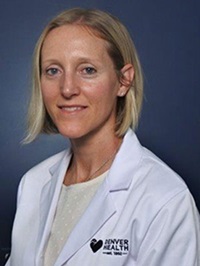
Beth Gillespie, MD, FACP, is an ABIM-certified hospitalist at Denver Health Medical Center, and an assistant professor in the CU School of Medicine. She is a masters candidate in epidemiology through the Colorado School of Public Health (expected graduation December 2023). Gillespie's primary professional interest is in clinical research and education surrounding the climate and health nexus, with particular focus on understanding the ideal role for local health systems in climate change mitigation and adaptation.
She held a leadership position (January 2017 - June 2020) representing the Society of General Internal Medicine (SGIM) on the Steering Committee for The Medical Consortium on Climate Change and Health, and is founding member of SGIM’s environmental health interest group which authored SGIM’s Position Statement on Climate and Health (approved by Council 2021) and advocates for more cross-cutting sustainability practices in the organization. She serves as inaugural sustainability chair for SGIM’s Planning Committee. Locally, Gillespie co-chairs the Environmental Sustainability at Denver Health.
In 2019, Gillespie completed a two-year clinical research fellowship focused on climate change and health through the Adult and Child Consortium for Health Outcomes Research and Delivery Science at the CU School of Medicine. Grateful for initial funding she received for climate-related health research through the Denver Health Pilot Program, Gillespie continued to work in this area through July 2022 as a guest researcher with the CDC’s Climate and Health Team, a position made possible through her 2021-2022 fellowship with CU’s Climate and Health Science Policy Program. Gillespie directs the medical school's elective on climate and health and is currently facilitating a group of motivated CU School of Medicine students working to integrate planetary health into the core curriculum.
Administrative Support:
Meagan Rivers: [email protected]
Student Council Sustainability Co-Chairs:
Student editors and contributors to the Planetary Health Report Card (PHRC). Link to University of Colorado PHRC 2022
Rebekah Davis, MS1; Armaan Dhillon, MS2; Whitney Kelly, MS3; Monisha Lensink-Vasan, MS1; Vivian Rajeswaren, MS4 (primary contact); Alessandra Santiago, MS2; Lukas Sloan, MS3 (primary contact); Caroline Walsh, MS2
Students focusing on planetary health subjects for their MSP: Armaan Dhillon, Jamie Smith
The University of Colorado School of Medicine completed its first Planetary Health Report Card (PHRC) for 2022. We continue to improve based on our standings for 2023 and here is our detailed 2025 PHRC. The following students and faculty contributed to this Report:
CU-CHASE:
Medical Students for a Sustainable Future (MS4SF):
Faculty Contacts for Research/QI:
Advocacy Opportunities:
Other Helpful Links: