

April 7, 2026
Welcome to the 2026 Spring edition of our CU Anschutz Maternal-Fetal Medicine e-newsletter. In this issue, we share considerations for managing multiple gestation pregnancies, celebrate the one-year anniversary of our maternal mental health and wellness clinic, and review ventriculomegaly.
By Shane Reeves, MD and Nicholas Behrendt, MD
A pregnancy with multifetal gestation is a relatively common finding that presents unique challenges and modified monitoring compared to single gestations. This begins in the first trimester where determination of the type of twin gestation (chorion and amnion number) is critical to safely managing the pregnancy. Evidence of two distinct gestational sacs on transvaginal ultrasound before 10 weeks indicates dichorionicity, while early monochorionic gestations may show delayed visualization of the thin diamniotic membrane.[1] Between 10-14 weeks, the "T" sign—describing perpendicular attachment of the intertwin membrane to the placenta—has sensitivity approaching 100% and specificity of 98% for identifying monochorionic diamniotic (MCDA) twins when observed alongside a single placental mass.[1] Monochorionic Monoamniotic twins (MCMA) are diagnosed when one placental mass is seen and a separating membrane cannot be distinguished on ultrasound. The twins are often very close to one another due to cord entanglement, which is ubiquitous in this type of gestation.
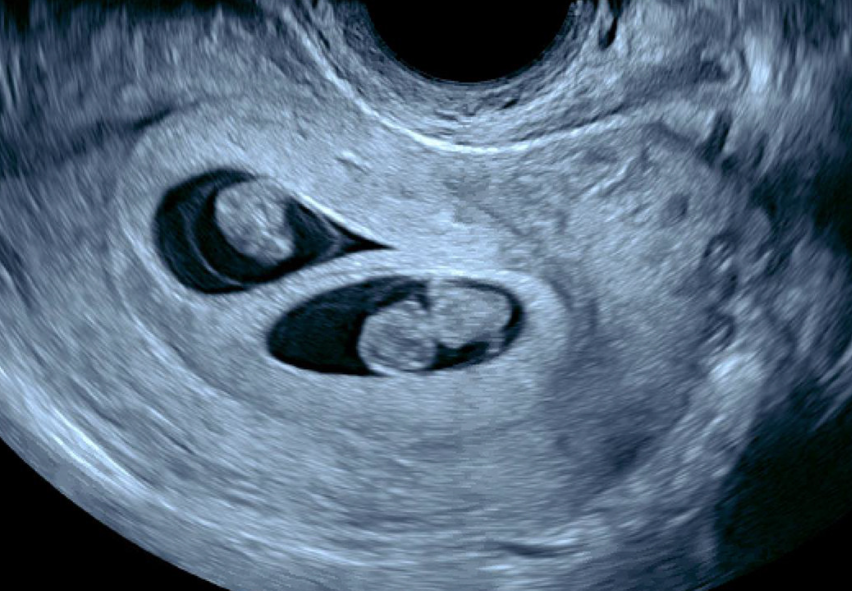
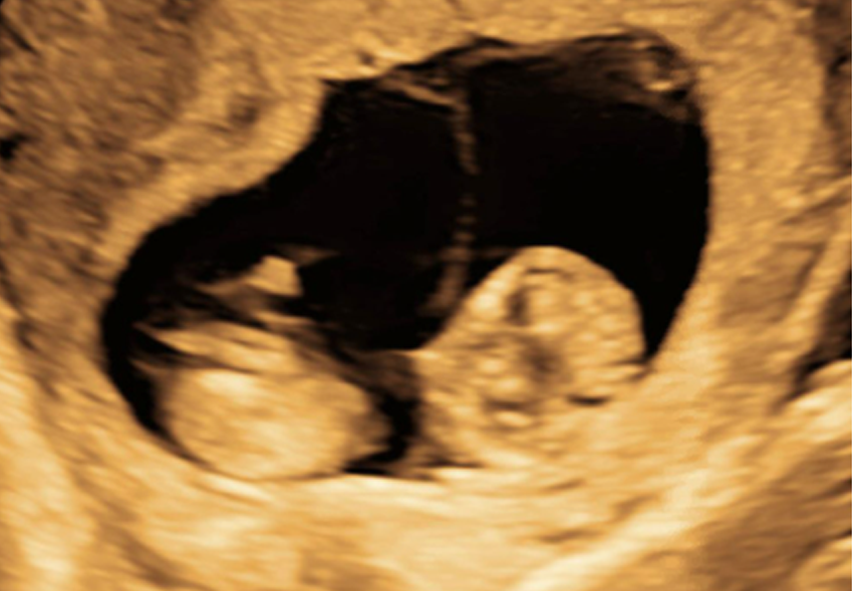
After 14 weeks, determination of chorionicity can be more challenging, although two separate placentas and discordant fetal sex are key indicators for dichorionicity. The membrane thickness can be helpful in midgestation, though this is less reliable than first-trimester assessment. Importantly, rare exceptions exist including sex-discordant monochorionic twins and monochorionic pregnancies with bipartite placentas appearing as two separate masses. In the last few years, some Cell Free DNA tests have added zygosity when screening for genetic anomalies in twins. Although this does not directly determine chorionicity, a dizygotic Cell Free DNA result means that it should be a dichorionic gestation. A monozygotic result does not result in a known chorion number as this could be any iteration of chorion and amnion number.
All twin gestations have increased risk of poor pregnancy outcomes including first-trimester pregnancy loss and an increased risk of fetal anomalies. Mean birth weight is decreased at approximately 2,300 grams with half delivering before 35 weeks. [2] Cerebral palsy and infant mortality is increased when compared to singleton gestations. [2] MCDA twins have additional risks including twin-twin transfusion syndrome (TTTS), twin anemia-polycythemia syndrome (TAPS), and selective fetal growth restriction. These pregnancies require heightened surveillance starting at 16 weeks of gestation with ultrasound examinations at least every 2 weeks until delivery to screen for these disorders as they each carry significant risks of perinatal morbidity and mortality.[1]
TTTS occurs in approximately 10-15% of MCDA pregnancies and results from unbalanced fetofetal transfusion through arteriovenous anastomoses in the shared placenta. This results in one fetus having excessive fluid volume in and around the fetus (polyhydramnios) while the other has decreased fluid volume (oligohydramnios).[1] Without treatment, advanced-stage TTTS presenting before 26 weeks has perinatal loss rates of at least 70% and substantial risk for neurologic disability among survivors.[2] The correct diagnosis of TTTS can result in improved outcomes and laser therapy has become the standard of care for treatment of TTTS. Even with fetoscopic laser photocoagulation (the standard treatment), outcomes remain variable with short-term brain injury occurring in 2-8% of cases and long-term neurodevelopmental impairment affecting 3-14% of survivors.[3] Prematurity is frequent, with median delivery at 32-34 weeks.[3] This procedure is done in specialized treatment centers.
TAPS is a chronic form of fetofetal transfusion resulting in one fetus having decreased blood cells (anemia) and the other having increased blood cells (polycythemia). This affects approximately 2-5% of MCDA pregnancies and can be seen spontaneously or after laser surgery for TTTS. Screening is performed during TTTS ultrasounds by evaluating the peak systolic velocity of blood flow in the middle cerebral artery of each fetus.[1] In a large international cohort, perinatal mortality was 15% overall (22% for donors, 7% for recipients), and severe neonatal morbidity occurred in 33% of affected twins.[4] Donor twins face particularly high risk of long-term neurodevelopmental impairment.[1] TAPS can develop at any time from the beginning of the second trimester through the third trimester. [4]
While FGR (estimated fetal weight < 10th percentile) of one or more fetuses can occur with any type of twin, it is particularly challenging with monochorionic twins. Because FGR is a risk for fetal demise, increased monitoring is warranted. If fetal demise happens in one fetus in a monochorionic pair, the other is at risk for neurologic injury and/or fetal demise. Monitoring for this includes umbilical artery, ductus venosus, and middle cerebral artery Dopplers. Monitoring and delivery recommendations are based on these.
Because these twins share a placenta, they are at risk for the same complications of MCDA twins. In addition to these risks, they have an increased chance of intrauterine fetal demise likely due to cord entanglement or other vascular issues. Because of this, their surveillance and care is unique to these twins (see below).
While these pregnancies should not experience TTTS or TAPS, they still require increased surveillance to help improve pregnancy outcomes. These risks include premature delivery, preterm premature rupture of membranes, fetal anomalies, fetal growth restriction, and maternal disease (gestational diabetes, preeclampsia, etc.). Serial fetal growth assessments, anatomic evaluation, and prompt evaluation of threatened preterm delivery are recommended for dichorionic gestations. Interventions such as increased monitoring, Doppler studies, and betamethasone can improve pregnancy outcomes.
By Kate McMeekin, WHNP-BC, PMHNP-BC
As our Maternal Mental Health and Wellness Clinic approaches its first anniversary, we are excited to share its impact and how the clinic continues to support patients across the region.
We currently operate 1.5 days per week and have received approximately 200 referrals from across Colorado. To date, just under 90 new patients from Colorado and Wyoming have been seen, with about 160 return visits.
Most patients (87%) are referred during pregnancy, while 13% are seen for preconception. Common reasons for referral include medication clarification, medication optimization, management of psychiatric medications during pregnancy and assistance with mental health resources.
Visits with Kate McMeekin, WHNP-BC, PMHNP-BC are comprehensive (40–60 minutes) and focus on mood symptoms, general health and wellness including the importance of sleep, social supports, pregnancy-related concerns, postpartum planning, individualized counseling on medication safety and the risks and benefits of treatment versus non-treatment. Patients are also connected with longer-term supports including psychiatry, therapy, support groups and community services.
Our clinic team works closely with OB teams, psychiatry, therapy, addiction medicine and doula services. We have received positive feedback from both patients and referring providers.
Thank you for your continued support and collaboration as our clinic grows. Together, we are working to improve mental health outcomes for birthing parents and their families. For more information or to schedule an appointment, please call 303-315-6100.
Ventriculomegaly is defined as a dilatation of fetal cerebral ventricles, >/= 10 mm. Ventriculomegaly can be the sign of a major intracranial anomaly or a variant of normal. The ventricles are a fluid filled structures that can change throughout pregnancy, meaning they can be normal at 20 weeks and significantly enlarged in the 3rd trimester either due to an anatomic defect or insult (intracranial hemorrhage). The work-up for ventriculomegaly should include a prompt referral to MFM for evaluation and consultation. At this consultation we will discuss common causes including: isolated and incidental, genetic abnormalities, anatomic defects, and infection. In the setting of mild isolated ventriculomegaly of 10-12 mm the likelihood of survival with normal neurodevelopment is > 90%. Once the ventricles are > 15 mm, there is a higher risk of significant developmental impacts. Depending on the findings we may recommend an amniocentesis for genetic testing, a fetal MRI for further evaluation of intracranial anatomy, and testing for CMV and/or toxoplasmosis. Thank you for trusting us with your patients.

Melissa Chu Lam, MD officially joined our division early this year yet moved to Colorado over one year ago with her husband. Initially supporting our UCHealth MFM partners in Colorado Springs, Dr. Chu Lam now sees patients in the Denver metro area. She attended University of Panama School of Medicine, completed residency at St. Luke’s Hospital, and fellowship at Mount Sinai (West). Her clinical interests focus on the management of obstetrical, medical and surgical complications of pregnancy as well as the detection and management of fetal anomalies. She also has a strong interest in infectious diseases in pregnancy. We are thrilled she has joined our division.
To refer a patient or for more information, call 303-315-6100 or fax 303-468-3481.
In UCH Epic, referrals can be submitted via Ambulatory Referral to OBGYN/MFM: (REF86). You MUST also select a location for referral to drop into our work queue.
We invite you to share your thoughts, experiences and suggestions related to our content and services. Do you have any questions or topics you'd like us to cover in future editions or educational events? Are there any success stories or challenges in Maternal-Fetal Medicine that you'd like to see featured? Have you experienced issues, concerns or discrepancies with our services? Please email Kelly Clark, [email protected], or fill out our online form. Your input helps us tailor our content and educational offerings to better serve your needs and interests. Join the conversation and be a part of shaping our community!