

Anschutz Health Sciences Building. Photo courtesy of ZGF Architects © Connie Zhou
University of Colorado Anschutz
At the Don Elliman Conference Center, located on the 2nd floor of the Anschutz Health Science Building (AHSB)
18900 N Revere Ct,
Featuring Keynote Speaker
Director of the Center for Precision Oncology and Rare Cancers, Professor of Medicine and Chair of Precision Oncology, Medical College of Wisconsin Cancer Center
Shared Content Block:
Cancer Center Styles -- Give headings inside accordions and tabs more top margin
| Time | Main Room | Breakout Room 1 | Breakout Room 2 | Breakout Room 3 | Breakout Room 4 | Breakout Room 5 |
|---|---|---|---|---|---|---|
| 7:30 | Registration, Poster Set Up | |||||
| 8:00 | Opening Remarks Chancellor Elliman | |||||
| 8:05 | Cancer Prevention and Control Program Presentation | |||||
| 8:30 | Developmental Therapeutics Program Presentation | |||||
| 8:55 | Break | Transition | |||||
| 9:05 | Concurrent Sessions | Cancer, Aging, Obesity, Colorado Priorities | Chromatin Biology & Therapy | Spatial Biology & Single Cell Technology | AI, Informatics, and Big Data for Cancer Research | Trainee Session |
| 10:05 | Break | Transition | |||||
| 10:15 | Main Room: COE CARES/Patient Advocates Interactive Session | |||||
| 11:00 | Lunch | Poster Session | Networking | |||||
| 12:30 | Intro of Keynote Speaker Hatim Sabaawy, MD PhD | |||||
| 12:35 | Keynote Address Razelle Kurzrock, MD PhD | |||||
| 1:30 | Panel Discussion with Keynote Speaker | |||||
| 2:05 | Break | Transition | |||||
| 2:15 | Concurrent Sessions | Drug & Immuno-therapy Design | Cancer Screening, Prevention & Survivorship | Team Science, Program Grants & Breaking Down Silos | Mouse Models of Cancer | |
| 3:15 | Break | Transition | |||||
| 3:25 | Molecular and Cellular Oncology Program Presentation | |||||
| 3:50 | Tumor Host Interactions Program Presentation | |||||
| 4:15 | Director’s Talk Wells Messersmith, MD | |||||
| 4:55 | Concluding Remarks | |||||
| 5:00 | Networking | Reception | |||||

Razelle Kurzrock, MD, FACP
Director of the Center for Precision Oncology and Rare Cancers, Professor of Medicine and Chair of Precision Oncology, Medical College of Wisconsin Cancer Center
Dr. Kurzrock is a world-renowned leader in precision oncology and research on rare cancers. She is the Associate Director of Clinical Research for the Medical College of Wisconsin Cancer Center, Associate Director of Precision Oncology at the Linda T. and John A. Mellowes Center for Genomic Sciences and Precision Medicine, and the founding director of the Michels Rare Cancers Research Laboratories at the MCW Cancer Center. She is recognized as one of the world’s 25 most important voices in precision medicine and one of the most highly cited scientists globally. She has authored over 950 scientific and medical publications. Dr. Kurzrock is the Chair of the Early Therapeutics and Rare Cancers Committee (SWOG NCI) — one of the largest clinical trials cooperative groups in the country — and has been the principal investigator for more than 100 early-phase clinical trials, leading to the FDA approval of eight life-changing drugs. In 2022, Dr. Kurzrock and the DART rare cancer study team received the National Cancer Institute Director’s Award of Merit for outstanding work.
Call for Abstracts
You and members of your lab are invited to submit abstracts for consideration for oral and poster presentations at the University of Colorado Cancer Center’s Scientific Retreat on November 20, 2026.
This event brings together investigators, trainees, clinicians, and research staff to highlight scientific advances, spark new collaborations, and align our collective work with the Cancer Center’s strategic priorities.
Retreat Theme: Advancing Our Strategic Vision
This year’s retreat is structured around the latest scientific advances made by Cancer Center members and how the Center’s strategic plan aligns with research being conducted in members’ labs.
The Cancer Center’s strategic plan emphasizes five core scientific foci:
1. Structural, Molecular, and Cellular Biology
Investigate chromatin biology, epigenetic regulation, and genome stability | Define mechanisms governing telomer function and genome integrity | Develop RNA-based approaches for understanding and treating cancer
2. Cancer Evolution from Initiation through Metastatic Spread
Characterize the molecular mechanisms underlying cancer initiation and cell fate decisions | Identify pathways driving tumor progression and metastatic spread | Determine how aging, obesity, hormones, and other host factors influence cancer evolution
3. Therapeutic Resistance
Identify mechanisms of resistance to cancer therapies | Develop novel therapeutic strategies to prevent or overcome treatment resistance | Translate discoveries into improved therapies or catchment area priority cancers
4. Immunotherapy
Define how the tumor microenvironment and host factors regulate anti-tumor immunity | Harness immunomodulators and the microbiome to enhance immune responses | Engineer next-generation cellular immunotherapies
5. Cancer Interception and Survivorship
Develop and investigate new interception targets | Design behavioral, supportive and palliative care interventions to improve survivorship | Leverage health services and implementation science approaches to improve equitable cancer care delivery
Abstracts should reflect one or more of these strategic areas, with priority given to work that demonstrates:
Recent new scientific impact or innovation
Cross program collaborations
Advances in translational potential
Innovation in efforts to address unmet clinical or population needs
Leverage of Cancer Center supported shared resources and emerging technologies
Submitted abstracts will be considered for main‑room oral presentations, concurrent targeted discussion sessions, and the poster session.
Abstract Submission Guidelines
Abstract length: 30 line maximum (based on an 8.5x11 page with ½ margins)
Format: Background, Methods, Results, Conclusions (or equivalent for early‑stage projects).
Eligibility: Full, Mentored, Affiliate, and Clinical Cancer Center members along with the trainees, fellows, and research staff working in Cancer Center member labs/research programs.
Abstract Submission
Important Dates
Abstract submission deadline: September 14, 2026, 5:00 pm
Notification of acceptance: October 21, 2026
Retreat date: November 20, 2026
New This Year: Keynote Panel Discussion – Future of Cancer Clinical Trials
Our Keynote Speaker is Razelle Kurzrock, MD, FACP
Google Scholar | N-of-1 Patient Centric Clinical Trials
Following the keynote address, we will host an expanded panel discussion featuring Dr. Kurzrock, clinical trial leaders, and others engaged in driving laboratory research into human applications through investigator-initiated clinical trials.
To enrich this session and ensure it reflects the interests of our research community, we invite retreat participants to submit questions for the panel.
Questions should be limited to the panel discussion topic: Future of Cancer Clinical Trials.
Some topic areas to consider:
Barriers and opportunities in clinical trial design or accrual
Translational pathways from discovery to implementation
Emerging technologies or methodologies
Broader issues in cancer research strategy and collaboration
Panelists
 Bradley R. Corr, MD
Bradley Corr, MD is an Associate Professor of Gynecologic Oncology at the University of Colorado. He completed his residency at the Hospital of the University of Pennsylvania and his fellowship at the University of Colorado. His academic and scientific career is dedicated to improving outcomes and patient care for women with gynecologic malignancies. He is a board-certified Gynecologic Oncologist by training, and his areas of interest are early-phase clinical trials and developmental therapeutics in endometrial and ovarian cancer. He currently serves as the Director of clinical research for the Division of Gynecologic Oncology at the University of Colorado Anschutz Medical Campus. He also holds the Katie Taylor Memorial Endowed Chair in Gynecologic Oncology. Within his institution he serves as the Deputy Associate Medical Director of the CCTO, Deputy Director of the Lead Academic Participating Site (LAPS) grant, chief gynecologic oncology investigator in the Phase I research division, as well as the lead gynecologic oncologist in the Women’s Cancer Developmental Therapeutics (WCDT) program at the University of Colorado. Nationally he serves as the vice chair of the phase I subcommittee of the developmental therapeutics committee of the NRG. He currently is awarded as an NRG/GOG scholar and holds an NIH/NCI R01 award evaluating combination CLK/DYRK inhibition with PARP inhibition in platinum resistant ovarian cancer. He has served as the local, national, and international PI on a multitude of clinical trials with sponsorship from the NIH/NCI, industry, and investigator initiated. Dr. Corr is a clinical trialist and physician scientist with specific interest in the Wnt pathway.
 Thomas Flaig, MD
, is a medical oncologist and has been part of the University of Colorado since 2003, when he started as an oncology fellow. He has held a variety of administrative roles on campus, including in the CU Anschutz School of Medicine, CU Anschutz Cancer Center and UCHealth University Hospital. He has been serving as vice chancellor for research for CU Denver | Anschutz since March of 2020.
In addition to his clinical care and administrative work, Dr. Flaig has significant clinical and translational research experience, having led both local and national multi-center clinical trials and served as the local principal investigator on a large number of clinical trials including Phase I, II and III studies. He also runs a translational lab focused on therapeutic and biomarker development in urologic cancers.
Dr. Flaig is a member of the National Cancer Institute’s bladder cancer task force. He also serves as chair of the AAMC Biomedical Research Advancement, Training and Oversight Group Steering Committee; chair of the National Comprehensive Care Network (NCCN) bladder cancer committee and co-chair of the National Clinical Trial Network (NCTN) SWOG Bladder Committee.
 Christopher Lieu, MD
, is a Professor of Medicine in the Division of Medical Oncology, and Associate Director for Clinical Research at the University of Colorado School of Medicine in Aurora. He trained in internal medicine at the University of Colorado, where he also served as a Chief Medical Resident. He completed his fellowship training in medical oncology at the University of Texas MD Anderson Cancer Center in Houston and served as the Chief Medical Oncology Fellow. He currently serves as the Associate Director for Clinical Research and Director of GI Medical Oncology at the University of Colorado Cancer Center, serves on the FDA Oncologic Drugs Advisory Committee, the National Cancer Institute Colon Cancer Task Force, the National Comprehensive Cancer Network (NCCN) Panel for Neuroendocrine Cancers, and the Vice-Chair of the NCCN Board of Directors.
Research
Dr. Lieu is interested in resistance mechanisms to targeted and immunotherapy in metastatic colorectal cancer, strategies to implement circulating tumor DNA in the minimal residual disease setting, and investigating novel therapeutic strategies in preclinical models to more effectively treat and prevent colorectal cancer. In addition, Dr. Lieu has a focus on early-onset colorectal cancer and leads a multidisciplinary clinic dedicated to young patients with colorectal cancer.
 Wells Messersmith, MD, FACP, FASCO
Dr. Messersmith graduated from Harvard Medical School (HMS) in 1998 and trained in internal medicine at Massachusetts General Hospital/HMS. He did his Medical Oncology / Drug Development Fellowship at Johns Hopkins, where he was awarded an ASCO Young Investigator Award and Passano Clinician-Scientist Award. He was on the Hopkins faculty from 2004-2007 as an Assistant Professor in the GI Oncology and Drug Development programs. Dr. Messersmith joined the University of Colorado Cancer Center faculty in 2007 as the Director of Gastrointestinal Medical Oncology. He served as co-Leader of Developmental Therapeutics Program and Associate Director for Translational Research, and was appointed Associate Director for Clinical Services as well as Chief Medical Officer for the Oncology Service Line in 2022. He has also served as Head of the Division of Medical Oncology (>80 faculty) from 2015 - 2026. He was appointed the inaugural “Coe Atherton Endowed Chair in Pancreatic Cancer Research” in 2025 via a gift from a grateful patient’s family. Dr. Messersmith was recently appointed as the Director of the CU Anschutz Cancer Center, becoming the 4th Director in the Cancer Center’s 41 year history.
The conference will held be at the University of Colorado Anschutz in Aurora, Colorado, in the Don Elliman Conference Center, located on the 2nd floor of Anschutz Health Science Building (AHSB).
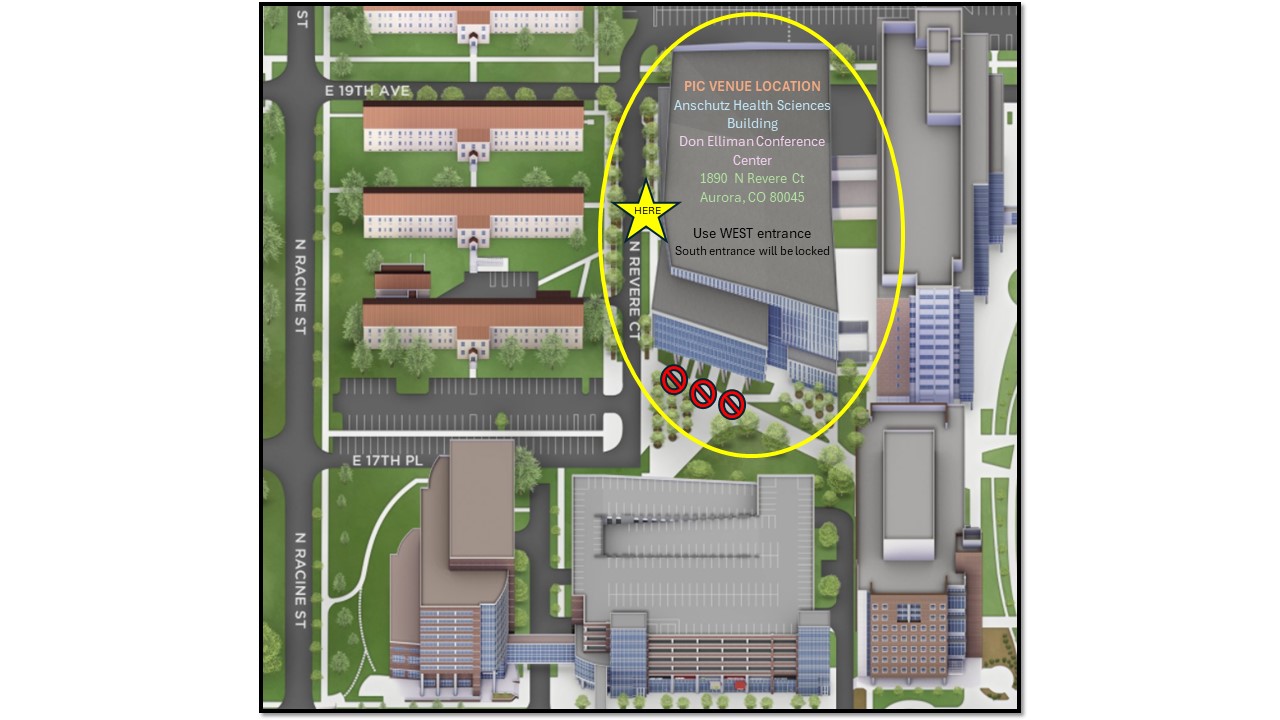
Parking will be available for all attendees in the Vail, Breckenridge, Snowmass or Aspen lots.
Enter the building through the west entrance. From past the security desk, you will make a left to take the elevator to the second floor. If you want to take the stairs, after the security desk, make a right and use the main staircase.
